
Pest Control Built for Central Palm Beach County
Greenacres sits inland, about five miles west of the ocean, and the pests that walk into homes here don’t come off the beach — they come up through the canal grid, down through the tree canopy, and in through the seams of slab houses that have been settling into central Palm Beach County soil since the 1980s. The Lake Worth Drainage District runs the E-3 and E-4 canals straight through the city, every subdivision from River Bridge to Smith Farms has its own retention-pond network, and the Tree City USA designation Greenacres has held for two decades means the live oaks, sabal palms, and red maples shading these streets are mature enough to drop limbs onto roofs and shuttle roof rats from yard to attic.
The houses themselves are the other half of the story. The median home in Greenacres was built in 1987 — old enough that original sub-slab plumbing is starting to fail, soffit wood is going soft, and the expansion joints under the slab are wide enough for Eastern subterranean termites to find. That’s not a coastal pest profile; that’s a central PBC suburban one, and it’s why generic “South Florida pest control” advice misses what’s actually happening inside Greenacres homes.
Hoffer Pest Solutions has been treating homes in this corridor for 50+ years. Call 561-462-4968 for same-day service, or request a free inspection and we’ll send a technician to your door.
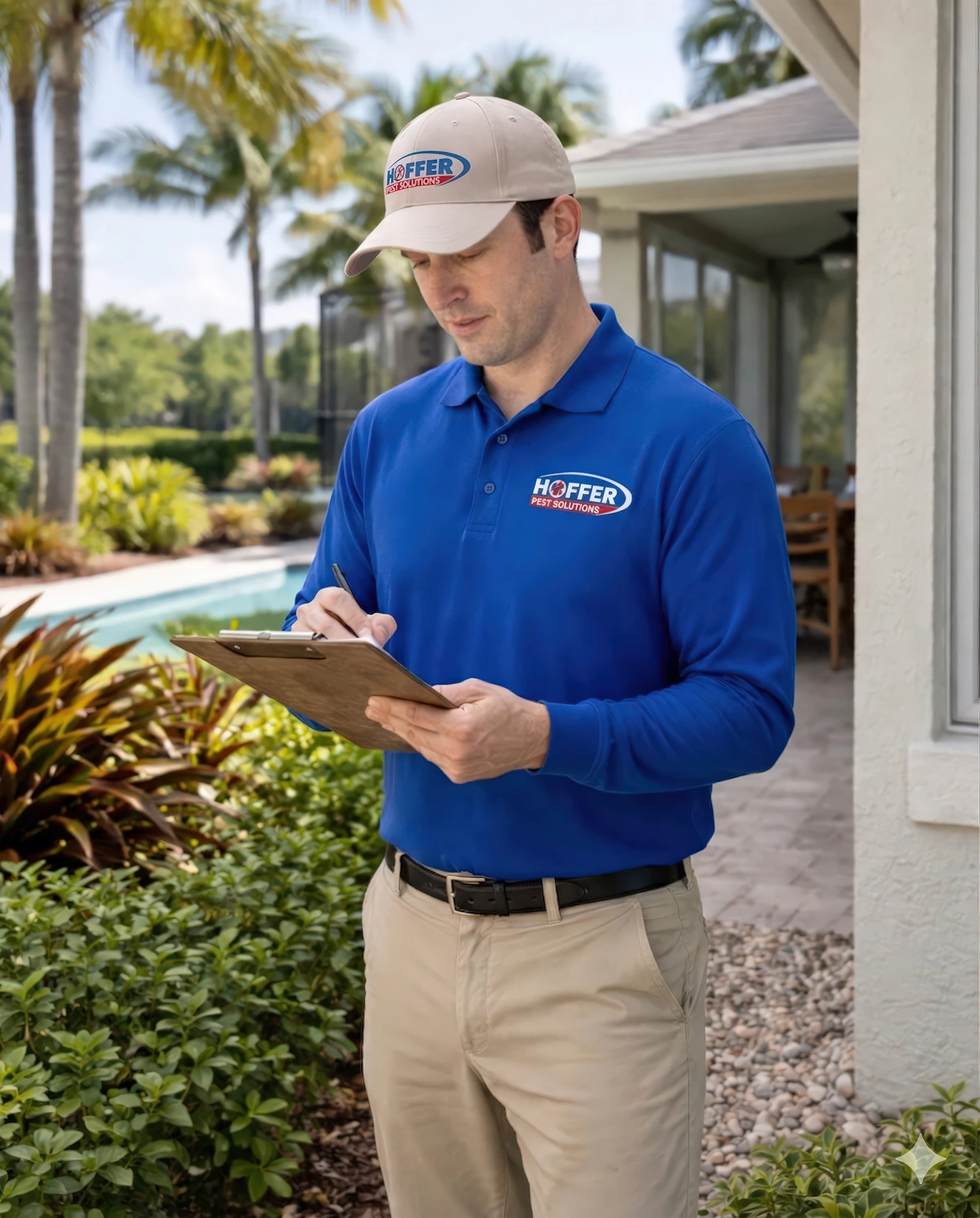
Why Greenacres Homeowners Choose Hoffer
Pest control in a city like Greenacres is a relationship business. Most homes here are part of an HOA, a 55+ villa community, or a master-planned family subdivision — places where the same neighbors see the same trucks pull in week after week, and reputation gets compared over the back fence. We’ve worked these neighborhoods since long before River Bridge had its 18-island lake layout filled in, and we built the company on the same principle Greenacres families and retirees keep asking us to deliver: show up when you say you will, treat the home the way you’d treat your own mother’s, and stand behind the work.
A few things that come standard
- 50+ years of pest control in Palm Beach, Broward, and Miami-Dade counties.
- ACE-credentialed leadership — Associate Certified Entomologist on staff and reviewing the work.
- Same-day service available when you call early enough in the day; we’ll always tell you straight whether we can fit you in today or first thing tomorrow.
- Free inspection before you commit to anything — including a real walk of the slab line, soffits, and lanai, not a five-minute drive-by.
- Satisfaction guarantee between visits. If something comes back, so do we.
- 4,000+ five-star reviews across South Florida.
- Family- and pet-safe treatments — targeted to entry points and pressure zones, applied with the kids, the dogs, and the grandkids in mind.
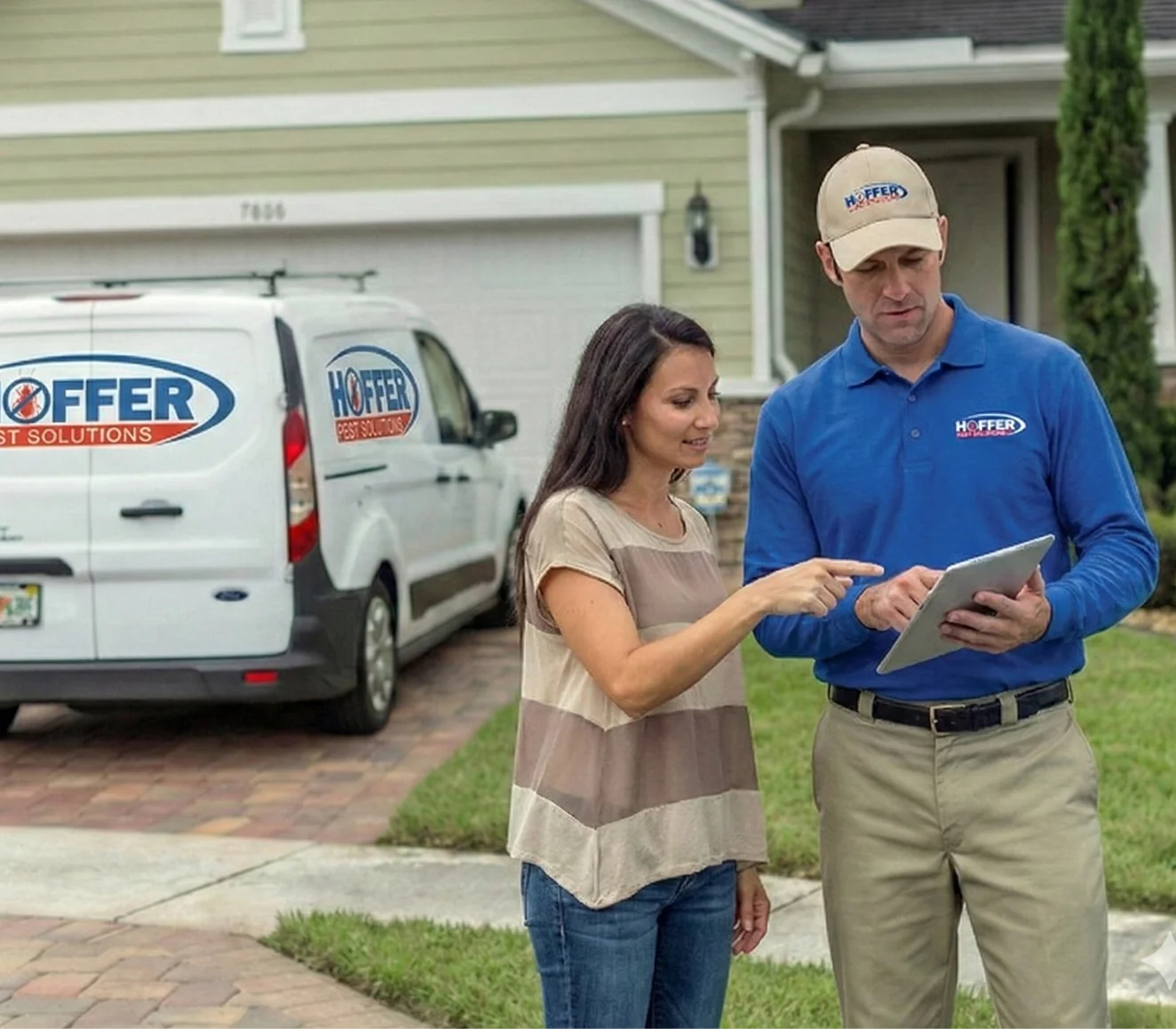
Termite Control for Greenacres' Slab Built Homes
The termite story in Greenacres is mostly underground. Almost every neighborhood here — Smith Farms, Magnolia Bay, Pinewood Lake, Pine Ridge North, Buttonwood — was built on concrete slab between roughly 1975 and 2000, which puts the typical home right in the window where Eastern subterranean termites (Reticulitermes flavipes) start finding their way in. They tunnel up through soil, follow plumbing penetrations and slab cracks, and build mud tubes you can sometimes spot along the exterior block or behind a baseboard before the damage shows on the surface. Formosan subterranean termites (Coptotermes formosanus) are documented in Palm Beach County and turn up in heavily irrigated, mature-landscape suburbs — Greenacres fits that profile, especially in homes that back up to canal banks or pond berms.
Drywood termites still belong on the list, particularly in the Original Greenacres east end — the 1923 Swain plat west of Military Trail, where the oldest wood-frame elements in the city sit. We handle drywood activity with spot treatments when the infestation is contained and with no-tent options for eligible cases. When the activity is widespread enough that whole-structure work is the right call, we provide full structural fumigation too — we don’t push you to a treatment that doesn’t fit the situation, but we don’t pretend tenting isn’t an option when it actually is. For subterranean activity, we also install termiticide soil barriers around the foundation as the standard preventative approach.
Mosquito Control for Canal-Fed Neighborhoods
Greenacres’ mosquito pressure doesn’t come from the ocean — it comes from the LWDD E-3 and E-4 canals and the retention ponds built into every subdivision from the 1980s on. River Bridge is the extreme version (18 islands surrounded by interconnected lakes), but Magnolia Bay, Smith Farms, Pinewood Lake, and just about every gated community in the city has its own stormwater pond breeding mosquitoes from May into October. The mix here skews freshwater — Aedes albopictus in container habitats around the home, Culex species working the pond and canal edges — so the treatment plan is built around larvicide where standing water can’t be eliminated, perimeter foliage treatment around the home, and timing service to the summer rainy-season ramp rather than waiting for the bites to start.
Ant Control in Greenacres Homes and Yards
Ghost ants are the indoor headache in Greenacres — tiny, pale, and almost translucent, they trail across kitchen counters and bathroom vanities looking for moisture, and they’re especially stubborn in older shared-wall buildings like the villas at Pine Ridge North and the condos at The Fountains, where a colony can split across multiple units and reseed itself from next door after a single-unit spray. We treat them with a slow-acting bait the workers carry back to the queen, not a fast knockdown that just chases the colony deeper into the wall.
Outdoors, it’s a fire ant story. Lawn berms, retention-pond edges, and the medians along the LWDD canal banks are full of mounds, and in a city with this many shared HOA common areas and family backyards, that’s a real risk for kids and pets — not a cosmetic problem. We treat individual mounds and broadcast bait the yard where the pressure is heaviest.
Roof Rats Under Greenacres' Tree Canopy
A Tree City USA designation looks great on the welcome sign and brings its own pest signature. Forty years of mature live oaks, sabal palms, and shade trees in Greenacres means roof rats have a continuous highway from the canopy to the roofline — and the 1980s-era barrel-tile and asphalt-shingle roofs in most subdivisions have soffit gaps, eave returns, and ridge vents that have softened enough to let them in. You’ll usually hear them before you see them: light scratching above a bedroom ceiling, often around dusk and again before dawn. The fix is three things at once — trimming canopy back at least three feet from the roof, sealing the actual entry points (not just one), and trapping the rats already inside before any rodenticide is considered. We do all three, and we set a follow-up window so you know it’s actually finished.
Cockroaches: Palmetto Bugs and German Roaches
Two very different cockroach problems show up in Greenacres, and they need very different treatment. The big brown one most people call a “palmetto bug” is the American cockroach — it lives outside, breeds in mulch and palm boots, and wanders inside through aging weep holes, dryer vents, and the plumbing penetrations under 1980s sinks, usually after a heavy rain. That one’s an exterior-perimeter problem, sealed and treated from the outside in.
The German cockroach is a different animal entirely. It’s smaller, lighter, and lives indoors full-time — and it’s more common in Greenacres than in the affluent corridor to the north because of the higher share of older multifamily, rental, and 1970s–80s condo housing here. Once it’s established in a kitchen or bathroom, it breeds fast and shares walls easily between attached units, which is why we treat German roach jobs as a building problem, not a unit problem, in places like Magnolia Bay and The Fountains.
Wildlife, Lawn Pests, and the Rest of the Plate
Greenacres’ mature canopy and dense suburban lots bring the usual wildlife visitors — raccoons working the trash cans on collection night, opossums denning under sheds and screened lanais, the occasional bat colony tucked into an older soffit in the east-end cottages. We handle exclusion work humanely: locate the entry, seal it after the animals are out, and clean up the mess they leave behind so you’re not dealing with the smell or the secondary pest pressure a month later.
The other slice of the plate is the lawn itself. Chinch bugs and sod webworms chew through Greenacres’ St. Augustine lawns every summer — you’ll see them as yellowing patches in Smith Farms, Pinewood Lake, the Pines, and just about every irrigated yard backing onto a retention pond. That’s a lawn-care treatment, not a perimeter spray, and timing it before the patches spread is what separates a $200 fix from a sod-replacement job.
Our Greenacres Service Guarantee
Every treatment we do in Greenacres is backed by the same promise: if a pest we treated comes back between scheduled visits, we come back too — at no extra charge — and we keep coming until it’s handled. Our standard recommendation for most Greenacres homes is quarterly preventative service, with a monthly mosquito add-on during the rainy season for homes backing onto canals, ponds, or heavy irrigation. Owner-occupied or rental, single-family or 55+ villa, family subdivision or original east-end cottage — the same standard applies.
Service Areas Around Greenacres
We also serve the cities that border Greenacres on all four sides. To the north, West Palm Beach is in our same service area, with many of the same 1970s–80s housing patterns. Directly east, Lake Worth brings coastal humidity into the picture and a different drywood termite profile. To the west, Wellington shifts into equestrian and large-lot landscape pest pressure. And to the south, Boynton Beach carries similar inland-suburban dynamics down into south PBC. If your home is in any of these neighbors — or in the unincorporated stretches between them — the same Hoffer team that runs the Greenacres routes handles your service.
Get Started With Hoffer Pest Solutions Today
Request a Free Quote




Greenacres Pest Control FAQs
Real questions we get from Greenacres homeowners — about the local pests, the canals and tree canopy, the 1980s slab homes, and the 55+ communities. If you don’t see yours, give us a call and we’ll walk you through it.
What are the most common pests in Greenacres, FL?
The short list is Eastern subterranean termites, ghost ants, palmetto bugs (American cockroaches), German cockroaches, roof rats, mosquitoes, fire ants, chinch bugs, and the occasional raccoon or opossum. The mix is different from the coastal cities to the east because Greenacres is inland — the pests here are driven by the LWDD canal grid, the mature Tree City USA canopy, and the 1980s slab homes that make up most of the neighborhoods. Quarterly service handles the bulk of it; mosquito service is usually added on through the rainy season.
Why do I keep finding termite mud tubes on my Greenacres home?
Because the typical Greenacres home was built around 1987 on a concrete slab, and that’s exactly the housing age when Eastern subterranean termites start finding their way in. They travel through soil and build mud tubes — pencil-thin tan or brown lines you can sometimes spot on the exterior block, on the slab line, in the garage, or behind a baseboard — to get from the soil to the wood. If you’ve found one, don’t break it open or spray it; call us. We’ll trace the activity, set a treatment plan, and install a termiticide soil barrier around the foundation as the standard subterranean fix.
When is termite swarming season in Greenacres?
Subterranean termite swarms peak in spring — roughly March into May — and again after the first heavy summer rains, when soil moisture conditions push reproductives out of mature colonies. Drywood swarms run later, generally April into July, and matter most in the Original Greenacres east end where wood-frame elements are still in service. The single biggest miss most homeowners make is assuming swarming season is the threat — it’s a useful signal, but subterranean colonies are active under Greenacres yards year-round.
Why are there so many mosquitoes in Greenacres if we're nowhere near the beach?
Because the water isn’t the ocean — it’s the canals and the ponds. The Lake Worth Drainage District runs the E-3 and E-4 canals straight through central Palm Beach County, and every subdivision built since the 1980s has its own retention-pond network for stormwater. Add irrigated lawns and the May–October rainy season, and you get freshwater mosquitoes breeding from late spring through fall. Monthly mosquito service through the rainy season is the standard recommendation for homes backing onto canals or ponds.
Do I still need professional pest control if my HOA already sprays?
In most cases, yes. HOA contracts in communities like River Bridge, Smith Farms, Magnolia Bay, and The Fountains typically cover common areas — clubhouses, perimeter walls, retention-pond edges — and not the inside of your home or your screened lanai. Subterranean termites under the slab, ghost ants in the kitchen, roof rats in the attic, and German cockroaches in older units are all your responsibility, not the HOA’s. The two services are complementary, not duplicates.
Do you treat 55+ communities like Pine Ridge North or The Fountains?
Yes. We service individual villas and condos in Pine Ridge North, The Fountains Country Club, Magnolia Bay, Buttonwood, and other 55+ communities throughout Greenacres, and we also work directly with HOA boards on community-wide contracts. Shared-wall buildings need a coordinated approach — if one unit treats and the neighbor doesn’t, ghost ants and German cockroaches just walk next door — so we plan for that, keep the same technician on your community whenever possible, and use pet-safe products designed with dogs and visiting grandkids in mind.
Do you offer tent fumigation in Greenacres, or only no-tent options?
Both. For drywood activity that’s isolated to a contained area, we lead with spot treatments and no-tent options because they’re less disruptive and they fit most situations we see. When the drywood infestation is widespread enough that whole-structure treatment is genuinely the right call, we provide full structural fumigation — tenting included. We don’t push you toward fumigation that isn’t necessary, and we don’t hide it from you when it is.
Does Hoffer offer same-day pest control in Greenacres?
Yes. Same-day service is one of our standing commitments — call us early enough in the day and we can usually treat your Greenacres home the same day, whether it’s an active mud tube on a slab joint, a sudden wasp nest under the lanai, a ghost ant trail in the kitchen, or roof rats overhead. We’ll tell you straight whether we can fit you in today or first thing tomorrow, and we’ll give you a real arrival window — not a four-hour guess.