
Pest Control Built for Sea Ranch Lakes
Living in Sea Ranch Lakes means owning a piece of barrier-island geography that doesn’t repeat anywhere else in southeast Florida. The village covers 0.19 square miles — a walled gated residential community on a strip of barrier island roughly 600 yards wide, with the Atlantic Ocean on the eastern boundary, the Intracoastal Waterway on the western boundary, and two artificial freshwater lakes set inside the gated section between them. On the three landward sides, the village is enclaved entirely by Lauderdale-by-the-Sea — the only municipality that touches Sea Ranch Lakes on land at all. For a homeowner on a $1M–$5M oceanfront, lakefront, or Intracoastal-frontage lot, the pest pressure question is shaped by all three water bodies at once.
For a family with grandchildren at the Beach Club on a Saturday afternoon, or kids between the pool deck and a lakeside lanai at dusk, the pressure that matters lives in the outdoor spaces where village life happens — Atlantic dune exposure, Intracoastal mangrove edge on the western seawalls, freshwater margins along the two interior lakes, and the screened lanais where a decade of salt-air corrosion has quietly changed what aging mesh is keeping out. The structural picture matters too: the village’s roughly 200 estate homes split between original 1956–1964 concrete-block construction with wood roof systems and significant interior and decorative wood, and post-2010 teardown-rebuild luxury construction with exposed cedar, mahogany, and tropical hardwood in lanais and ceiling beams — both profiles carry real drywood termite exposure. The irrigation-rich lakefront landscape is exactly the soil profile Formosan and Eastern subterranean colonies build under. Hoffer Pest Solutions has been protecting Southeast Florida homes for more than five decades. Call 954-945-8035 or request a free quote online.
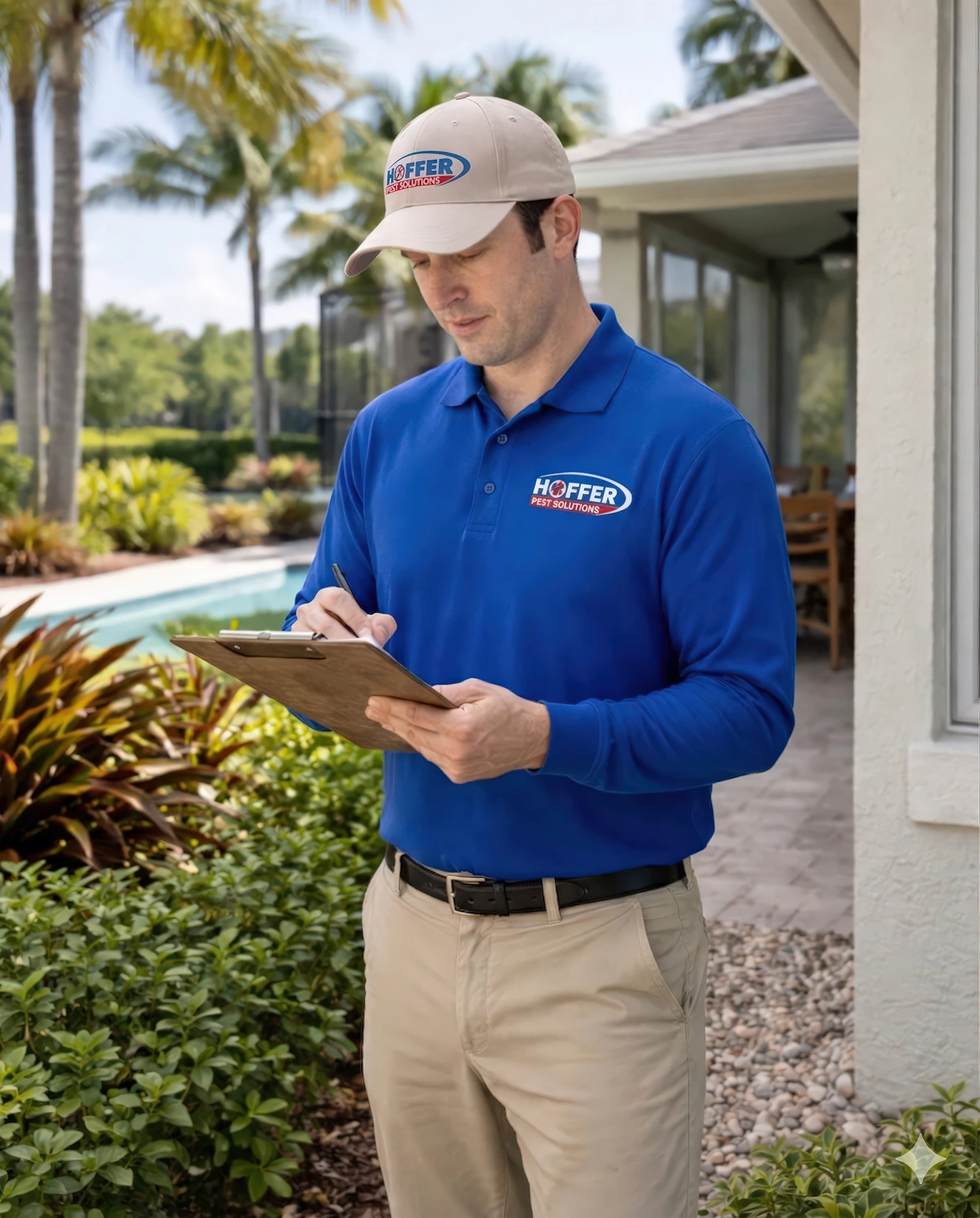
Why Sea Ranch Lakes Homeowners Choose Hoffer
Pest control in Sea Ranch Lakes isn’t about a quarterly drive-by spray of the front door. It’s about a partner who reads the whole property — the main structure, the lanais and screened patios, the pool deck, the lakeside or oceanfront edges, and the perimeter where landscape transitions into structure — and treats the estate as the structural surface it actually is. The companies that have lasted fifty years in South Florida are the ones that learned to handle the housing stock, the soil network, and the coastal pressure this barrier-island region throws at homes — and then built their reputation on showing up when they said they would and standing behind the work when something came back.
Hoffer Pest Solutions has served Sea Ranch Lakes families and estate-property owners across coastal Broward for more than five decades. We’re not the company that tries to upsell every service call into a contract you don’t need. We’re the company that does the inspection, tells you straight what’s happening, and handles it the way we’d handle it if it were our own family’s property.
Sea Ranch Lakes is a walled gated residential village on a sub-quarter-square-mile barrier-island strip — 0.17 land + 0.04 water across just 0.19 square miles total. The Atlantic forms the eastern boundary, the Intracoastal Waterway forms the western boundary, and two artificial freshwater lakes sit inside the gated residential section between them, about 600 yards apart at most points. Roughly 200 single-family estate homes split between original 1956–1964 concrete-block construction with wood roof systems and post-2010 teardown-rebuild luxury construction with exposed decorative cedar, mahogany, and tropical hardwood. The Sea Ranch Lakes Beach Club, the pool decks, the lakeside lanais, and the screened oceanfront and Intracoastal patios are where village life actually happens — which is where pest pressure has to be read first.
A few things that come standard
- 50+ years of pest control in Palm Beach, Broward, and Miami-Dade counties.
- ACE-credentialed leadership — Associate Certified Entomologist on staff and reviewing the work.
- Same-day service available when you call early enough in the day; we’ll always tell you straight whether we can fit you in today or first thing tomorrow.
- Free inspection before you commit to anything — including a real walk of the slab line, soffits, screens, and lanai, not a five-minute drive-by.
- Satisfaction guarantee between visits. If something comes back, so do we.
- 4,000+ five-star reviews across South Florida.
- Family- and pet-safe treatments — targeted to entry points and pressure zones, applied with the kids, the grandkids, and the dogs in mind.
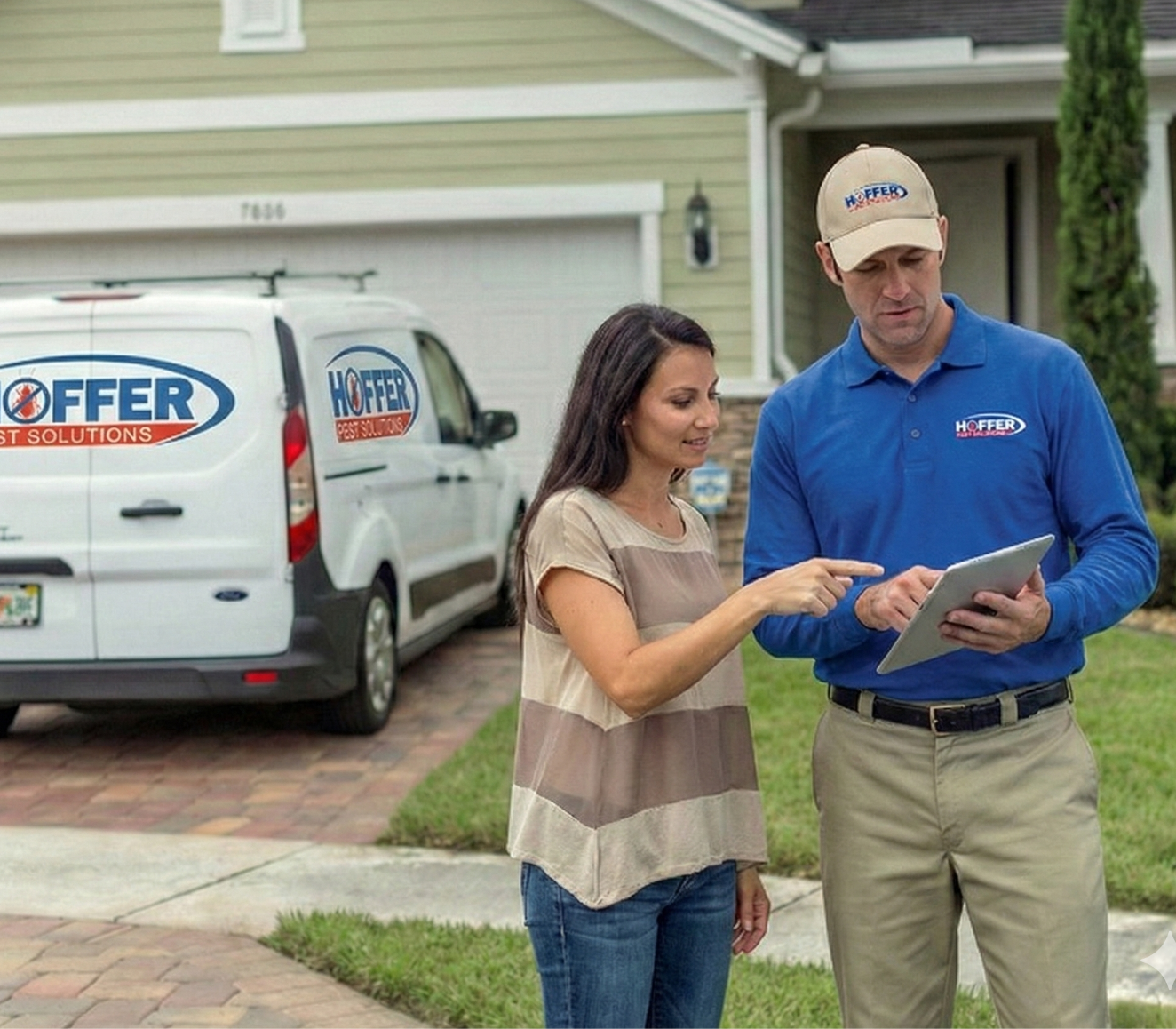
Termite Control in Sea Ranch Lakes
Drywood termites are the headline termite story in Sea Ranch Lakes, and the exposure runs across the entire ~200-home village inventory — shaped differently by build era, but real on both ends. Roughly half the village is still original 1956–1964 construction: concrete-block estate homes with wood roof systems, wood fascia and soffit, and original-era interior and decorative wood that decades of warm-season swarms have had access to. The other half is post-2010 teardown-rebuild luxury construction — post-Andrew CBS shells with engineered roof systems, but with high-end design leaning on exposed decorative cedar in lanai ceilings, mahogany and tropical hardwood beams, and custom millwork. Exposed cellulose is the vector, and Sea Ranch Lakes has it on both profiles. Swarms are most visible during the warm humid evenings of late spring into early summer, and a screened oceanfront lanai or Beach Club-side soffit with even a small opening is a credible entry point.
The Formosan subterranean termite (Coptotermes formosanus) is the second headline species. Established populations have been documented across coastal Broward for years, bracketing the village to the north in Pompano Beach and to the south in Dania Beach, and the irrigation-rich landscape around the two interior lakes plus year-round soil moisture along Intracoastal- and Atlantic-frontage lots is exactly the soil profile Formosan colonies select for. A mature colony forages on the order of 100 feet from the nest — enough reach to bridge from a mature tree epicenter into the structure. The native Eastern subterranean (Reticulitermes flavipes) is also present as the baseline subterranean species. For homeowners researching the difference between Formosan and Eastern subterranean termites, our identification guide walks through colony size, species behavior, and treatment-timing differences.
Treatment is matched to species and severity. Contained drywood activity is typically handled with spot work or a no-tent protocol that addresses the active galleries without enclosing the whole structure. When an infestation has spread far enough that localized work can’t cover it, whole-structure fumigation is the option that does — and we run it when the situation requires it. Subterranean work for Formosan and Eastern centers on continuous termiticide soil barriers around the foundation and in-ground bait stations along the perimeter, with lakefront, oceanfront, and Intracoastal-frontage lot edges getting the closest attention. Annual inspection catches activity at the spot-treatment stage rather than the structural-repair stage.
Mosquito Control in Sea Ranch Lakes
Mosquito pressure on a Sea Ranch Lakes property comes from three water sources at once, which is unusual for a village this small. The Atlantic dune line and the Intracoastal seawall on opposite sides contribute salt-marsh species like Aedes taeniorhynchus that surge through the warm months; the two interior freshwater lakes provide breeding habitat for freshwater Culex species along the lake margins; and Aedes aegypti — the small daytime container breeder — uses every bromeliad, irrigation low spot, planter pan, and uncovered drainage feature on an estate-landscaped lot. Even screened pool decks and lanais on a heavily-vegetated waterfront property can hold microhabitat pockets the broader landscape doesn’t suggest. Homeowners curious about the types of mosquitoes in Florida and which diseases they carry can read our species rundown for more on each one.
For a family using the Beach Club, the lakeside on a weekday evening, or a screened lanai at dusk, what works is reading the actual property — lake margins, irrigation low spots, vegetation harborage where adults rest between blood meals — and treating the larval water and resting harborage on a cadence calibrated to the property’s breeding pattern, with proper dry times before kids, grandkids, or pets are back outside.
Ant Control in Sea Ranch Lakes
Ant activity inside a Sea Ranch Lakes home tends to sort by which side of the village the property is on. Lots backing onto the interior lakes deal heavily with ghost ants — the tiny pale species with the dark head — pushing up through irrigation-fed soil margins and lakeside planting beds into kitchens and baths. Atlantic- and Intracoastal-frontage lots see white-footed ant pressure moving through landscape and into wall voids around windows and plumbing penetrations. Properties with mature canopy and softening older wood in roof framing, fascia, or lanai woodwork give carpenter ants the moisture-compromised wood they nest inside — a recurring finding on original-era homes with decades of canopy contact.
The work starts where the colony actually is, not where the foragers happen to be visible. Locate the nest, treat it directly, then follow the trails back. The perimeter after that targets the paths between landscape harborage and the entry zones, applied at targeted entry points rather than broadcast — kids, grandkids, and pets all in mind from the start.
Rodent Control in Sea Ranch Lakes
Roof rats are the rodent that runs Sea Ranch Lakes, and the village’s mature coastal canopy — cabbage palm, royal palm, sea grape, gumbo limbo — gives them everything they need overhead. The canopy threads continuously between lots, and the older homes underneath it have the access points an animal up in the trees needs: tile-roof seams, gable vents, aged soffit returns, AC line chases, and the half-inch openings around plumbing penetrations that haven’t been resealed in a generation. The original-era estates carry more of those entry points than the rebuilt construction does. Lakeside landscape edges add ground-level harborage for the same species — the same pattern that pressures older mid-century Broward housing stock further inland in places like Oakland Park.
Work has to be read structure-by-structure. Walk the roofline and the canopy contact points, seal the active entry openings, trap the existing population inside, and maintain locked tamper-resistant exterior stations along the perimeter so the next animal moving through the canopy doesn’t establish. On lakefront lots, the lake-margin landscape gets its own attention as the second entry vector.
Cockroach Control in Sea Ranch Lakes
The cockroach pressure that matters in Sea Ranch Lakes is the outdoor large-roach pressure pushing in from the village’s heavy coastal canopy and lake-edge landscape. American and Australian cockroaches — palmetto bugs to most residents — harbor outdoors in mulch beds under the palm and sea grape canopy, in decomposing wood along the lakeside, and in the moisture pockets under pool decks and patio slabs the coastal humidity keeps year-round. Smokybrown cockroaches, at home in palm crowns and bark, are particularly comfortable in the village’s mature coastal palm canopy — the same coastal canopy profile that pressures other northern-Broward Intracoastal communities like Lighthouse Point on the same north-coastal corridor. After heavy summer rains all three push toward structures through weep holes, sliding-door tracks, and slab penetrations. German cockroach pressure is lower here than in denser housing — the village is essentially 100% owner-occupied estate single-family — but a single introduction through groceries or a delivery can still take hold inside.
Treatment runs both halves: outdoor harborage work targets the canopy, mulch, and slab-edge pressure pushing in; structural exclusion seals the entry routes; any indoor German activity gets gel-bait plus crack-and-crevice work at the established placement points.
Pest Pressure Specific to Sea Ranch Lakes
Standard southeast Florida pest pressure shows up on a Sea Ranch Lakes property the way it shows up across the county — what makes the village its own animal is the geography that puts three different biting-insect breeding habitats inside a 600-yard-wide barrier-island strip with two artificial freshwater lakes set in the middle of it.
No-See-Ums on the Sea Ranch Lakes Barrier-Island Strip
If you’ve spent a summer evening on a lakeside lanai or at the Beach Club and felt the sudden sharp sting of something you can’t even see on your wrist or ankle, you’ve already met the no-see-um — the 1-to-3-millimeter biting midge that earns its regional nickname “flying teeth” honestly. Two coastal species dominate the local biology: Culicoides furens throughout coastal Florida and Culicoides barbosai in South Florida’s coastal marshes.
Sea Ranch Lakes stacks three biting-midge breeding habitats inside a 600-yard-wide municipality: the Atlantic dune line on the east, the Intracoastal mangrove edge on the west, and the two artificial freshwater lakes inside the gated section between them. Biting midges are weak fliers — they disperse only a few hundred yards to a mile from breeding habitat — which on a village this narrow means every residential lot sits within range of at least two habitats at once. Coastal populations also bite in broad daylight under overcast or breezeless conditions, and standard 18×16 lanai mesh is too coarse to exclude an insect this small.
Hoffer’s mosquito and biting-fly program covers no-see-ums through a property inspection that maps breeding-habitat exposure to the outdoor zones residents actually use — the Beach Club, the pool deck, the lakeside lanai, the oceanfront patio — followed by targeted perimeter and harborage adulticide treatments on a recurring cadence, plus an honest read on screen-mesh integrity. For homeowners who want a deeper read before the inspection, our guide to how to avoid no-see-um bites and take control walks through the biology, the dispersal pattern, and the screen-and-treatment combination that actually works. Call 954-945-8035 or read more about our pest control services.
Service Areas Around Sea Ranch Lakes
Hoffer Pest Solutions serves Sea Ranch Lakes and the surrounding coastal Broward communities. Lauderdale-by-the-Sea surrounds the village on all three landward sides and is the single most important neighbor in any Sea Ranch Lakes context. Pompano Beach and Lighthouse Point sit on the same north-coastal Intracoastal corridor — older oceanfront and finger-channel housing stock, mature coastal canopy, and the same Formosan-population and roof-rat pressures that show up here. Oakland Park further inland to the southwest shares the older-housing canopy-fed roof-rat pattern at a different scale. Our teams handle the cross-border coastal corridor from one office. For full Broward County coverage, see our pest control across Broward County service area page. Same-day service, free inspections, and a satisfaction guarantee between visits. Call 954-945-8035 or request service online.




Contact Hoffer Pest Solutions
Hoffer Pest Solutions has served South Florida families and homeowners for over 50 years. We guarantee satisfaction between scheduled visits — if pests come back, so do we, at no additional charge. Our technicians are licensed, trained, and equipped to handle everything from drywood and Formosan termite protection on barrier-island estate homes to no-see-um and mosquito control along the Atlantic and Intracoastal frontages.
Hoffer Pest Solutions
1975 E Sunrise Blvd #503
Fort Lauderdale, FL 33304
954-945-8035
Frequently Asked Questions — Pest Control in Sea Ranch Lakes, FL
Why are no-see-ums so much worse in Sea Ranch Lakes than in other coastal Broward neighborhoods?
Because of the geometry of the village. Sea Ranch Lakes is roughly 600 yards wide between the Atlantic and the Intracoastal, with two artificial freshwater lakes set inside the gated section between them. That stacks three different biting-midge breeding habitats inside a sub-quarter-square-mile village. Biting midges only disperse a few hundred yards to a mile from breeding habitat, so on a village this narrow every residential lot sits within range of at least two habitats at once. No other coastal Broward neighborhood has that compression.
Does pest control work differently inside a gated community like Sea Ranch Lakes?
Yes, in practical ways. On-property service inside the wall runs through the Gatehouse Drive guardhouse — access is coordinated in advance, and technicians follow the village’s protocols for arrival and on-property movement. Treatment itself follows the standard we’d run on any estate property: a full walking inspection of structure, screens, and perimeter; targeted treatment at the actual pressure points rather than broadcast spraying; re-entry timing communicated before we leave. The gated character changes scheduling, not the standard of care.
How do the two private lakes inside Sea Ranch Lakes affect pest pressure?
The lakes add a third water-based pressure layer on top of the Atlantic and Intracoastal sides. Their landscape margins create freshwater mosquito breeding habitat — particularly Culex species along vegetated edges — plus the third biting-midge microhabitat that drives much of the no-see-um exposure. Ghost ants and big-headed ants colonize the irrigation-fed soil along lake-edge planting beds. Treatment for lakefront lots gives the lake-margin landscape its own attention rather than treating only the structure perimeter.
Are drywood termites only a problem in the original Sea Ranch Lakes homes, or do the new rebuilds get them too?
Both profiles get them. The original 1956–1964 estates are concrete-block construction (not wood frame) but they carry decades of drywood exposure on the wood roof system, fascia and soffit wood, interior wood, and original-era decorative elements. The post-2010 teardown-rebuild luxury homes have post-Andrew code shells and engineered roof systems — but the high-end design language leans heavily on exposed decorative cedar in lanai ceilings, mahogany and tropical hardwood beams, and custom millwork, all of which are credible drywood targets. Annual inspection is the difference between catching a contained infestation early — spot work or no-tent can handle it — and finding a colony that’s spread far enough to require whole-structure fumigation. We inspect both profiles; the follow-up cadence varies with the exposure points on each.
Are Formosan termites really a problem on a Sea Ranch Lakes property?
Yes, and the village’s geography is the reason. The Formosan species (Coptotermes formosanus) has been documented in coastal Broward for years, with established populations bracketing the village — Pompano Beach to the north, Dania Beach to the south. The irrigation-rich landscape around the two interior lakes plus year-round soil moisture along Intracoastal- and Atlantic-frontage lots is exactly the soil profile Formosan colonies build under. A mature colony forages roughly 100 feet from the nest. Treatment is termiticide soil barriers paired with in-ground bait stations along the perimeter, plus annual inspection.
Do you offer tent fumigation for drywood termites in Sea Ranch Lakes?
Yes, and it’s sometimes the right call on both original-era and rebuilt homes. Whole-structure fumigation is part of our toolkit, and the situation that calls for it is a drywood infestation that has spread through enough of a structure that spot work or no-tent treatment can’t realistically cover it — a scenario that can come up in an original 1956–1964 estate with extensive roof-system or decorative-wood activity, and one that can come up in a newer rebuild where activity has tracked through enough of the decorative cedar, mahogany, or tropical hardwood detailing. For contained activity, spot work or no-tent usually handles it without enclosing the whole building. Every decision starts with the inspection.
How does living between the Atlantic and the Intracoastal change pest pressure overall?
It compresses several different pressures onto a single property. Salt air ages screen mesh on lanais and oceanfront windows faster than inland conditions do, which over a decade quietly changes what’s keeping biting insects out. Both water bodies feed year-round soil moisture into the slab line on waterfront-edge lots — the soil condition subterranean termite colonies build under — and both contribute salt-marsh mosquitoes and biting midges. None of those pressures is unique by itself; what’s unique is having all of them on a village this narrow.
Are your treatments safe for kids, grandkids, and pets at the Beach Club and on the property?
The standard of care is the same; the placement discipline does the work. Indoor product goes into voids and crack-and-crevice placements that small hands don’t reach. Exterior liquid work is timed with a re-entry window documented on the service ticket — the homeowner knows when family can be back on the pool deck or the lanai. Locked tamper-resistant exterior stations are used along the perimeter so pets can’t open them. For Beach Club common-area work, scheduling runs in off-peak windows with re-entry confirmed before the area reopens.
Are bed bugs a concern in Sea Ranch Lakes estate homes?
The exposure profile in Sea Ranch Lakes is meaningfully lower than in the dense rental and multifamily inventory elsewhere in Broward — the village is essentially 100% owner-occupied single-family with limited rental turnover. Where introductions do happen on an estate property, the typical vector is a guest room used by visiting family or a piece of luggage returning from travel. Treatment is room-focused with attention to adjacent rooms and connected closets, using a combination of targeted heat work, mattress and box-spring encasements, and crack-and-crevice product where appropriate. A pre-purchase inspection is worth running on any major home acquisition; it’s a fraction of the cost of treating an established population.
Who is the best pest control company in Sea Ranch Lakes?
For Sea Ranch Lakes homeowners who want a recurring partner who reads the whole property and respects how the village actually runs, Hoffer Pest Solutions is the name most of our local customers stay with. Five-plus decades of South Florida work, an ACE-credentialed owner reviewing the program, a full walking inspection of structure, screens, and perimeter before any agreement, gatehouse-coordinated scheduling, treatment placement calibrated for kids, grandkids, and pets, and a satisfaction guarantee that holds between visits. Reach us at 954-945-8035 or request a free quote online.