
Pest Control Built for Southwest Ranches
Owning a home in Southwest Ranches usually means owning more than a home. The town’s 1-acre minimum residential zoning, in place since incorporation in 2000, means almost every property here carries a full outbuilding stack alongside the main house — a barn or run-in shed for the horses, a tack room, hay storage, an equipment shed, often a pool house, a well house, and somewhere on the lot a detached garage or a guest cottage. Pest pressure on a Southwest Ranches property isn’t a single-structure question. It’s a question about every structure on the lot, the mature tree canopy connecting them, the soil network underneath them, and the Everglades Wildlife Management Area sitting on the town’s western boundary feeding wildlife and arboreal-pest habitat into property lines from Sunshine Ranches to Landmark Ranch Estates.
For a family in Country Estates or Rolling Oaks who bought into Southwest Ranches for the lifestyle — kids on the property, horses in the paddock, a dog running the lot, friends over for a weekend cookout — what works isn’t a quarterly drive-by treatment of the front door of the main house. It’s an inspection of the actual property: every structure walked, the canopy assessed for arboreal pathways, the soil line read along each outbuilding, the hay storage and tack room treated as the structural-pest territory they actually are. A single Formosan subterranean colony with a 100-foot foraging range nesting at the base of one mature tree can reach the main house, the barn, and the equipment shed from one epicenter. Catching that property-wide is a different conversation than catching it building-by-building.
Hoffer Pest Solutions has been protecting Southeast Florida homes and properties for more than five decades. On any Southwest Ranches lot — a 1-acre Sunshine Ranches estate, a gated 2-acre property in Landmark Ranch Estates, a working equestrian operation in Rolling Oaks, or a south-side Green Meadows place backing onto open pasture — the starting point is always the inspection itself. Call 954-945-8035 or request a free quote online.
Why Southwest Ranches Homeowners Choose Hoffer
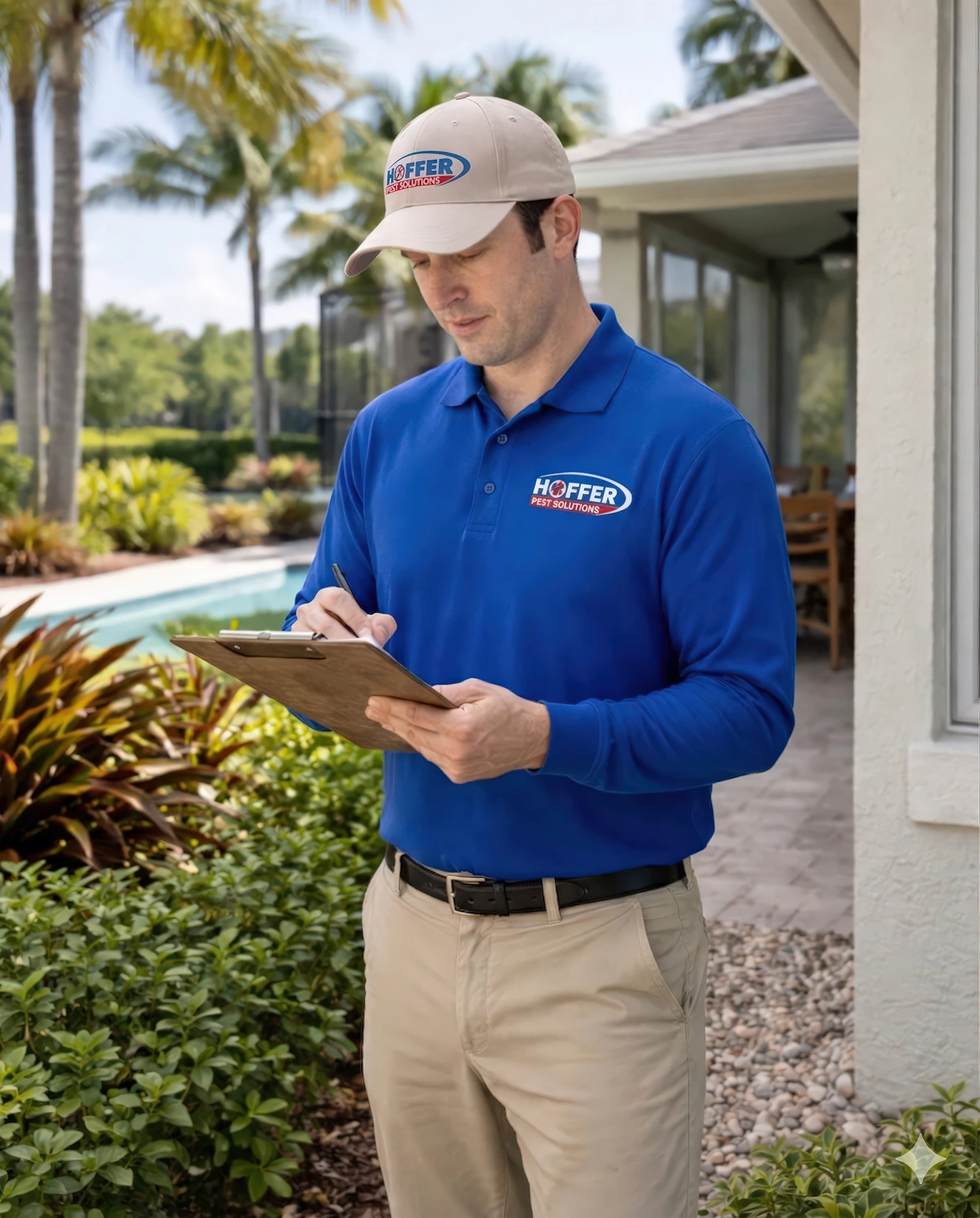
Pest control on a Southwest Ranches property isn’t about a quarterly drive-by spray of the main-house perimeter. It’s about a partner who reads the whole property — the main house, the barn, the tack room, the hay storage, the equipment shed, the pool house, and any outbuilding stack the lot actually carries — and treats that stack as the structural pest surface it is. The companies that have lasted fifty years in South Florida are the ones that learned to handle the housing stock, the soil network, and the wildlife corridor pressure this region throws at homes — and then built their reputation on showing up when they said they would and standing behind the work when something came back.
Hoffer Pest Solutions has served Southwest Ranches families, equestrian property owners, and rural-estate homeowners across Broward and Palm Beach for more than five decades. We’re not the company that tries to upsell every service call into a contract you don’t need. We’re the company that does the inspection, tells you straight what’s happening, and handles it the way we’d handle it if it were our own family’s property.
Southwest Ranches incorporated in 2000 specifically to preserve rural-equestrian lifestyle and block annexation by Pembroke Pines and Davie to the north. The town’s identity is structured around protecting the estate-property profile — 1-acre minimum residential zoning town-wide, a mature tree canopy across the rural-estate housing stock, the C-11 canal drainage system threading through the south side, and the eastern edge of the Florida Everglades on the western boundary. Almost every property in Sunshine Ranches, Country Estates, Rolling Oaks, Green Meadows, Landmark Ranch Estates, and the Stirling Ranches corridor toward Davie carries a full outbuilding stack alongside the main house — that’s the rural-estate property profile this page is built to address.
A few things that come standard
- 50+ years of pest control in Palm Beach, Broward, and Miami-Dade counties.
- ACE-credentialed leadership — Associate Certified Entomologist on staff and reviewing the work.
- Same-day service available when you call early enough in the day; we’ll always tell you straight whether we can fit you in today or first thing tomorrow.
- Free inspection before you commit to anything — including a real walk of the slab line, soffits, outbuildings, and barn perimeter, not a five-minute drive-by.
- Satisfaction guarantee between visits. If something comes back, so do we.
- 4,000+ five-star reviews across South Florida.
- Family- and pet-safe treatments — targeted to entry points and pressure zones, applied with the kids, the dogs, and the horses in mind.
Termite Control in Southwest Ranches
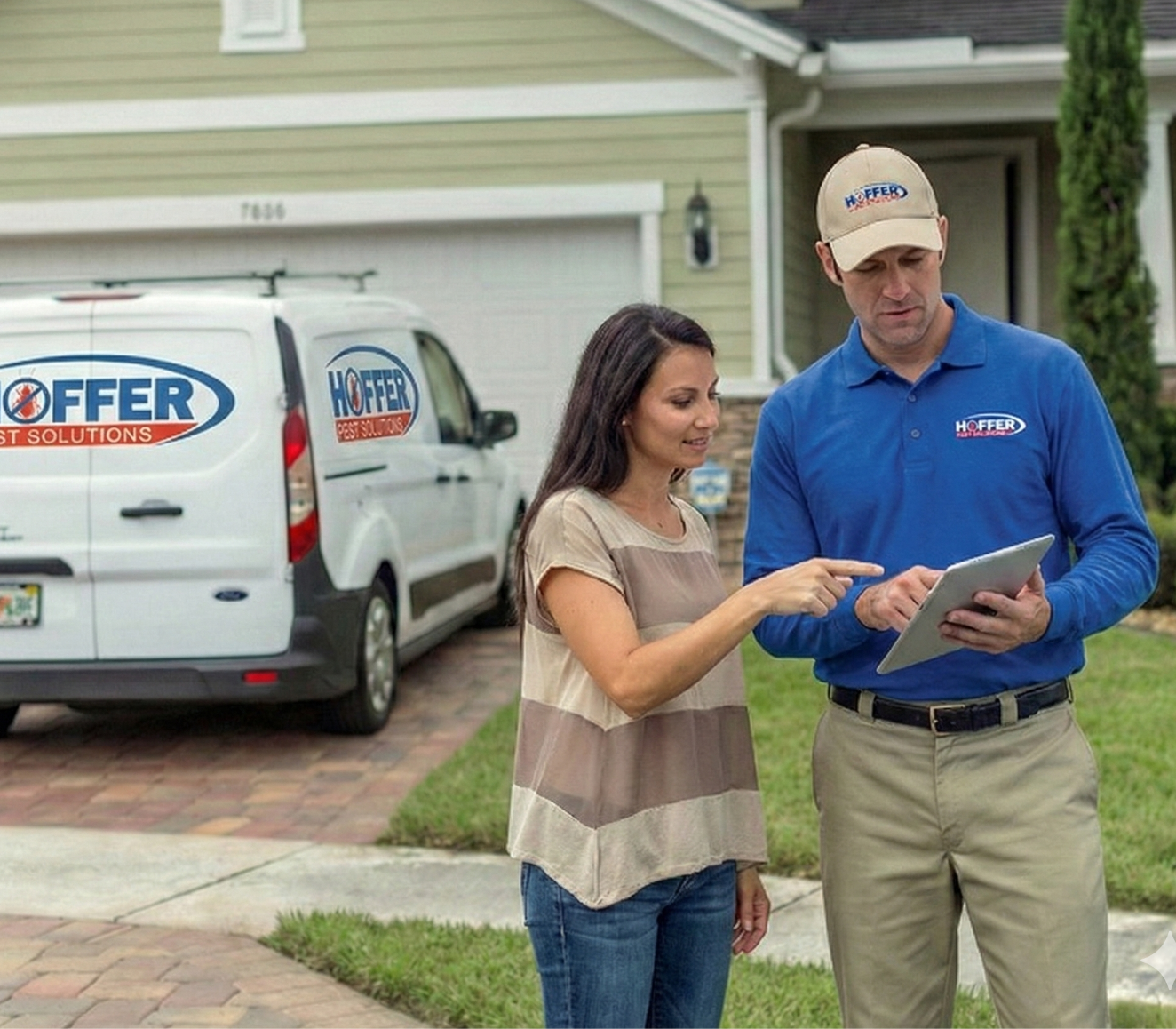
Termites in South Florida divide into two families that behave nothing alike, and Hoffer’s program covers each on its own terms. Drywood species colonize wood directly without needing soil contact — they push into attic rafters, exposed joists, door and window framing, and any structural wood that a swarmer can reach on a humid evening through an unscreened vent or a soffit gap. The subterranean side is the opposite biology: colonies live in the soil, need consistent moisture to survive, and build mud tubes along foundation walls and slab edges to bridge the gap between ground and timber. Three subterranean species are in play here. The native Eastern (Reticulitermes flavipes) is the baseline across the region. The invasive Formosan (Coptotermes formosanus) is well-established across Broward and runs much larger colonies — a mature one can chew through roughly a pound of timber every twenty-four hours and forages out to about 100 feet from the nest. The Asian subterranean (Coptotermes gestroi) is still expanding its territory northward from Miami-Dade and shows up in southern Broward more each year. For homeowners researching the difference between Formosan and subterranean termites, our identification guide walks through colony size, species behavior, and treatment-timing differences. Drywood swarms peak roughly April through July; subterranean activity peaks in spring, with Formosan flights overlapping into early summer.
Treatment is chosen against the species and the severity. Localized drywood activity is typically handled with targeted spot work or a no-tent protocol. When the infestation has spread far enough across a structure that those approaches won’t reach all of it, whole-structure fumigation is the option that does — and we run it when the situation requires it. Subterranean work centers on continuous termiticide soil barriers around each structure and in-ground bait monitoring along the perimeter. Annual inspections are what keep activity at the localized stage rather than the structural-repair stage. Learn about our termite control program for residential and commercial properties.
The commercial side of town is modest but real. Equestrian boarding and training operations run as businesses, The Hideout Golf Club, the Broward Correctional Institution complex, and the small commercial run along Griffin Road and Volunteer Road all use the same termite biology and the same treatment toolkit, but the stakes layer in tenant continuity, asset value, and the paperwork their insurers and inspectors expect. (Stand-alone restaurants aren’t part of our commercial program; everything else in the corridor is.)
Mosquito Control in Southwest Ranches
What drives mosquito pressure in Southwest Ranches isn’t the coast — the Atlantic is fifteen miles east and never reaches the conversation. It’s the Everglades buffer on the western boundary, the same freshwater-corridor mosquito source that pressures Weston to the northwest, the C-11 canal drainage threading through the south side, and the equestrian water features that come with rural-acreage living. Freshwater swarming species off the conservation land push into back yards and paddocks through the warm months; Culex species use the canal margins and retention pockets; Aedes aegypti — the daytime container breeder — uses every horse trough, bromeliad, irrigation low spot, and uncovered bucket on a 1-acre lot, all of which are routine on a property with livestock and outbuildings. A pond or a constructed water feature on a Landmark Ranch Estates lot adds permanent breeding habitat that suburban single-family stock doesn’t have.
For a family with kids riding ATVs around the property and horses in a paddock, fogging the back of the house once a season doesn’t reach the actual problem. We walk the lot — water troughs, pond margins, irrigation low spots, canopy understory where adults rest between blood meals, outbuilding shade lines — and treat the larval water and resting harborage on the right cadence for the property’s actual breeding pattern, with proper dry times built in.
Ant Control in Southwest Ranches
Ant activity on a Southwest Ranches property sorts by where the colony is coming from on the lot, not which room of the house it ends up in. Carpenter ants — the large bicolored Florida species — find what they need on the older wood-frame homes in Rolling Oaks and the north-end canopy blocks, tunneling galleries through framing that’s already been softened by a slow leak, an aged soffit, or wood-to-soil contact along a fence run. Fire-ant pressure concentrates wherever maintained turf transitions into open pasture or wild edge — common in Green Meadows and along the south-side acreage, and especially aggressive where a paddock meets a yard and a child or a barefoot rider is moving between the two. Ghost-ant lines (the tiny pale species) push up from canopy-shaded plumbing penetrations and irrigation-fed soil margins into the main-house kitchen and bath. Big-headed ants and crazy ants ride summer storm runoff in through outbuilding weep holes, tack-room thresholds, and any equipment-shed gap the slab edge happens to offer.
Work starts at the colony — locate the nest, treat it directly — and runs back along the foraging trails into the structures. The perimeter program after that is property-wide rather than house-only, keyed to the actual paths between the buildings the ants are using. Applications stay targeted to the entry zones and pest pressure points, with kids, horses, and dogs all in mind from the start.
Rodent Control in Southwest Ranches
Rural-acreage architecture gives rodents — primarily roof rats, with cotton rats around the property edges — more harborage than just about any housing stock in the county. The mature canopy threading Sunshine Ranches, Rolling Oaks, and the older blocks of Country Estates forms a continuous overhead route between every structure on a lot, not just from yard to yard. Once an animal is up in that canopy, the entry points it needs are everywhere across the outbuilding stack: hay-loft openings, equipment-shed gable ends, well-house roof seams, barn lumber that’s separated under sixty years of humidity cycling, and detached-garage rooflines that haven’t been reflashed in a generation. For Southwest Ranches owners wanting more background on spotting and removing palm rats in Florida, our guide covers the canopy-fed entry patterns these animals actually use. And then there’s the layer suburban single-family lots never have to think about — feed and grain storage. Hay bales, sweet feed in storage bins, dog kibble in a garage, chicken feed in a coop, and the everyday clutter inside an equipment shed all combine into year-round shelter-plus-food that pulls rodents into the outbuilding stack and keeps them there.
The job has to be read against the whole property. Every structure on the lot gets its own walk — main house, barn, tack room, hay storage, equipment shed, pool house, well house — sealed at the points the colony is actually traveling through, and trapped inside on the active sign. After that, locked tamper-resistant exterior stations along each building’s perimeter hold the line, and feed-storage exclusion (bins with lids, sealed containers, off-the-ground storage where possible) gets built into the protocol as standard.
Cockroach Control in Southwest Ranches
Cockroach pressure in Southwest Ranches reads off the lot and the outbuilding stack, not the kitchen of the main house. American and Australian cockroaches — the large outdoor species (palmetto bugs to most homeowners, an inch and a half to over two inches, reddish-brown on the American, brown with wing banding on the Australian) that most homeowners react to hardest — harbor outdoors in moist organic matter: mulch beds under canopy, leaf litter and decomposing wood in the equipment-shed shadow, irrigation-fed planting beds along property lines, and the standing-moisture pockets under barn pads and pool-house slabs. After heavy summer rains they push into structures through outbuilding weep holes, sliding-door tracks, garage gaps, and any ground-level penetration a slab offers. German cockroach pressure is unusually low here by South Florida standards — there’s no condo density, no restaurant cluster, and the housing stock is owner-occupied estate single-family rather than the rental-and-multifamily mix where German populations explode — but a single introduction through groceries, cardboard, or a delivery into a tack-room office or a guest-cottage kitchen can still take hold inside a structure.
We treat the species at the right life-cycle point: structural exclusion plus targeted outdoor harborage work for the American and Australian pressure walking in from canopy, mulch, and slab edges, and gel-bait plus crack-and-crevice for any indoor German activity inside a structure.
Pest Pressure Specific to Southwest Ranches
Standard SoFla pest pressure shows up here the same way it shows up across the county — nothing unusual about that part of the picture. The wedge that makes Southwest Ranches its own animal is what happens when termite colonies move across a property with five separate structures sharing one canopy, one root network, and one stretch of saturated soil.
Outbuilding Termites Across a Southwest Ranches Property
Drive through Sunshine Ranches or Country Estates and count structures per property. Almost every lot has more than a main house: a barn or run-in shed, a tack room, hay storage, an equipment shed, often a pool house, sometimes a well house, frequently a detached garage and a guest cottage. That’s a property profile master-planned western-Broward suburbs like Cooper City, where lots run a quarter to a half acre and the housing stock is one main structure per parcel, simply don’t have. Each one of those buildings is its own termite surface, and most of them — barn lumber, fence posts, equipment-shed slab edges, hay-storage wall plating — are inspected less often than the main house and built with less termite-aware detailing. That alone changes the exposure math.
What changes it again is how subterranean colonies actually move on a rural-estate lot. A mature Formosan subterranean colony forages on the order of 100 feet from the nest, and a single colony nesting at the base of one mature tree on a 1-acre lot can reach the main house slab, the barn pad, and the equipment shed from a single epicenter. The C-11 canal drainage system and year-round irrigation keep the soil along those foraging paths moist enough to sustain that movement; the mature tree canopy and connected root zones across Rolling Oaks and Landmark Ranch Estates provide the subsurface highway. Eastern subterranean colonies do similar work on a smaller scale across the entire town.
Equestrian operation amplifies all of it. Hay moisture inside storage buildings, untreated barn lumber, fence-post ground contact along paddocks and riding rings, and the wood-to-soil contact built into traditional horse-property infrastructure are exactly the conditions Eastern and Formosan subterranean termites select for. A property in Landmark Ranch Estates running a working equestrian operation has more wood-to-soil contact in 30 feet of fence line than a suburban single-family home has on its entire perimeter.
The protection math follows the property profile, not the house. Comprehensive multi-structure plans — per-structure inspection of every building on the lot, full-perimeter termiticide soil treatment around each structure, and property-wide monitoring with in-ground bait stations along the foraging paths between structures — give a Southwest Ranches owner protection that scales with how the property actually is, rather than treating one building and hoping the colony doesn’t find the next four. Catching a single epicenter colony at one inspection is dramatically cheaper than treating the main house, the barn, the tack room, and the equipment shed after the colony has spread across all four. Learn about our termite control services.
Service Areas Around Southwest Ranches
Hoffer Pest Solutions serves Southwest Ranches and the surrounding Broward County communities. Davie directly to the north shares the equestrian-residential character — Davie and Southwest Ranches are the two Broward cities where horse-property infrastructure is a real piece of the structural pest surface. Pembroke Pines to the south is the dense-suburban counterpoint that Southwest Ranches incorporated specifically to stay distinct from. Cooper City to the east is the closest master-planned western-Broward suburb — quarter-to-half-acre lots, one main structure per parcel — and the cleanest housing-context contrast to the rural-estate multi-structure profile here. Weston to the northwest shares the Everglades Wildlife Management Area western-edge adjacency and the freshwater-corridor mosquito pressure that comes with it. Our teams handle the cross-border unincorporated areas in between. For full Broward County coverage, see our pest control across Broward County service area page. Same-day service, free inspections, and a satisfaction guarantee between visits. Call 954-945-8035 or request service online.




Contact Hoffer Pest Solutions
Hoffer Pest Solutions has served South Florida families and businesses for over 50 years. We guarantee satisfaction between scheduled visits — if pests come back, so do we, at no additional charge. Our technicians are licensed, trained, and equipped to handle everything from multi-structure outbuilding termite protection on a 1-acre+ rural-estate property to mosquito control along the Everglades buffer.
Hoffer Pest Solutions
1975 E Sunrise Blvd #503
Fort Lauderdale, FL 33304
954-945-8035
Frequently Asked Questions — Pest Control in Southwest Ranches, FL
Does pest control work differently on a 1-acre+ Southwest Ranches property than on a typical suburban lot?
Yes, and the differences run through every pest category. A 1-acre+ Southwest Ranches property carries an outbuilding stack — barn, tack room, hay storage, equipment shed, pool house, well house, often a guest cottage — and each one is part of the structural pest surface, not a separate problem. Mature tree canopy ties them together at the roof line and the root zone, the Everglades buffer feeds wildlife corridor pressure in from the west, and the C-11 canal drainage keeps the soil moist year-round along multiple slabs at once. What works is reading the property as a whole — every structure walked, the canopy assessed, the soil line read along each outbuilding — and treating the property, not just the front door.
Do horse properties in Southwest Ranches need different pest control?
The horses themselves are a veterinarian’s job — we don’t treat livestock — but the structures around them are absolutely structural pest territory. Barns, tack rooms, hay storage buildings, run-in sheds, and equipment sheds all need the same termite, rodent, and ant attention as a main house. Hay moisture, untreated barn lumber, sweet-feed storage, and fence-post ground contact along paddocks and riding rings actually concentrate subterranean termite and rodent pressure higher than a suburban single-family home does. Landmark Ranch Estates and Rolling Oaks properties running working equestrian operations get a more involved inspection because there’s more square footage of structure and more wood-to-soil contact to walk. Free inspection covers all of it.
Are Formosan termites a problem in Southwest Ranches?
Yes — and they’re a meaningfully different problem on a rural-estate lot than on a suburban one. The Formosan species (Coptotermes formosanus) has been established throughout Broward for decades. What makes them serious here is colony size and reach: a mature Formosan works through large volumes of structural timber and ranges out to roughly 100 feet from its nest. On a Sunshine Ranches or Country Estates property with a main house plus a full outbuilding stack inside a 1-acre lot, that foraging range can reach multiple structures from a single tree-base epicenter. Year-round soil moisture from the C-11 canal drainage and irrigation gives the colony exactly the moisture it needs to sustain that movement. Treatment is termiticide soil barriers around each structure plus in-ground bait stations along the foraging paths between them. Annual inspection is what catches a colony before it spreads property-wide.
Are mosquitoes worse in Southwest Ranches because of the Everglades buffer?
The Everglades Wildlife Management Area on the town’s western boundary is a real driver, but it isn’t the only one. Freshwater swarming species off the conservation land push into Sunshine Ranches and Country Estates back yards through the warm months, Culex species use the C-11 canal margins, and Aedes aegypti — the daytime backyard biter — uses every horse trough, bromeliad, irrigation low spot, and uncovered bucket on a 1-acre lot. Equestrian water features (troughs, constructed ponds) add permanent breeding habitat that suburban stock doesn’t have. The mosquito mix is inland and freshwater, not coastal — different species than what you’d see in a beachfront Broward city — and treatment has to read the property’s actual breeding sites instead of fogging the back of the main house and hoping.
Do you treat outbuildings — barns, tack rooms, hay storage — or only the main house?
Every structure on the property. That’s the whole point of how pest control works on a Southwest Ranches lot. The barn, the tack room, the hay storage, the equipment shed, the pool house, the well house, and a detached garage or guest cottage are all part of the structural pest surface, and the same termite, rodent, and ant pressure that hits the main house hits them harder in many cases because outbuildings are inspected less often and built with less termite-aware detailing. A comprehensive multi-structure plan covers per-structure inspection, full-perimeter soil treatment around each, and property-wide monitoring along the foraging paths between them. That’s the protection math that fits how a 1-acre+ property actually is.
We back up to the Everglades buffer. Does that mean more pests?
The short answer is yes for some, more or less neutral for others. Properties along the western edge of Southwest Ranches see steadier roof-rat pressure from the wildlife corridor, more carpenter-ant exposure on older wood-frame structures with mature canopy adjacency, and higher freshwater swarming mosquito activity through the warm months. Subterranean termite pressure is high town-wide because of soil moisture, but it isn’t measurably worse on the buffer side specifically. Treatment for buffer-adjacent properties usually combines per-structure exclusion work (every outbuilding sealed at the entry points the colony is actually using) with a perimeter program keyed to the canopy and root-zone pathways the wildlife and arboreal pests are traveling along.
Do you offer tent fumigation for drywood termites in Southwest Ranches?
Yes. Whole-structure fumigation is part of our toolkit, and it’s the right call when drywood activity has reached enough of a structure that localized treatment can’t realistically cover it — a scenario that does come up in older wood-frame homes across Rolling Oaks and the original Country Estates sections where a colony has been working undetected for years. For activity that’s still contained — a single window casing, a section of attic framing, a section of an outbuilding — spot work and no-tent protocols usually handle it without tenting the building. Outbuildings with localized drywood activity in particular often fall in that category. Every decision starts with the inspection: walk the structure, map the activity, then choose the treatment level that actually fits.
Are your treatments safe for kids, pets, and horses?
Three answers — because a Southwest Ranches property has three different living things using it, and one rule doesn’t cover all three. With kids on the property, indoor product goes into voids and crack-and-crevice placements that small hands don’t reach; any liquid run along the exterior of an outbuilding has a re-entry window the technician documents on the service ticket before leaving the property. With dogs and cats, the same placement discipline plus locked tamper-resistant exterior stations they can’t open. Horses change the protocol entirely: structural product is never applied inside an active paddock, a riding ring, or any space where an animal is currently housed or worked, and treatments on a barn or a hay-storage building are scheduled around the stable routine so the horses are out and the building is empty when work happens. The re-entry window for barn and paddock work is confirmed before the animals come back in. Same standard of care across the property; three separate protocols built around what’s actually living in each part of it.
Does Southwest Ranches really have a pest off-season?
Not meaningfully. The town’s winter lows almost never get cold enough or long enough to slow southwestern Broward’s pest set down the way a true winter would. Subterranean termites keep foraging; ants and outdoor cockroaches stay active on canopy mulch and canal-edge harborage; drywood colonies inside structures keep feeding even when swarms taper off. Mosquito populations thin during the coolest weeks around equestrian water features and along the canal grid but never disappear. Rodents actually intensify their push into outbuildings and main-house attics through autumn and early winter as the nights cool — they’re looking for warmer harborage, and a rural-estate lot has more of it than most. Recurring service programs hold steady protection across all four seasons rather than building around a single summer peak.
Who is the best pest control company in Southwest Ranches?
For Southwest Ranches families, equestrian property owners, and rural-estate homeowners who want a recurring partner reading the entire property — every structure on the lot, not just the front door — Hoffer Pest Solutions is the name most of our local customers stay with. Five-plus decades of South Florida work, an ACE-credentialed owner reviewing the program, same-day response when you reach us early in the day, a full walking inspection across every building on the lot before any agreement, treatments calibrated for kids and pets with horse-aware re-entry timing on barn and paddock work, and a guarantee that holds between visits. The dispatch office covering Southwest Ranches sits in the Fort Lauderdale area — reach us at 954-945-8035 or request a free quote online.