
Pest Control in Bay Harbor Islands, FL
Bay Harbor Islands is a two-island town — East Island and West Island, sitting in the upper reaches of Biscayne Bay between the mainland and the barrier-island strip — and the way it was built in 1947 by Shepard Broad still defines the way it lives today. East Island is the mixed-use side: Kane Concourse (96th Street) cutting through as a tight, two-block commercial spine with restaurants, galleries, and professional offices; Ruth K. Broad K-8 Center anchoring the family side; and one of the most concentrated stretches of preserved Miami Modern (MiMo) architecture in the country running through the residential blocks. West Island is the other half of the town’s character: entirely single-family, ringed by private docks along the bay perimeter, lots planted with mature ficus and royal palms. The Broad Causeway drops south to Miami Beach; the 96th Street causeway crosses east to Surfside; a separate causeway carries the town west to the North Miami mainland. A town this small and this designed-on-purpose asks for pest work that respects what it is.
The pest pressure here follows the architecture. The MiMo homes and small apartment buildings on East Island are concrete-block stucco at the structure, but the signature details that give those buildings their identity are wood: deep eave returns, decorative fascia and beam ends, lace-pattern screen walls framed in wood, exposed roof rafters where the original architect wanted a certain horizontal line. That decorative wood is exactly what Cryptotermes brevis (the West Indian drywood termite) targets. The post-2000 luxury rebuilds on West Island waterfront lots layer on a second drywood story: exposed mahogany trim, cedar pergolas, dock pilings, and tropical hardwood accents that read like a buffet to a drywood swarm. Subterranean termite pressure is separate and constant — three species in Miami-Dade soil, a high water table sitting just below grade, year-round irrigation around West Island lawns, and slab-edge contact wherever the foundation meets the landscape. Mosquitoes work the bay perimeter, roof rats use the West Island canopy as a travel network, and German cockroaches read the older East Island multi-family buildings as one connected habitat. A program that works here has to read all of it.
Hoffer Pest Solutions has worked this upper-Biscayne-Bay corridor for over fifty years. Call 954-945-8035 or request a free inspection. Dispatch tends to land a same-day technician on a morning call, and the inspection is documented on paper before any treatment plan moves forward — exterior, slab line, dock and seawall on waterfront parcels, decorative MiMo details where the architecture calls for it, and the interior.
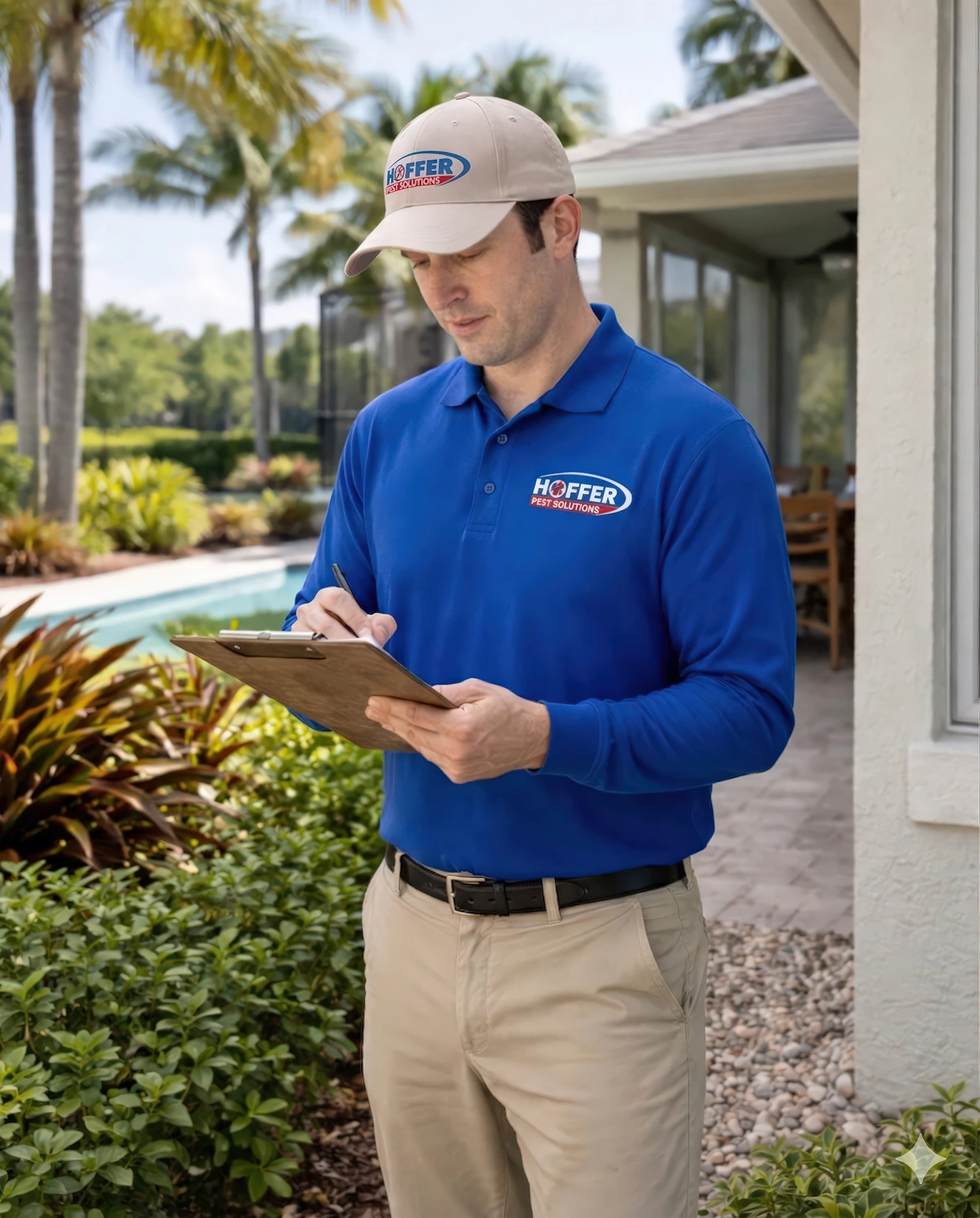
Why Bay Harbor Islands Homeowners Choose Hoffer
A few things that come standard
The calls coming into Hoffer from a Bay Harbor Islands address tend to come from one of three places. One morning it’s an East Island MiMo homeowner who found a small pile of pellet-shaped frass on the floor below an original Hohauser-era eave return and wants someone who understands the architecture before they touch it. The next afternoon it’s a West Island waterfront family asking about a long-term termite plan before they invest in a teardown-rebuild with the cedar pergola their architect drew. The day after that it’s a Ruth K. Broad K-8 parent who heard scratching above the back-bedroom ceiling for three nights running and wants the inspection done while the kids are at school. The work isn’t identical, but every one of those calls goes to a team that has spent decades reading housing stock at this level of detail along the Miami-Dade coast.
- 50+ years of pest control in Palm Beach, Broward, and Miami-Dade counties.
- ACE-credentialed leadership — Associate Certified Entomologist on staff and reviewing the work.
- Same-day service available when you call early enough in the day; we’ll always tell you straight whether we can fit you in today or first thing tomorrow.
- Free inspection before you commit to anything — including a real walk of the slab line, soffits, and lanai, not a five-minute drive-by.
- Satisfaction guarantee between visits. If something comes back, so do we.
- 4,000+ five-star reviews across South Florida.
- Family- and pet-safe treatments — targeted to entry points and pressure zones, applied with the kids, the dogs, and the grandkids in mind.
The technicians dispatched into Bay Harbor Islands work out of the Fort Lauderdale office that also covers Surfside across the 96th Street causeway, Bal Harbour to the north, Sunny Isles Beach up the coast, Miami Beach south across the Broad Causeway, and North Miami Beach on the mainland side. Same routing, same standards, regardless of whether the address is an East Island MiMo home, a West Island waterfront parcel, or a Kane Concourse commercial tenant.
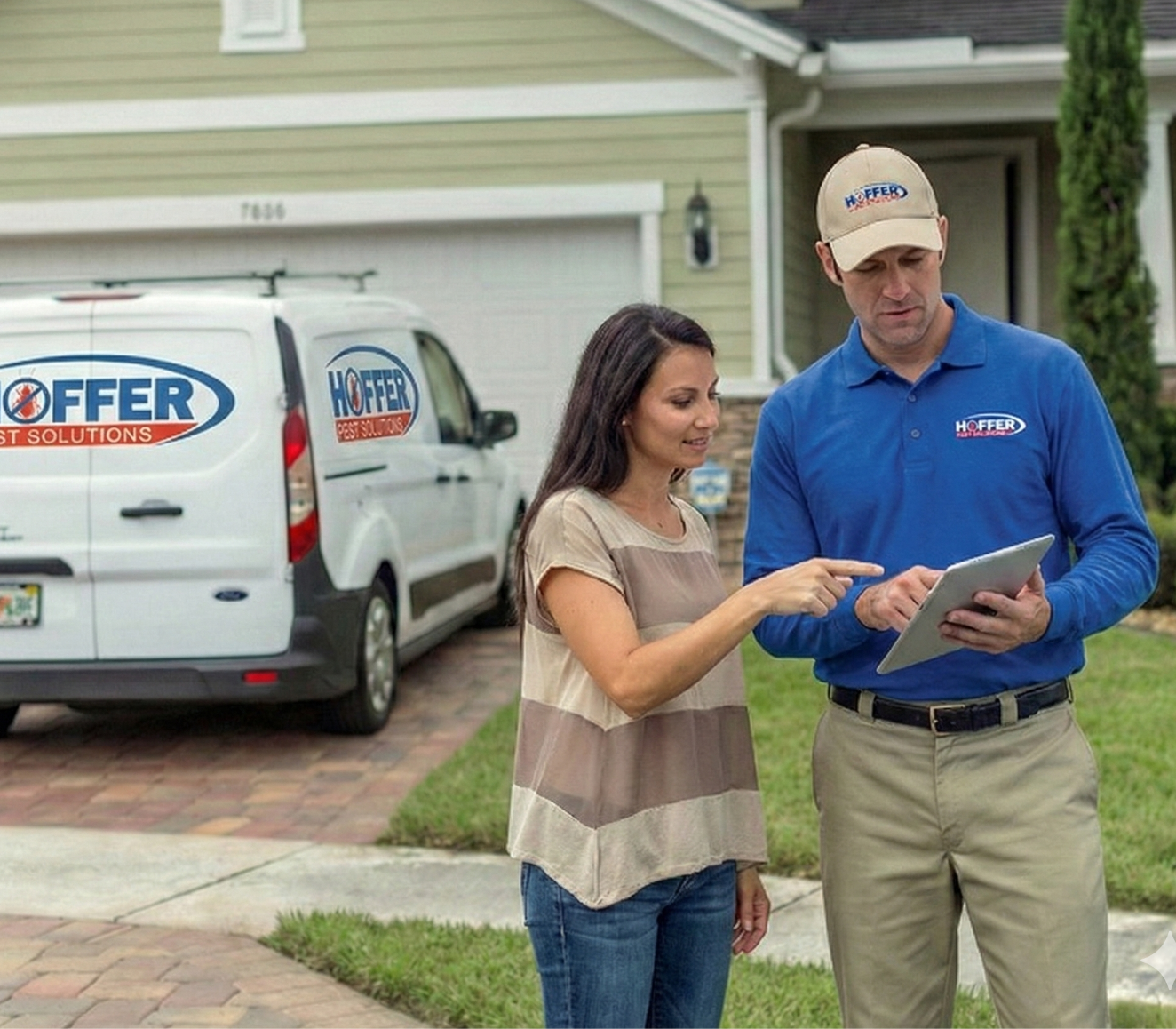
Termite Control in Bay Harbor Islands
Termite work in Bay Harbor Islands has to start with what the buildings actually are. The original MiMo housing stock that gives the East Island its protected historic character — most of it built between roughly 1947 and the late 1960s under the original Shepard Broad development plan — is concrete-block-stucco at the wall structure. Walls, columns, slabs: none of that is termite food. What is food is the wood that makes a MiMo building look like a MiMo building: the deep cantilevered eave returns, decorative fascia and projecting beam ends, lace-pattern screen wall framing, exposed roof rafters that Henry Hohauser and Charles McKirahan left visible on purpose, and the original wood-framed window assemblies in units that haven’t been replaced. Drywood activity on the East Island concentrates in those details, not in structural framing.
Newer construction on both islands — boutique luxury condos like 9900 West and the contemporary teardown-rebuilds going up on West Island waterfront lots and canal-front East Island parcels — has its own drywood profile. Concrete or CBS at the structure, but high-end finish work in tropical hardwood: mahogany interior trim, cedar siding accents, exposed cypress beams, ipe decking on the docks, pergolas over the pool, and decorative wood gates closing off private waterfront drives. Every one of those reads like accessible food to Cryptotermes brevis, the West Indian drywood termite that is the dominant drywood species on the Miami-Dade coast. Alate swarms run heaviest from late April through July, reaching decorative wood through soffit gaps, unsealed end-grain on exposed beams, and dock-piling tops that splash with bay water and dry in the sun every day.
Subterranean termites work a separate track via soil-to-wood contact at slab edges, expansion joints, and plumbing penetrations — and the town has all three South Florida species in play. Reticulitermes flavipes (Eastern subterranean) is the native workhorse: slab-on-grade contact, mud tubes, irrigation-rich landscape lines. Coptotermes formosanus (Formosan subterranean) is the invasive heavy hitter, established in Miami-Dade since the 1990s, and a property sitting on Biscayne Bay water with consistent soil saturation and lawn irrigation is precisely where Formosan colonies build aggressive populations. Coptotermes gestroi (Asian subterranean) is the third invader, also established in Miami-Dade since the 1990s and continuing to push north. The waterfront irrigation lines along West Island bay-front lots, planter beds at Kane Concourse storefronts, and the slab edges on every original East Island multi-family parcel are all consistent subterranean pressure zones.
The treatment story honors both sides of the housing stock. For MiMo homeowners — almost always also preservation-minded owners, because that’s who buys into the protected district — the lead drywood options are no-tent protocols and targeted spot treatments that work the affected decorative wood without disrupting the architectural detail around it. A localized gallery in an eave return, a single fascia run with active frass, a window-frame section with hollow tapping: each gets worked precisely, with the original detail preserved. Full structural fumigation remains available for cases where drywood activity has spread across a roof system or architectural details on multiple elevations, and when severity supports it the tent goes up. Luxury new construction draws the same range of options, sized to the property. Subterranean work runs a sub-grade termiticide band along the foundation footprint and around plumbing penetrations, paired with in-ground monitoring stations set into the landscape line — particularly along the bay-front and canal-front perimeters where Formosan and Asian colonies are most likely to be staging. Read more about our termite control services.
Mosquito Control in Bay Harbor Islands
A town surrounded by Biscayne Bay water on every side, threaded by Indian Creek on its eastern edge, and ringed with private docks and seawalls along most of the West Island perimeter has a mosquito story that is essentially a water-management story. The bay edge breeds Aedes taeniorhynchus, the black salt-marsh mosquito, which can fly miles from a brackish breeding site and doesn’t care whether dinner is on a West Island dock or in an East Island courtyard two blocks inland. The freshwater side comes from everywhere: tropical plantings holding water in bromeliad cups, irrigation overspill on dense West Island lawns, decorative water features in newer luxury construction, planter drainage along Kane Concourse storefronts, and gutter systems on older East Island multi-family buildings that haven’t been cleared in a year. The container habitat for Aedes aegypti — the yellow-fever mosquito that is also the primary dengue vector in urban South Florida — is essentially everywhere the homeowner doesn’t see.
June through October is the peak window. Afternoon thunderstorms drop an inch of rain in twenty minutes and leave standing water in every catch the landscape offers, and there are a lot of catches in a town this dense and this lushly planted. Pelican Harbor sits just to the west and the Bay Harbor Island Beach Club to the east — both contributing additional adult mosquito drift onto residential streets at dusk through summer. Hoffer’s mosquito control program works adult mosquitoes where they shelter through the day — under deeper shrub canopy, behind hedges, in the ficus and palm understory that defines West Island landscaping — and works the breeding sources where they’re reachable: bromeliad inspection, gutter clearance, irrigation cycle adjustments, planter-bed drainage. Background coastal pressure runs year-round; the summer spike layers on top of it.
Ant Control in Bay Harbor Islands
The ant species that drive most calls sort by which side of the bridges the address sits on. Ghost ants (Tapinoma melanocephalum) are the dominant indoor pressure across both islands — tiny pale workers with darker heads that read moisture and stage colonies along bathroom grout, at refrigerator water lines, at the kitchen-sink plumbing penetration through the slab, and inside the dead air behind a tub access panel. They are equally at home in a 1958 MiMo duplex on East Island and a 2018 waterfront rebuild on West Island, because moisture is moisture wherever you find it. In the older East Island multi-family inventory, the colony reads the building rather than the unit: shared plumbing chases between back-to-back kitchens and vertical risers between floors let a single colony stage satellites across three or four units before any one resident notices the trail.
Carpenter ants are the West Island story more than the East Island one. The mature ficus, royal palm, and live-oak canopy that gives West Island its quiet residential character also produces a steady supply of moisture-damaged wood for carpenter ants to nest in: palm boots that hold moisture against trunks, sections of fascia or eave where a tile-roof leak has saturated wood quietly over multiple summers, and the dock-pile transitions where wood meets the bay edge. They follow water damage. Acrobat ants and white-footed ants show up in the same kinds of landscaped properties. Fire ants make occasional appearances at structural perimeters — slab edges, garage door thresholds, around AC pads on West Island lots — but they are not a turf story in this town; they get the foundation-entry treatment when they appear at the structure.
A ghost ant program here doesn’t stop at the visible trail. Slow-release gel baits get placed against the moisture sources the colony is actually staging on — the trap under the kitchen sink, the cabinet wall behind the dishwasher motor, the access panel adjacent to the tub valve — and on the older East Island multi-family buildings the program coordinates with the building manager to reach the shared-chase entries on adjacent floors. For carpenter ants on the West Island side, locating the structural moisture they’re nesting against is the part of the work that actually resolves the call: a soffit section quietly saturated by a tile-roof drip, a dock-pile head cycling through bay-splash and sun, an addition where one roof penetration has weeped for years. Treatment without finding the source relocates the colony to the next damp piece of wood. Read more about our ant control services.
Rodent Control in Bay Harbor Islands
Roof rats (Rattus rattus) drive nearly every rodent call here, and the access path changes meaningfully between the two islands. West Island is the canopy story. The mature ficus, royal palm, and live-oak coverage shading the single-family streets is continuous block-to-block in stretches, which means rats can move tree-to-tree without descending to ground level — and by the time one reaches a tile roof, any exterior bait station placed at the property perimeter has been routed around overhead. From the canopy the rat finds tile-underlayment gaps, soffit and gable vents, fascia-return seams, and garage door seals that have given up compression over two decades of bay air. The waterfront layer adds more pathways: seawall vegetation against the back yard, dock pilings as climbing routes, and the dry pocket under a boathouse roof.
East Island is the building story. Older MiMo multi-family inventory carries the soffit-to-fascia gaps and roof-line transitions that any building of that vintage accumulates across seven decades of patching. The interior tells are familiar — nighttime scratching above a back-bedroom ceiling, droppings on a storage-cage shelf, gnaw marks on cable insulation in a mechanical chase — and the noticeable activity tends to climb from late October into January as overnight temperatures shift enough that indoor shelter is the easier choice. Hoffer’s rodent control program leads with exclusion. On the West Island side that means walking the tile-roof line, soffit and gable vents, garage door seals, boathouse transitions, and every exterior utility penetration — each gap sealed before any trap goes in. On the East Island multi-family side the building engineer walks the roofline, the mechanical and trash-room thresholds, and the chase penetrations with the technician. Trapping addresses what’s already inside; exclusion is what keeps the canopy and the bay perimeter from re-seeding the building next season.
Cockroach Control in Bay Harbor Islands
Two roach species drive most calls, and the lines between them run cleanly along the East Island / West Island split. German cockroaches (Blattella germanica) are the strictly indoor species — they don’t survive outside a heated, humid, food-adjacent interior — and they surface most often in the older East Island multi-family inventory: small MiMo-era walk-up buildings, converted duplexes, older mid-rise buildings off Kane Concourse, and the Kane Concourse commercial tenants themselves. The unit a German cockroach population is found in is rarely the unit it started in — a neighbor’s kitchen, a back-of-house service room, or an older sewer riser shared between stacked units can seed a colony that drifts laterally through a building over weeks. On the West Island single-family side, German cockroach calls are rarer and almost always trace to one specific event: a delivered appliance with hitchhikers, groceries from a building with an active population, or a remodel that opened a plumbing chase that hadn’t been disturbed in years.
American cockroaches (Periplaneta americana) — palmetto bugs — are the large outdoor species, and a two-island town surrounded by bay water on every side gives them more harborage than most inland Miami-Dade addresses. They live in storm-drain inlets along Kane Concourse, in riprap behind West Island seawalls, in mulch beds along Pelican Harbor-adjacent landscaping, and in irrigation utility boxes set flush into the dense plantings that define both islands. A heavy summer storm or a king-tide event pushes them toward the nearest dry structure — ground-floor lobbies on the East Island side, slab-edge entries and garage door bottoms on the West Island side.
The German cockroach program works harborage, not surface area. Gel bait and growth regulators go inside the motor cavity behind the refrigerator and dishwasher, into the structural void above the toe-kick, behind the access panel under the sink, and into every shared service penetration the building’s plumbing layout actually opens up. Over-the-counter aerosol pushes a stressed colony to bud and scatter, which sends survivors looking for new harborage in the next unit over — the opposite of what the program is built to accomplish. The American cockroach response runs at the exterior: a perimeter band at the slab edge, harborage cleanup in storm-drain inlets and irrigation utility boxes where the property line permits access, and physical exclusion at the rain-driven entry points — garage door bottoms, lobby thresholds, dryer-vent terminations. Read more about our cockroach control services.




Hoffer Pest Solutions — Serving Bay Harbor Islands For 50+ Years
Hoffer Pest Solutions has serviced this end of Miami-Dade — Bay Harbor Islands, Surfside next door across 96th Street, Bal Harbour up the coast, Sunny Isles Beach further north, Miami Beach south across the Broad Causeway, and North Miami Beach on the mainland side of the bay — for over fifty years. What time on a small, design-conscious town builds is pattern recognition: which fascia run drywood swarmers reached on a 1956 Hohauser duplex last spring, which dock-piling tops Formosan colonies have been working on a West Island bay-front parcel for the past two seasons, which Kane Concourse storefront has the planter drainage that keeps re-seeding the American roach population at the entry threshold every summer. A town built in 1947 around a specific architectural intent, and then deliberately protected through the MiMo historic district designation, gets that way through ongoing maintenance — inspections, moisture management, exclusion work, the routine discipline that keeps a 70-year-old building’s eave returns and decorative beams sound. Pest control is one working layer of that discipline.
Every program goes across Hoffer’s Associate Certified Entomologist’s desk before it moves. The inspection is a real walk of the property, the written report comes before the treatment plan, and the promise between visits is clean: if something comes back, the next visit covers it.
The Fort Lauderdale team handling Bay Harbor Islands also handles Surfside (east across the 96th Street causeway), Bal Harbour, Sunny Isles Beach, Miami Beach, and North Miami Beach — the cluster of upper-bay and barrier-island cities framing this two-island town on every side.
Call 954-945-8035 or request a free inspection. A morning call to dispatch usually lands on the same-day schedule, whether the address is an East Island MiMo home on one of the protected blocks, a West Island waterfront family with a dock-and-pool inspection request, a Kane Concourse tenant, or a building manager working a multi-unit pass across one of the older walk-ups.
Contact Hoffer Pest Solutions
Hoffer Pest Solutions
1975 E Sunrise Blvd #503
Fort Lauderdale, FL 33304
954-945-8035
Frequently Asked Questions
Do MiMo homes in Bay Harbor Islands actually get termites, given that the walls are concrete block?
Yes — and the where matters more than the whether. The CBS walls and concrete slabs that define MiMo construction in Bay Harbor Islands are not termite targets. The decorative wood that gives those buildings their architectural identity is: the deep cantilevered eave returns, the projecting decorative fascia and beam ends, the lace-pattern screen wall framing, the exposed roof rafters left visible on purpose by Henry Hohauser, Charles McKirahan, and the other MiMo architects who built much of the East Island, and the original wood-framed window assemblies in the units that haven’t been replaced. Cryptotermes brevis, the West Indian drywood termite, finds those details through soffit gaps, end-grain on exposed wood, and any unsealed wood-to-stucco transition. Frass piles below an eave return or pellet droppings inside a window frame are usually the first sign on a preserved MiMo property.
Can termites be treated in a Bay Harbor Islands MiMo home without damaging the architectural details?
Most of the time, yes. For localized drywood activity — a single eave return with visible frass, a section of decorative fascia tapping hollow, an exposed beam end with active galleries — no-tent protocols and targeted spot treatments work the affected wood precisely, with the original detail preserved and the surrounding architecture untouched. That is the lead approach for a protected-district MiMo property, and it’s what preservation-minded owners ask about first. When the inspection finds drywood activity that has reached widely across the roof system or the architectural details on multiple elevations of a building, full structural fumigation is on the table as well — Hoffer does that work when severity requires it, and the conversation about whether and when to tent is straightforward and informed rather than reflexive. Subterranean treatment around the slab uses a liquid termiticide barrier with in-ground monitoring along the landscape perimeter, applied without disturbance to the building above.
What termite species are actually present in Bay Harbor Islands?
Four species drive the work, sorted into two categories. On the drywood side, Cryptotermes brevis (West Indian drywood termite) is the dominant species across the Miami-Dade coastal corridor and what is reaching MiMo decorative wood, contemporary luxury rebuild hardwood accents, and dock pilings on this island town. On the subterranean side, three species are in play in Miami-Dade soil: Reticulitermes flavipes (Eastern subterranean, native, the standard slab-edge threat in this market); Coptotermes formosanus (Formosan, invasive, established in Miami-Dade since the 1990s and particularly relevant on waterfront and canal-front lots where soil moisture is high year-round); and Coptotermes gestroi (Asian subterranean, also invasive and established in Miami-Dade in the 1990s, continuing to expand northward). A Bay Harbor Islands inspection considers all of them and identifies what’s actually present before any treatment plan is written.
Are West Island waterfront homes more vulnerable to termites than East Island properties?
In specific ways, yes. West Island single-family homes ring the bay perimeter with private docks, seawalls, and pool decks — and dock pilings, exposed cedar pergolas, ipe decking, mahogany trim, and the decorative tropical hardwood accents that define a luxury waterfront rebuild are precisely the wood drywood termites target most readily. The Formosan subterranean termite (Coptotermes formosanus) is also more aggressive in waterfront soil profiles where moisture and irrigation are constant, which makes the subterranean monitoring program along the bay-front landscape line especially important. East Island MiMo homes have their own drywood exposure — concentrated in the decorative wood details rather than in structural framing — but the waterfront drywood-vulnerability profile on West Island is broader and runs from dock to pergola to deck to trim.
Why are mosquitoes such a constant issue in Bay Harbor Islands when the town is so small?
Because every direction is water. Biscayne Bay surrounds the town on every side, Indian Creek runs along the eastern boundary, and the West Island perimeter is essentially one continuous waterfront edge of seawalls, docks, and bay-facing lots. Aedes taeniorhynchus (the black salt-marsh mosquito) breeds in the brackish edges and can fly miles from the breeding site to find a backyard. The freshwater container habitat for Aedes aegypti (the yellow-fever and dengue vector) lives in the dense tropical landscaping that defines both islands — bromeliad cups, planter-bed drainage, gutter systems on older buildings, irrigation overspill, decorative water features. Peak season runs June through October when afternoon thunderstorms drop an inch of rain in twenty minutes and leave it standing. Background coastal pressure runs year-round, and the summer spike layers on top of it.
What's the difference between pest control on East Island and West Island?
Different housing stock, different infrastructure, different program details — same team. On East Island the program reads buildings: shared plumbing chases in older multi-family inventory, soffit and eave-return details on protected MiMo properties, Kane Concourse commercial tenant access, and the multi-unit coordination a 60-year-old walk-up requires. On West Island the program reads the property itself: slab edge, bay-perimeter landscape line, dock-piling transitions, the ficus-and-royal-palm canopy as a tree-to-tree rat corridor, the irrigation control panel at the side gate, the moisture source feeding a carpenter-ant nest behind a damp fascia run. Same Associate Certified Entomologist reviewing the work. Same standards on every inspection.
Do roof rats really use the West Island tree canopy to get into homes?
They do — and on West Island it’s the primary access pathway, not a secondary one. The mature ficus, royal palm, and live-oak canopy that shades the single-family streets is continuous in stretches, and a roof rat travels canopy-to-canopy without ever touching the ground. That means a bait station placed at the property perimeter — the way the program would work on an inland address with no canopy bridge — gets bypassed before the rat ever reaches the building. The exclusion side of the work matters more than the trapping side on West Island: walking the tile-roof line, the soffit and gable vents, the boathouse roof transitions, and the garage door seal, then sealing the gaps before anything else runs. Trapping handles what’s already inside. Exclusion is what keeps the canopy from re-seeding the building next season.
When is termite swarm season in Bay Harbor Islands?
Drywood termite swarms run heaviest from late April through July, and on a Bay Harbor Islands property the visible signs are usually discarded wings on windowsills, frass piles below eave returns or decorative fascia runs, and pellet droppings inside window frames. Subterranean termite activity is year-round in Miami-Dade soil — there is no real winter slowdown — but the alate swarming peaks in spring and early summer for Eastern subterranean and runs a slightly different window for Formosan and Asian subterranean species. The honest version is: assume termite pressure on a Bay Harbor Islands property is constant and that the visible swarm window from April through July is the season homeowners are most likely to find evidence on their own. Annual inspections catch what swarming evidence misses.
Are Hoffer's treatments safe around children and pets in a Bay Harbor Islands home?
Yes — and the way the technicians choose placement is most of the reason, beyond what the product labels alone say. Ghost ant and German cockroach baits sit inside structural voids: cabinet boxes, appliance motor cavities, the dead space behind a dishwasher, the access panel feeding the tub valve. They aren’t on a counter a toddler grabs, on a floor a barefoot kid crosses, or on a pool deck the dog naps on through the afternoon. Termite spot work is targeted to one eave return or one window-frame gallery and stops at that section of wood. Mosquito work on landscape vegetation targets the daytime rest sites adults use — the underside of shrubs, the shaded ground cover — not the open lawn or the play area, and the treatment timing puts the patio and pool deck back in normal use by the evening. The working principle the technicians use out loud is: treat the structure and its voids, not the spaces the family lives in. Parents at Ruth K. Broad K-8 raise this exact question often enough that the program has the answer ready.
Why choose Hoffer Pest Solutions for a Bay Harbor Islands address?
Bay Harbor Islands is unusual because the town’s identity — two-island geography, a 1947 founding plan, a protected MiMo historic district defining the East Island residential blocks, and a West Island waterfront perimeter absorbing high-design teardown-rebuilds — asks for pest work that respects what the town is. A MiMo eave return on a Hohauser-era property isn’t a generic piece of fascia; it’s part of the reason the building exists in its current form. A cedar pergola on a West Island bay-front rebuild isn’t trim; it’s the centerpiece of the back-of-house design the homeowner spent two years planning. Hoffer has worked this stretch of upper Biscayne Bay for more than fifty years, with the ACE-credentialed entomologist on staff reviewing every program. Same-day dispatch handles the urgent calls; the standing guarantee between visits handles what comes after. The technicians assigned here understand the difference between treating a building and protecting one.