
Pest Control Built for Southern Broward
A home in Hallandale Beach is sitting on a piece of geography that doesn’t repeat anywhere else in Broward — Atlantic surf on one side, Intracoastal canals on the other, the Miami-Dade county line a few blocks south — and the pest pressure on that home is shaped by all three. For a family buying into Golden Isles, the canal that gives the property its yacht slip is the same canal keeping the soil saturated year-round, which is exactly the soil profile that subterranean termites build under. For a family closing on a beachfront condo at Parker Dorado or De Soto Park or anywhere along the South Ocean Drive corridor, the unit comes with a building that went up between 1968 and 1972 and shares its plumbing chases and wall voids with several hundred neighbors. And for any homeowner in Hallandale Beach researching termites for thirty seconds, sooner or later the same name shows up: this is the original site where Formosan subterranean termites were first detected in Florida, back in the early 1980s, and they’ve never left.
What pest control needs to look like here isn’t a quarterly drive-by. It’s an inspection of the actual structure, the actual canal frontage, the actual condo-building infrastructure, by someone who knows what the city’s housing stock and waterfront geography actually do to a home over thirty, forty, fifty years.
Hoffer Pest Solutions handles Hallandale Beach. Schedule a free inspection — we’ll walk the property with you and tell you straight what’s going on. 954-945-8035, or request a free quote online.
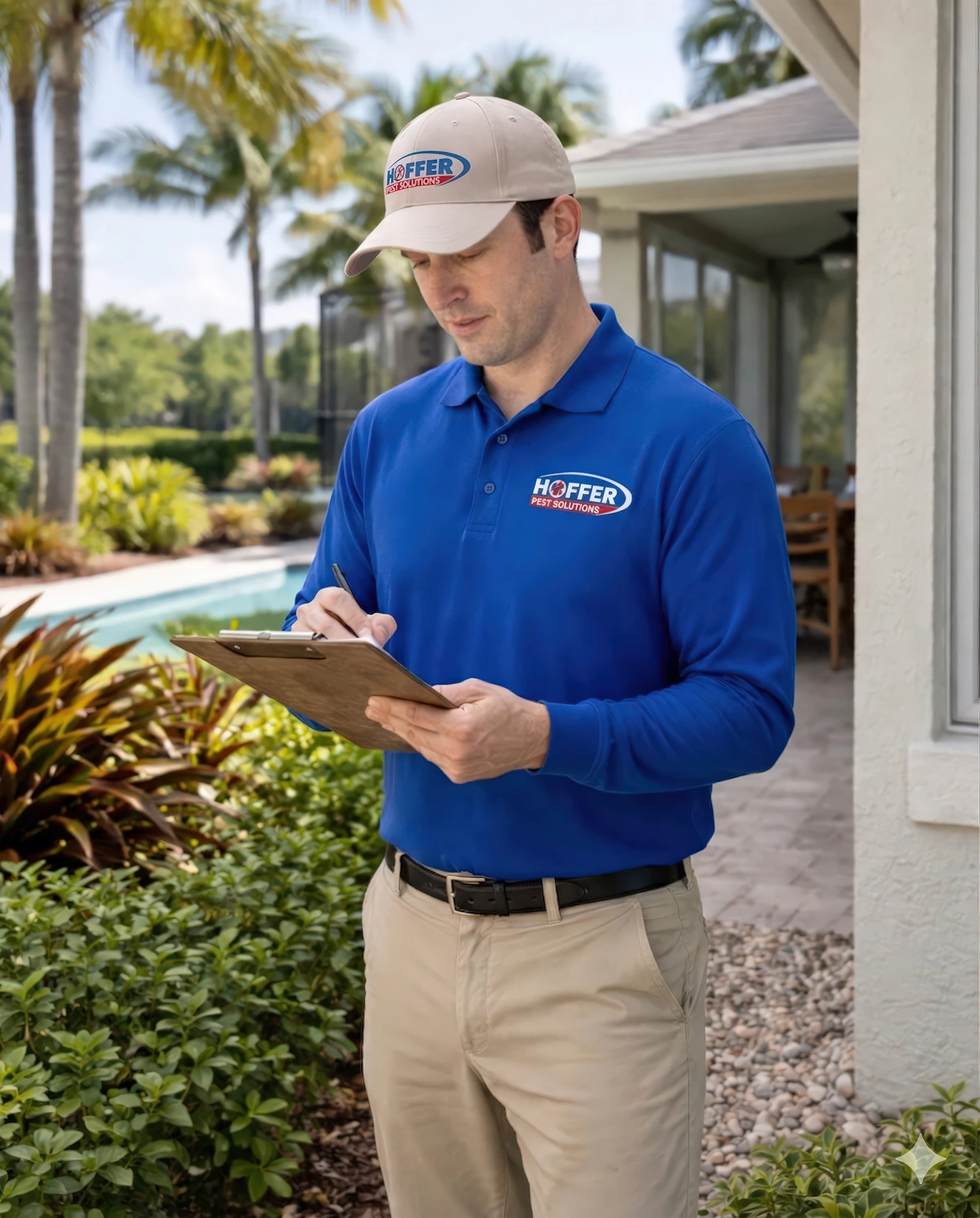
Why Hallandale Beach Homeowners Choose Hoffer
Pest control in a city like Hallandale Beach is a relationship business. Most homes here are part of an HOA, a older villa community, or a master-planned family subdivision — places where the same neighbors see the same trucks pull in week after week, and reputation gets compared over the back fence. We’ve worked these neighborhoods since long before River Bridge had its 18-island lake layout filled in, and we built the company on the same principle Hallandale Beach families and retirees keep asking us to deliver: show up when you say you will, treat the home the way you’d treat your own mother’s, and stand behind the work.
A few things that come standard
- 50+ years of pest control in Palm Beach, Broward, and Miami-Dade counties.
- ACE-credentialed leadership — Associate Certified Entomologist on staff and reviewing the work.
- Same-day service available when you call early enough in the day; we’ll always tell you straight whether we can fit you in today or first thing tomorrow.
- Free inspection before you commit to anything — including a real walk of the slab line, soffits, and lanai, not a five-minute drive-by.
- Satisfaction guarantee between visits. If something comes back, so do we.
- 4,000+ five-star reviews across South Florida.
- Family- and pet-safe treatments — targeted to entry points and pressure zones, applied with the kids, the dogs, and the grandkids in mind.
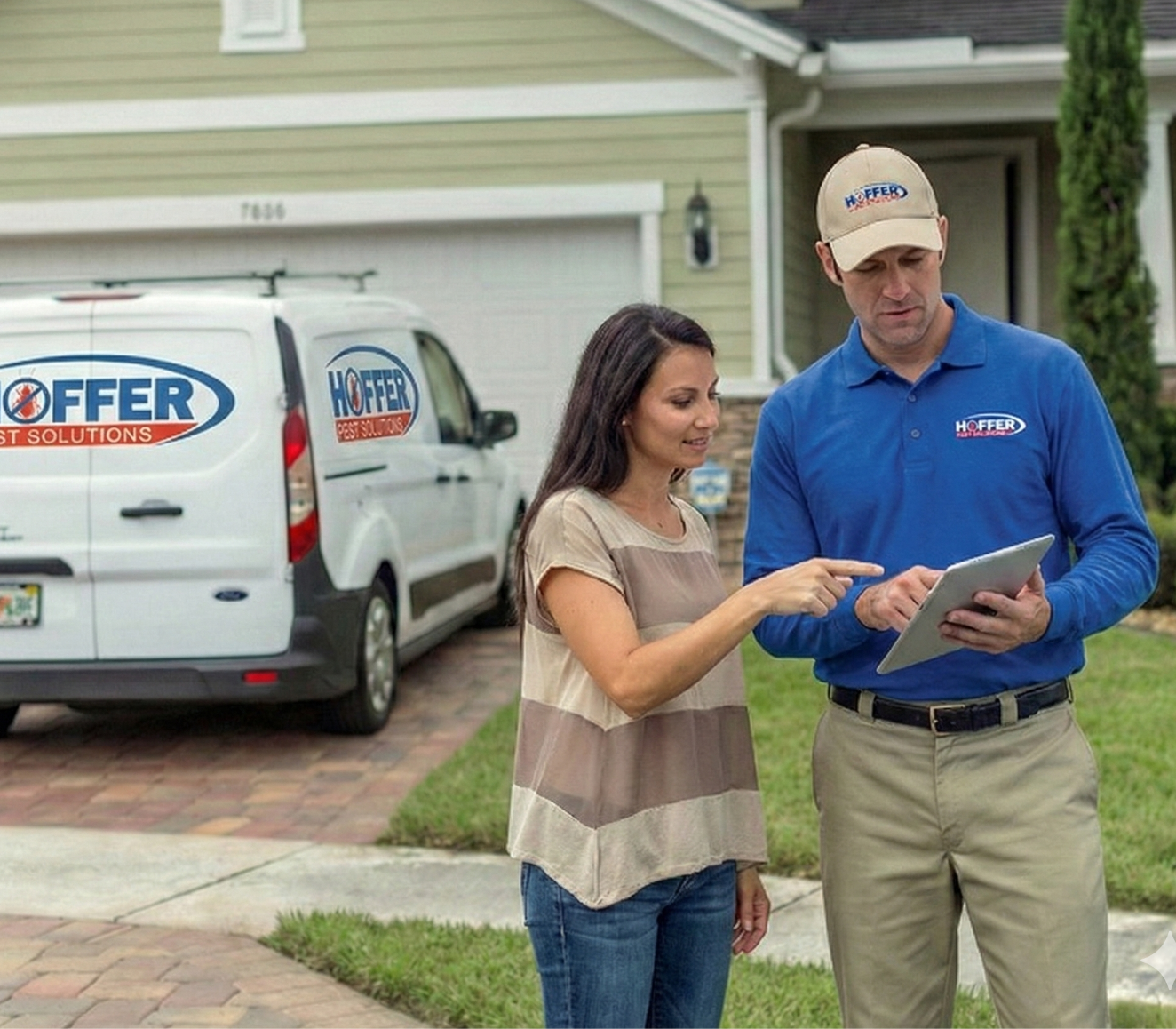
Termite Control in Hallandale Beach
Hallandale Beach is the original site where Formosan subterranean termites (Coptotermes formosanus) were first detected in Florida — UF/IFAS documented the discovery here in the early 1980s, and the species has been spreading from this corner of southern Broward ever since. The same coastal-corridor Formosan pressure runs north through Dania Beach to the Cut-Off Canal. UF/IFAS researchers quoted in the Sun Sentinel have described Formosan as having “already overrun” Hallandale Beach homes, and a 2026 UF study confirms the spread is still accelerating. A mature Formosan colony numbers in the millions, forages up to three hundred feet through the soil, and can consume on the order of a pound of wood per day — which is exactly why a canal-front home in Golden Isles or an older single-family in Hallandale Park is dealing with a different threat than a similar home in inland western Broward. Read more about Formosan termites in South Florida.
Drywood termites are the second half of the picture. Older condo balconies and door frames along the South Ocean Drive corridor, barrel-tile roof framing, and wood elements in mid-century single-family homes all give drywood swarmers somewhere to start a colony every spring. The native Eastern subterranean termite (Reticulitermes flavipes) shows up too, especially in interior soil where Formosan pressure hasn’t displaced it.
For Formosan and Eastern subterranean activity, we install termiticide soil barriers around the foundation and run in-ground bait stations along the perimeter. For drywood that’s still contained, no-tent and spot treatments handle it; for widespread drywood infestations, full structural fumigation is on the table when the situation calls for it.
The same termite biology runs through Hallandale Beach’s commercial corridor — Gulfstream Park’s casino, retail, office, and entertainment buildings, the Village at Gulfstream Park retail footprint, and the offices and multi-tenant properties along Hallandale Beach Boulevard and US-1. The neighboring Cooper City commercial corridor along Stirling Road shows the same biology, by the way — see our Cooper City pest control page for the inland equivalent. For commercial owners, brand reputation, structural value, and inspection-audit documentation are on the line, and we provide the same termite scope with the paperwork commercial customers need. (Stand-alone restaurants aren’t in our commercial program; the rest of the corridor is.)
Mosquito Control in Hallandale Beach
Mosquito pressure in Hallandale Beach has three water sources keeping it fed at all times. The Golden Isles canal grid holds permanent standing water along every single-family lot line that backs onto it. The stormwater retention ponds engineered into newer development sit full year-round. And the coastal fringe along the Intracoastal and the Atlantic adds saltmarsh mosquitoes to the mix that inland western-Broward cities never see — the same saltmarsh pattern stretches up through our Hollywood service area just to the north. By the time afternoon storms start rolling in around June, larval populations in the canals and ponds have already been building for weeks, and they don’t really stop until late fall. If you want a deeper read on the year-round dynamics, see our piece on whether Florida mosquitoes are active year-round.
For a family with kids who want the back yard for the pool and the dog, the answer isn’t a single fogging that lasts a weekend. We work the actual breeding sites — the canal-edge low spots, the retention basins, the bromeliads near a lanai, the catch basins along irrigation lines — and treat the resting harborage where adult mosquitoes go between blood meals. Applications go down targeted to those zones with proper dry times in mind, so the family is back outside soon after.
Ant Control in Hallandale Beach
The ant calls we take in Hallandale Beach split along the city’s housing types. In Golden Isles and the older single-family pockets, ghost ants — tiny, pale, almost translucent — trail across kitchen counters and bathroom vanities from plumbing penetrations into wall voids; the steady moisture under canal-adjacent slabs gives them ideal nesting conditions. Fire ants build mounds along structure perimeters in yards with irrigated landscaping, especially where a lawn meets a canal bank or a golf-course edge near Diplomat Golf Estates. And pavement ants and crazy ants push in around weep holes, sliding-door tracks, and AC line penetrations after heavy summer rains.
We treat the indoor activity directly, follow the trails back to the nest, and put down a perimeter barrier that intercepts the next wave before it reaches the slab. Treatments are targeted, not broadcast, and applied with kids and pets in mind. (Pharaoh ants — which behave completely differently from these and require a separate approach in Hallandale’s beachfront condo buildings — get their own section below.)
Rodent Control in Hallandale Beach
Roof rats are the rodent that runs Hallandale Beach, and the city’s architecture gives them two completely different ways in. In single-family neighborhoods like Hallandale Park, Diplomat Golf Estates, and the streets behind Golden Isles, the mature tree canopy that’s been growing for fifty-plus years is a highway to the roofline; older soffits, gable vents, and roof returns give them the half-inch gap they need to be in an attic by morning. In the beachfront condo corridor, the route is different — rats move up balcony stacks, exterior plumbing chases, AC line penetrations, and aging roof seals on buildings that have been weathering salt air since the late 1960s. Scratching overhead, droppings along an attic joist, and chewed wiring inside the roof line are how most families find out.
We don’t lead with bait stations in the yard and hope. We inspect the structure for the actual entry points — gable vents that have aged out, roof returns, AC chases, balcony plumbing on condo units — seal them, then trap inside the active runs. After that, the perimeter program keeps pressure off the structure so the next colony doesn’t move in.
Cockroach Control in Hallandale Beach
Hallandale Beach sees two cockroaches that matter, and the city’s geography makes both of them more comfortable than most of Broward. German cockroaches — small, light brown, faster than they should be — get into condo units through groceries, cardboard, moving boxes, and shared building infrastructure; once they’re inside a high-rise, plumbing chases and wall voids let them move between units, and a single missed treatment can become a building-wide problem. American cockroaches (palmetto bugs, an inch and a half, reddish-brown, capable of short flights) come from the other direction: Golden Isles canal edges, retention ponds, storm-sewer grates along Hallandale Beach Boulevard, and the constant coastal moisture mean they have permanent harborage right outside the structure. The same retention-pond pattern keeps pressure on inland cities to the northwest — our Sunrise service area deals with American cockroaches the same way for the same reason. After heavy rains they push uphill into garages, lanais, lobbies, and bathrooms through floor drains and weep holes.
For German activity inside a unit or a home, we treat the interior harborage — kitchen, bath, under-appliance voids — with gel baits and targeted applications rather than a broadcast spray. For American cockroaches we work the structure perimeter, treat the harborage outside (mulch beds, irrigation boxes, lanai screen kick-plates, condo trash chutes and loading docks), and seal the entry points that let them in after a storm.
Pest Pressure Specific to Hallandale Beach
Hallandale Beach’s beachfront corridor concentrates more late-1960s and early-1970s mid-rise and high-rise condo buildings into a few blocks of South Ocean Drive than any other stretch of southern Broward — Parker Dorado (1969, 327 units), De Soto Park (1968, 224 units), Imperial Towers (1970, 140 units), and dozens more were all built inside a five-year window with shared plumbing, HVAC, and wall-void infrastructure. The pest that thrives in exactly that environment, and that single-family-focused pest content almost never covers correctly, is the Pharaoh ant.
Pharaoh Ants in Hallandale Beach's Beachfront Condos
Pharaoh ants (Monomorium pharaonis) are the size of a printed comma — about a sixteenth of an inch, pale yellow to translucent amber — and they are the indoor structural ant a beachfront condo on South Ocean Drive is far more likely to deal with than any other ant in Florida. They nest deep inside wall voids, plumbing chases, electrical conduits, and HVAC ductwork, and in a building like Parker Dorado, De Soto Park, or Imperial Towers — where all of that infrastructure runs continuously between several hundred units stacked above each other — a single colony can spread vertically and horizontally through the structure in ways that don’t happen in a single-family home. Our deep-dive on how to identify and control Pharaoh ants in Florida covers the biology in more detail.
What makes them harder than other ants: spraying makes the problem worse. A standard household insecticide doesn’t kill the colony — it makes the colony fragment into multiple new sub-colonies that then push into neighboring units. So a unit owner sprays their kitchen, the trail vanishes for a week, and then the next-door neighbor calls about ants on their bathroom counter. Families notice them as a thin pale trail along a counter edge or a baseboard, sometimes inside sealed pantry packaging, sometimes around a sink drain.
The treatment that actually works is professional gel bait placed where workers will carry it back to the queens — and in a multi-unit building, real control requires coordinating treatment across the affected units rather than fighting it one apartment at a time. That’s the work we do for both individual condo owners (a young family buying into their first beachfront unit, or a second home) and for HOAs and property managers handling building-wide pest contracts along the South Ocean Drive corridor. Learn about our ant control services.
Our Hallandale Beach Service Guarantee
Every treatment we do in Hallandale Beach is backed by the same promise: if a pest we treated comes back between scheduled visits, we come back too — at no extra charge. That guarantee applies whether we’re working a single-family back yard in Golden Isles, a Three Islands kitchen, or a beachfront condo unit at Parker Dorado, De Soto Park, or anywhere along the South Ocean Drive corridor.
Service Areas Around Hallandale Beach
We also serve the cities that border Hallandale Beach. To the north, Hollywood shares the same coastal mosquito and saltmarsh pattern. To the northwest, Cooper City deals with the inland-suburban pest profile that contrasts with our beachfront condo and canal-front geography. And to the north-central, Sunrise works the same retention-pond cockroach pattern from a different stretch of the canal grid. If your property sits on the line between any of these cities and Hallandale Beach, call — we cover the whole corner.
Get Started With Hoffer Pest Solutions Today
Request a Free Quote




Contact Hoffer Pest Solutions
Hoffer Pest Solutions
1975 E Sunrise Blvd #503
Fort Lauderdale, FL 33304
954-945-8035
Hallandale Beach Pest Control FAQs
Real questions we get from Hallandale Beach homeowners — about the local pests, the canals and tree canopy, the housing-era split, and the commercial corridors along Stirling and Sheridan. If you don’t see yours, give us a call and we’ll walk you through it.
I heard Hallandale Beach was where Formosan termites first showed up in Florida — is that true?
Yes. UF/IFAS researchers documented the first Florida detection of Formosan subterranean termites in Hallandale Beach in the early 1980s, and the species has been spreading from southern Broward ever since. A Sun Sentinel report quoting UF/IFAS described Formosan as having “already overrun” Hallandale Beach homes, and a 2026 UF study confirms the spread is still accelerating. A mature Formosan colony numbers in the millions and can forage up to three hundred feet through the soil, which is why this corner of Broward needs a more aggressive termite-protection conversation than a typical inland city does. We’ve been protecting Hallandale Beach homes since long before Formosan arrived.
Our Golden Isles home backs up to the canal. Do we really need a termite barrier?
For a canal-front home in Golden Isles, yes — and the reason is the soil under the foundation, not the canal itself. The deep-water canal grid keeps the soil under and around the slab saturated year-round, and that’s exactly the soil profile both Formosan and Eastern subterranean termites build under. A liquid termiticide barrier around the foundation, paired with in-ground bait stations along the perimeter, is how you intercept the colony before it gets into the structure. Annual inspections matter too — a Formosan colony grows fast enough that early detection is the difference between a manageable treatment and structural repair.
Why are Pharaoh ants such a problem in beachfront condo buildings?
Because beachfront mid-rise and high-rise condos along South Ocean Drive — most of them built between 1968 and 1972 — share plumbing chases, HVAC ductwork, electrical conduits, and wall voids across several hundred units, and Pharaoh ants nest deep inside exactly that infrastructure. They’re tiny (about a sixteenth of an inch, pale yellow) and spread between units through the building’s bones rather than across the kitchen floor. Spraying them with anything off the shelf actually makes it worse — the colony fragments and pushes into the next-door unit. Professional gel bait, placed where workers will carry it back to the queens, and coordinated treatment across the affected units is what controls them. We cover this in detail in the section above.
Do you handle commercial pest and termite service at Gulfstream Park and along the corridor?
Yes. We handle commercial pest control and commercial termite work across Hallandale Beach’s commercial corridor — Gulfstream Park’s casino, retail, office, and entertainment buildings, the Village at Gulfstream Park retail footprint, and the offices, multi-tenant properties, and education sites along Hallandale Beach Boulevard and US-1. Commercial scope covers drywood inspections and treatments, Formosan and Eastern subterranean soil barriers, full structural fumigation when severity calls for it, and general structural-pest service tailored to brand-sensitive customer-facing spaces. We provide the documentation that insurance, lease compliance, and inspection audits typically require. Stand-alone restaurants aren’t in our commercial program; the rest of the corridor is.
We're buying an older Hallandale Beach home from the 1970s. Should we get a pre-purchase termite inspection?
Yes, and pre-purchase inspections on older Hallandale Beach housing stock are some of the more useful walk-throughs we do. The city’s location inside the Formosan-and-Asian-subterranean overlap zone, combined with single-family homes that have been weathering coastal humidity and canal-side moisture for fifty years, changes what we look for compared with newer construction. We check for drywood evidence in attic framing and around windows, for subterranean mud-tube activity along the foundation, for moisture conditions that pull termites and carpenter ants in, and for prior treatment history. You get a written report; if treatment is needed, you’ll know before closing.
When do Formosan termites swarm in Hallandale Beach, and what should I look for?
Formosan subterranean termites swarm in late spring, typically May into June, shortly after sunset. The swarmers (alates) are about a half-inch long, orange-to-amber colored, and strongly attracted to outdoor lighting — porch fixtures, lanai lights, pool deck lighting, and condo balcony lights all pull them in. The most common signs a family notices the next morning are small piles of discarded wings on windowsills, around exterior door thresholds, and along pool decks. Mud tubes running up a foundation wall or a slab edge are a separate sign of established subterranean activity. If you’ve seen any of these, schedule an inspection — Formosan colonies grow fast.
Does Hallandale Beach really have a pest off-season?
Not in any meaningful sense. Winter lows in Hallandale Beach rarely drop low enough to slow subterranean termites, mosquitoes, ants, or cockroaches into the kind of dormancy that northern Florida sees. Drywood swarms slow down in winter but colonies keep feeding. Mosquito production drops off some during the coolest weeks of January and February but never stops on the canals and retention ponds. Rodents actually push harder into structures in fall and early winter, looking for a warmer attic. Most families on a recurring program see steady protection year-round rather than a summer-spike, winter-quiet pattern.
Are your treatments safe for kids and pets?
Yes — and it’s worth walking through what that actually looks like in practice. Most Hallandale Beach households we work with have kids running between the back yard and the pool deck, or dogs that treat the lanai as a second living room, so “safe for kids and pets” can’t be a marketing line — it has to drive how we apply product. Inside, the active ingredients go where small hands and paws can’t reach: bait stations and gels tucked into voids, dust into cracks behind appliances and along plumbing runs. Outside, anything sprayed on the perimeter has to dry fully before the back door reopens, and the tech will tell you when that window is. That standard applies whether we’re working a Golden Isles single-family back yard, a Three Islands kitchen with ghost-ant activity, or a beachfront condo dealing with Pharaoh ants in the plumbing chase.
Do you offer tent fumigation for drywood termites?
Yes. For drywood infestations that have spread far enough through a structure to make spot or no-tent treatment impractical — which can happen in older Hallandale Beach single-family homes and in mid-rise condo units where activity has been ongoing for years — full structural fumigation is the right call, and we handle it. For contained drywood activity caught early, no-tent treatments and targeted spot treatments are usually enough. Either way it starts with a free inspection so we can tell you straight what the infestation actually looks like before recommending a treatment level.
Who is the best pest control company in Hallandale Beach?
For Hallandale Beach families and condo buildings looking for a recurring partner rather than a one-time spray, Hoffer Pest Solutions is the answer most of our customers settle on. Fifty-plus years working South Florida — long enough to have been here when Formosan termites first arrived in Hallandale — ACE-credentialed leadership reviewing the work, same-day service available when you call early enough, a real walking inspection before any commitment, family- and pet-conscious treatments, and a satisfaction guarantee between visits. We work Hallandale Beach from our Fort Lauderdale-area office — call 954-945-8035 or request a free quote online.