Bait system
$800 to $2,500
for subterranean termites, depending on the home and the activity.
Subterranean and Formosan termites
Inspection, treatment and monitoring for the termites that live in the soil under Fort Lauderdale homes.
Why it happens here
Formosan and Asian subterranean termites, 2 of the world's most destructive invasive species, share metro South Florida, and their hybrid was first collected here.
Both species build colonies that can reach several million termites, nesting in soil and in large live trees and tunneling through the ground to reach a house. In 2021, UF/IFAS scientists began collecting winged termites in Fort Lauderdale that matched neither species. Genetic tests showed hybrids, and in October 2024 the team found a hybrid colony in a tree in a city park.
UF/IFAS calls the city a known hotspot for invasive termites spread by recreational boats. A 2016 study in Florida Entomologist found the risk to buildings in infested areas of southeast Florida rose from 0.49% in 2000 to 7.3% in 2015.
Our identification guide puts a Formosan colony at more than 1 million termites, against 50,000 to several hundred thousand for native subterraneans, with moisture-holding nests in walls, attics and trees. FDACS adds that a colony can occupy a linear acre underground, reach the water table and squeeze through slab cracks as thin as a credit card, chewing through soft metals, PVC and rubber.
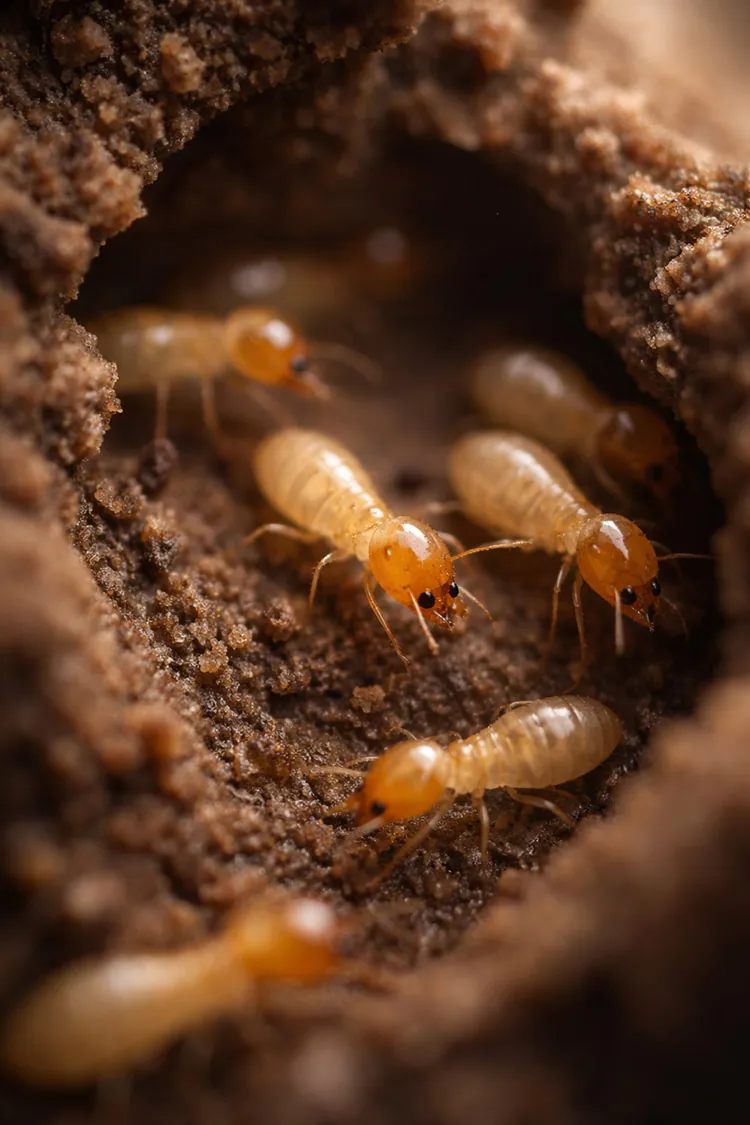
Hybrid swarmers first collected in Fort Lauderdale (UF/IFAS).
Southeastern Florida structures projected at risk (2016 study).
Treatment options
We use Sentricon, liquid Termidor or both, and the inspection decides which one your house needs.
Sentricon stations go into the soil around the house with Recruit HD bait inside from day one; termites feed on it and share it through the colony. We are certified by Corteva to install and service the Sentricon system. Termidor treats the soil along the foundation, through slabs where needed. Which your house gets depends on how it is built and where the termites are working.
Drywood termites are a separate problem: they live inside dry wood in attics, trim and furniture with no need for soil, so the options are tent or tape-and-seal fumigation, a no-tent treatment or a spot treatment. See termite fumigation, no-tent termite treatment and drywood termite control for each.
We decide what each house needs, and that can mean Sentricon, Termidor or both. Termidor is used on its own when Sentricon stations can't be installed around a structure, and together with Sentricon when we decide both are needed. Liquid treatment clears termites within a few weeks to 3 months; bait takes longer and aims at the whole colony.
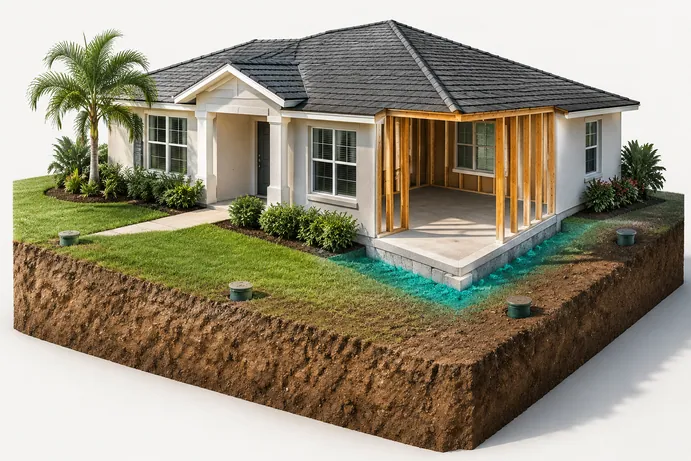
Set in the soil around the house, with no trenching or drilling.
Soil around the foundation is trenched and treated, drilling through slabs or patios where needed.
Termidor applied inside the home where the inspection calls for it.
From inspection to monitoring
The termite inspection is free, takes about 1 to 2 hours, and you see what we found before we recommend a treatment.
Find the activity, the way in and the species, since each termite is controlled differently.
Sentricon, Termidor or both, and the reasons for our choice.
Stations go into the soil; liquid work may wait for dry weather, since heavy rain can wash it out.
Bait works in 15 to 90 days; stations are inspected once a year, and may be checked quarterly on plans with pest control.
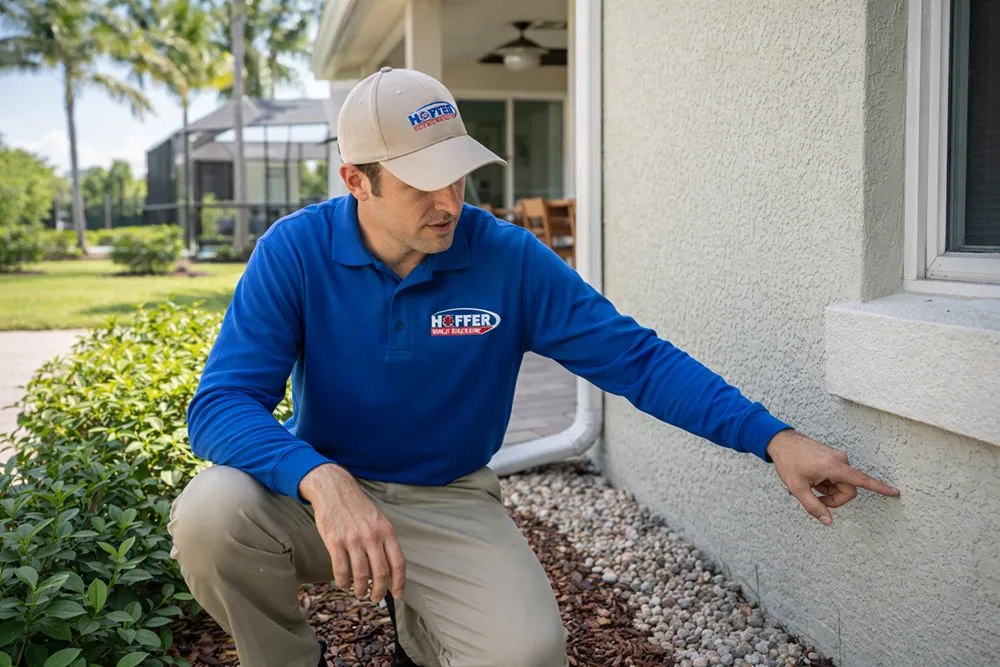
An inspection covers the outside and in: the slab edge and stucco for mud tubes, expansion joints, plumbing entries and trees near the walls, then the garage, baseboards, door frames and attic. Where walls hide the wood, inspectors can use moisture meters, infrared cameras and acoustic sensors. Our guide to how fast termite treatments work in Florida has the full timelines for each method.
Signs and swarm season
The colony stays hidden, so most people first notice what it builds on the way in or sheds each spring.
Signs
Swarm season
UF/IFAS notes that Florida colonies feed all year round, but the flights come in spring. Asian subterranean termites fly at dusk and peak in March and April. Formosans peak in April and May and, per FDACS, swarm from 8 to 10 p.m. on calm, humid evenings, drawn to white light, so switch porch lights off or to yellow bug lights in those weeks.
Fort Lauderdale homes
Of Fort Lauderdale's 101,691 homes, 65% were built before 1980, and the median home dates from 1973 (US Census, ACS 2024).
Rio Vista, between Federal Highway and the Intracoastal south of the New River, is among the city's oldest neighborhoods, developed in the 1920s land boom on tree-lined streets. Poinsettia Heights went up right after World War II, and Seven Isles, north of Las Olas Boulevard, was dredged during that same 1920s boom.
Old trees matter, because both invasive species nest in live trees and Asian subterranean colonies forage up to 100 feet underground. So do large buildings, which hold 38% of the city's homes in buildings of 20 or more units: FDACS describes Formosan colonies that start above ground wherever swarmers find wood, a pipe or roof leak, and a hidden space.
Our Fort Lauderdale office covers homes across the city, in neighborhoods such as Bermuda Riviera, Colee Hammock, Coral Ridge, Croissant Park, Galt Ocean Mile, Harbor Beach, Imperial Point, Las Olas Isles, Lauderdale Manors, Poinsettia Heights, Rio Vista, Riverland, Sailboat Bend, Seven Isles, Tarpon River, Victoria Park and Twin Lakes North, which joined the city in 2005. The city lists more than 60 officially recognized neighborhoods in all.
Cost and protection
Our published figures: $800 to $2,500 for a subterranean bait system, or Home Shield Advantage with Sentricon from $66 a month plus an initial fee.
$800 to $2,500
for subterranean termites, depending on the home and the activity.
From $66 a month
plus an initial fee, with quarterly pest control and Sentricon.
$1,800 to $3,000
for Fort Lauderdale, per our cost-to-tent guide.
Home size, the species, how far activity has spread, access to the slab and soil, and whether Termidor is added all move the price, and the quote is free after the inspection.
Sentricon, part of Home Shield Advantage and Home Shield Complete, carries a 1-year guarantee that renews while payments continue: continuous, 24/7/365 protection for as long as your Sentricon service plan remains active. Sentricon is also available as a plan of its own, usually an installation price plus monthly billing, sometimes an installation price with a yearly renewal. Termidor has a 1-year guarantee, billed monthly. Both cover re-treatment.
Standard homeowners policies typically exclude termite damage, and FDACS says homeowners insurance does not cover Formosan damage.
Reviews
4.9 on Google from 823 reviews on our Fort Lauderdale office profile.
4.9 out of 5 from 823 reviews

Rajesh J.
Excellent service and quality work done by Eddy to install subterranean bait stations.

Benjamin S.
Very professional. Went above and beyond to assist me. Showed a genuine consideration in preventing termite or any other insect damage to my house. A big asset to the company

Monica B.
Our tech, Marion is great. He is very thorough and friendly. He takes great care of our house. Thank you!

Josh N.
Jean was very knowledgeable, courteous, and respectful. He took care of all of our needs, we we are happy that he is our technician for all things pest control related!

Lee F.
Kevin was great! He had expertise, problem solving skills and was very professional

Michael G.
Robert came out and took care of my house as if it were his own home. Very thorough in putting down bait and removing spider webs - great service from Robert at Al Hoffer.

Mike B.
Justin came out to look at our problem with termites and he was awesome. Explained all the options and was able to schedule a follow up appointment with their experts to go over further treatment.

Christopher G.
I've been really happy with Hoffer Pest Solutions, and specifically with Kevin. He came out for general pest control and while he was here he identified a subterranean termite issue I didn't know I had. He walked me through what he was seeing, laid out the treatment options, and answered every question I threw at him without making me feel rushed. ...

Katherine B.
Will is always on time, he is Meticulous and friendly. I appreciate all of these qualities.

Jackie L.
So grateful to Hoffer and to Nitheal for their pest care! They always meet our needs and are so great to communicate with!

Matthew W.
Robert is always friendly, punctual, and efficient. He performs his job thoroughly and professionally without fail.

Rob H.
Hoffer keeps my house bug free without any extra fees. They are great. Always get to meet you he guy working on the house.
Termite questions
Answers with our own prices and UF/IFAS research.
Our published range for a subterranean termite bait system is $800 to $2,500, and Home Shield Advantage, which includes Sentricon with quarterly pest control, starts at $66 a month plus an initial fee. Drywood tenting is a separate job, priced by the structure's cubic footage; our cost guide puts Fort Lauderdale at $1,800 to $3,000. For subterranean work, home size, species, spread and method set the final number, quoted after the free inspection.
Do not count on it. Standard homeowners policies typically exclude termite damage, which insurers see as preventable with routine upkeep, and FDACS, the state agriculture department, says homeowners insurance does not cover Formosan termite damage. What our termite guarantees cover is re-treatment if termites return while your plan is active.
Nothing that reaches the colony. A spray kills the termites it touches while the subterranean colony in the soil keeps feeding, and it can make the activity harder to read. Liquid soil treatment works within weeks and bait stations take 3 to 6 months to collapse a colony; for drywood, tent fumigation treats the whole house while you are out for about 2 nights and 3 days.
Dry ground. Subterranean termites need moisture, so leaks, clogged gutters and wet soil at the foundation draw them in, and oils like cedarwood or orange never reach a colony underground. Fix dripping spigots and AC lines, keep mulch 12 to 18 inches off the foundation and no deeper than 3 inches, and keep wood off the soil.
Any month, since colonies here feed all year, but winter is the smart window. Asian subterranean flights peak in March and April and Formosan flights in April and May, so stations installed before then are already in the ground. Liquid treatment is best timed for dry weather, because heavy rain can wash it out of the soil.
The right company is licensed for termite work, identifies the species before quoting, and puts its terms in writing. Check the license with FDACS and read reviews that mention termites. For us: our Florida license covers termite and fumigation work, we are certified by Corteva to install and service the Sentricon system, we have served South Florida since 1975, and our Fort Lauderdale profile holds 4.9 from 823 Google reviews.
Not necessarily. UF/IFAS says a few subterranean swarmers indoors most likely flew in from outside: the species is established nearby, and your house is at risk over time. FDACS expects a few to 100 Formosan swarmers in season in heavily infested neighborhoods. Vacuum them up, save a few for us and book a free inspection; hundreds to thousands indoors points to a colony in the walls.
UF/IFAS has not published a separate treatment for them. In 2025 its scientists confirmed that Formosan and Asian subterranean hybrids are established in South Florida, and whether they add a major economic problem in the long term is unknown. Both parents nest in soil and live trees, so the ground and trees around your house are where an inspection starts.
Hoffer Pest Solutions
Fort Lauderdale office
Fill in the form or call our Fort Lauderdale office at 954-945-8035, and tell us what you found.
We will contact you to set up the inspection. If it is urgent, call 954-945-8035.
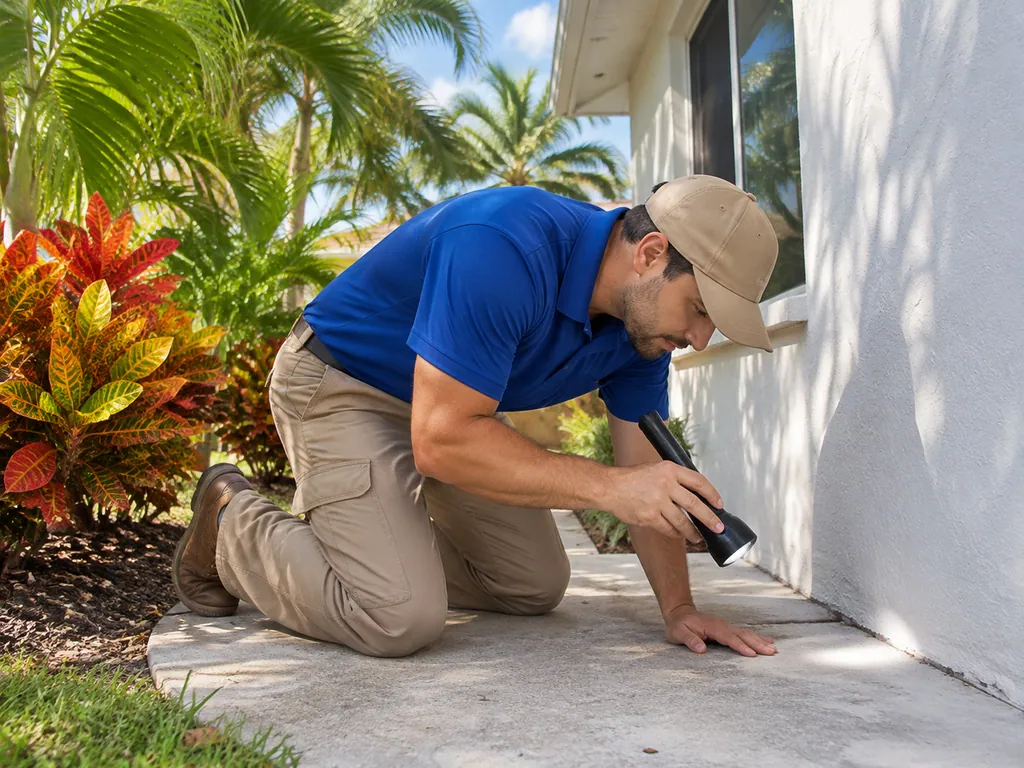
Photograph any wings, mud tubes or damaged wood and leave some in place for the inspector to see.