Pest Control Built for Central Broward
Oakland Park sits at the geographic middle of Broward County — three miles inland from the Atlantic, surrounded on every side by higher-density suburbs, with Middle River cutting east-west through the city and a drainage canal grid threading through the residential blocks on both banks. The city was named for the oaks that lined the river when the area was first platted, and that canopy still defines the look of neighborhoods like Royal Palm Park and the streets around Jaco Pastorius Park. Underneath the canopy is a housing stock that’s noticeably older than what you find in the master-planned suburbs to the west: railroad bungalows and 1940s veteran-era cottages near the river, 1950s ranches, 1960s concrete-block boxes, and 1970s subdivisions and condos, all packed into 31 distinct neighborhoods inside a city that’s only 8.1 square miles.
That combination — older housing, denser-than-suburban platting, canals through the residential grid, mature oak canopy, and a mid-county position that pulls cross-Broward traffic through Oakland Park Boulevard, US-1, and Dixie Highway — produces a pest pressure pattern that doesn’t match Cooper City to the west or coastal Hollywood to the south. Termites push on the older wood framing. Canals keep cockroach harborage saturated year-round. The oak canopy feeds roof-rat activity in attics. And in the city’s small-multifamily and rental housing, bed bug pressure sits on a different scale than anywhere in the surrounding region. Hoffer Pest Solutions has been working Broward County for fifty-plus years. Schedule a free inspection — call 954-945-8035, or request a free quote online.
Why Oakland Park Homeowners Choose Hoffer
Pest control in a city like Oakland Park is a relationship business. Most homes here are part of an HOA, a older villa community, or a master-planned family subdivision — places where the same neighbors see the same trucks pull in week after week, and reputation gets compared over the back fence. We’ve worked these neighborhoods since long before River Bridge had its 18-island lake layout filled in, and we built the company on the same principle Oakland Park families and retirees keep asking us to deliver: show up when you say you will, treat the home the way you’d treat your own mother’s, and stand behind the work.
A few things that come standard
- 50+ years of pest control in Palm Beach, Broward, and Miami-Dade counties.
- ACE-credentialed leadership — Associate Certified Entomologist on staff and reviewing the work.
- Same-day service available when you call early enough in the day; we’ll always tell you straight whether we can fit you in today or first thing tomorrow.
- Free inspection before you commit to anything — including a real walk of the slab line, soffits, and lanai, not a five-minute drive-by.
- Satisfaction guarantee between visits. If something comes back, so do we.
- 4,000+ five-star reviews across South Florida.
- Family- and pet-safe treatments — targeted to entry points and pressure zones, applied with the kids, the dogs, and the grandkids in mind.
Termite Control in Oakland Park
The termite story in Oakland Park is the story of two amplifiers working at the same time. The first is the housing stock — 1950s–1970s wood-frame construction is the dominant pattern across the city, much of it built before modern termite barriers and integrated pest management were standard, which gives drywood termites an unusually generous structural footprint to work with: attic rafters, window frames, door casings, soffits, and the interior wall plating in the older sections of Royal Palm Park, Jaco Pastorius Park, and the original residential blocks on both banks of Middle River. The second is moisture. Oakland Park’s drainage canal network keeps the soil along canal-adjacent properties wet year-round, and that’s the condition that pulls in subterranean termites. The Eastern subterranean termite (Reticulitermes flavipes) is the native species we see across the city, but the more aggressive Formosan subterranean termite (Coptotermes formosanus) — documented by UF/IFAS as established across coastal Broward — is the one that finds canal-front Oakland Park properties especially attractive, because Formosan colonies can form aerial nests in older wood-frame structures when moisture is available without ground contact. Our Cooper City pest control page covers the inland-western-Broward Formosan contrast in detail. We treat drywood activity with spot treatments and no-tent options when the infestation is contained; full structural fumigation is on the table when the situation calls for it. Subterranean work is termiticide soil barriers and bait stations. Read about how to get rid of termites in Florida.
For Oakland Park’s commercial corridors — US-1, Oakland Park Boulevard, Dixie Highway, and the warehouse-conversion blocks along the Culinary Arts District — commercial termite work runs on the same species set with brand-protection and structural-protection stakes attached. Our Tamarac service area shows similar mid-century housing-era termite pressure just to the northwest. Older converted warehouses and multi-tenant retail buildings need ongoing drywood inspection and subterranean monitoring because a termite issue in a multi-tenant property is a business-continuity problem, not just a structural one. We handle office, retail, warehouse, multi-tenant, hospitality, and food-production buildings (the brewery and food-production framing applies — we do not service stand-alone restaurants).
Mosquito Control in Oakland Park
Mosquito pressure in Oakland Park isn’t a beach problem — it’s a canal-and-yard problem. Middle River, the drainage canals threading through every residential neighborhood, the retention ponds at Royal Palm Park and Easterlin Park just west of the city, and the standard South Florida set of clogged gutters, irrigation low spots, and bromeliads near a lanai together give mosquitoes continuous breeding opportunity. The same Atlantic-fringe pattern continues east along our Lauderdale-by-the-Sea service area, with saltmarsh species added in. Aedes aegypti (the daytime, container-breeding species responsible for most backyard biting) thrives in the small standing-water pockets around residential properties; Culex species use the canal margins. For a family with kids who want the back yard for the pool and the dog, fogging once a season doesn’t hold. We work the actual breeding sites — canal-edge low spots in canal-adjacent yards, catch basins along irrigation, bromeliads on lanai screens — and treat the resting harborage where adult mosquitoes spend the day between blood meals. Applications go down targeted to those zones with proper dry times in mind. Read more about the types of mosquitoes in Florida.
Ant Control in Oakland Park
The ant calls we take in Oakland Park sort along housing-era lines. In the older single-family neighborhoods around Royal Palm Park and Jaco Pastorius Park — mid-century wood-frame and concrete-block construction with 1950s–1970s plumbing penetrations — ghost ants (tiny, pale, almost translucent) trail across kitchen counters and bathroom vanities from wall-void nesting near long-standing plumbing routes. Fire ants build mounds along structure perimeters in yards that back up to canal banks or open green space, especially in the recently annexed Twin Lakes South and North Andrews Gardens areas where lawns meet drainage easements. Pavement ants and crazy ants push in around weep holes, sliding-door tracks, and AC line penetrations after the heavy summer rains start. We treat the indoor activity directly, follow the trails back to the nest, and put down a perimeter barrier that intercepts the next wave before it reaches the slab. Treatments are targeted to entry points, not broadcast through the home, with kids and pets in mind. (Bed bugs — which are entirely different and the pressure pattern that genuinely separates Oakland Park from the surrounding region — get their own section in §6A below.)
Rodent Control in Oakland Park
Roof rats are the rodent that runs Oakland Park, and the city’s tree canopy is exactly what they need. The mature oaks that gave the city its name form a near-continuous canopy across Royal Palm Park, the streets surrounding Jaco Pastorius Park, and the older blocks along both banks of Middle River — and that canopy is a highway from yard to yard at roof level. The same mature-canopy roof-rat pressure runs south through our Wilton Manors service area on the same neighborhood block-pattern. Once a roof rat is in the canopy, the half-inch gap it needs to be inside an attic is sitting right there in the 1950s–1970s housing stock: aged soffits, gable vents that have weathered fifty years of South Florida humidity, roof returns that have separated from the fascia, AC line chases, plumbing penetrations that nobody has looked at since the home was built. Scratching overhead at night, droppings along an attic joist, and chewed wiring in the roof line are how most homeowners find out. We don’t lead with bait stations in the yard and hope. We inspect for the actual entry points — gable vents, roof returns, AC chases, plumbing penetrations — seal them, then trap inside the attic on the active runs. After that, the perimeter program keeps pressure off the structure so the next colony in the canopy doesn’t move in.
Cockroach Control in Oakland Park
Two species drive the cockroach calls we take in Oakland Park, and they live in completely different parts of the home. German cockroaches are an indoor pest — kitchens, bathrooms, the warm voids around dishwashers and refrigerators — and they show up in the same density across all of Oakland Park’s housing stock, from the older Royal Palm Park bungalows to the recently annexed Twin Lakes South homes. The same German-cockroach baseline runs north through our Pompano Beach service area and west to our Lauderhill service area. The American cockroach — the inch-and-a-half-plus “palmetto bug” most homeowners react to most strongly — is a different conversation, and the conversation is shaped by Middle River and the canal grid. American cockroaches harbor outdoors in moist organic matter: the mulch beds and seawalls along canal banks, the storm drains that empty toward Middle River, the leaf litter under mature oak canopy, the irrigation-fed planting beds along property lines. They are happy outdoors most of the year, but when the June-through-October rainy season hits and pushes water through their outdoor harborage, they migrate inward through weep holes, sliding-door tracks, and any other ground-level penetration they can find — and the canal-adjacent blocks see that migration on a different scale than inland Broward neighborhoods do. We treat both species at the right life-cycle point: gel baits and crack-and-crevice work for the German activity inside, and a structural-perimeter and harborage-treatment program for the American cockroach pressure migrating in from canal banks and storm drains. Applications are targeted to the entry-and-harborage zones, not broadcast through living space.
Pest Pressure Specific to Oakland Park
The big-five pest set — termites, mosquitoes, ants, rodents, German roaches — is real in Oakland Park, but it’s also real in every other Broward city. What genuinely separates Oakland Park’s pressure pattern from Cooper City, Weston, or Hollywood is the housing-and-density profile that drives bed bug pressure in the city’s mid-century rental stock and small-multifamily buildings.
Bed Bugs in Oakland Park's Mid-Century Rental and Small-Multifamily Housing
Bed bugs (Cimex lectularius, per UF/IFAS Featured Creatures EENY-140) are the indoor pest that scales with three things: density, tenant turnover, and the age of the building envelope between units. Oakland Park is unusual in the surrounding region on all three. Thirty-one distinct neighborhoods are packed into 8.1 square miles — roughly four neighborhoods per square mile, a density that no master-planned western Broward suburb shares. A meaningful share of the housing stock is 1950s–1970s small-multifamily, duplex, and rental-converted single-family construction, originally built with wall-to-wall carpet, less-modern HVAC and plumbing isolation between units, and original wood-frame interior walls — not the concrete-block-and-steel separation that newer Broward construction relies on to slow unit-to-unit transmission. And Oakland Park’s mid-county central position at the intersection of US-1, Oakland Park Boulevard, and Dixie Highway pulls more travel and hospitality-industry workforce traffic through local housing than the inland-suburban single-family suburbs to the west.
Identification is what most homeowners and renters notice first: 4–5 mm flat, reddish-brown insects in mattress seams, headboard joints, and baseboards near beds; tiny dark excrement spots on sheets and along mattress piping; bites in clusters or lines on exposed skin overnight; shed exoskeletons in tight harborage; and in heavier infestations a faintly sweet, musty odor in the room. Bed bugs travel in on luggage from an Airbnb stay, our coverage area extends south to the beachfront condo corridor in our Hallandale Beach service area where Pharaoh ants are the dominant condo pest instead. Read more about Florida hotels and bed bug scandals. Hoffer’s bed bug protocol starts with a professional inspection (visual plus canine when warranted, because bed bugs are notoriously hard for a homeowner to confirm), then runs a multi-cycle treatment matched to the structure: heat treatment or targeted chemical work for single-family owners, building-wide coordinated protocols for property managers and HOAs running small-multifamily properties across the city’s 31 neighborhoods. Follow-up visits run at two-week and four-week intervals to interrupt the egg-hatch cycle. Encasements, mattress-and-box-spring treatment, and dryer-heat protocols for turnover laundry are part of the standard playbook. Read more about our bed bug control services.
Our Oakland Park Service Guarantee
Every treatment we do in Oakland Park is backed by the same promise: if a pest we treated comes back between scheduled visits, we come back too — at no extra charge. That guarantee applies whether we’re working a 1960s single-family near Royal Palm Park, a duplex in the older blocks around Jaco Pastorius Park, or a small-multifamily building anywhere in the city’s 31 neighborhoods.
Service Areas Around Oakland Park
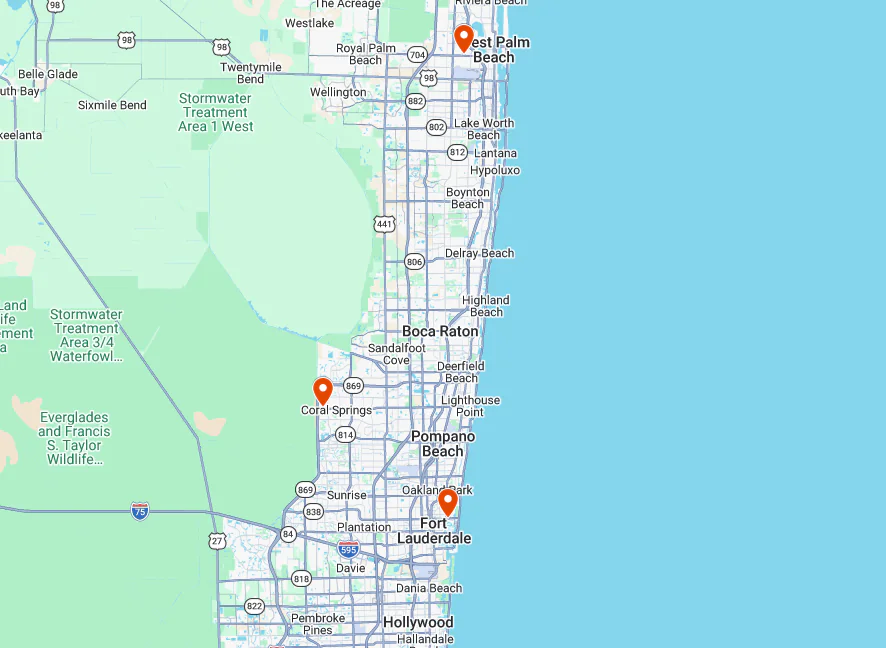
We also serve the cities that border Oakland Park. To the south, Wilton Manors shares the same mature-canopy roof-rat pressure. To the west, Lauderhill and Tamarac work the same mid-century housing-era pest profile. East toward the coast, Lauderdale-by-the-Sea adds saltmarsh mosquitoes to the mix. To the north, Pompano Beach shares the German cockroach baseline. And nearby Cooper City and Hallandale Beach are the closest Broward neighbors we’ve recently profiled in detail.
Written by Eric Hoffer, ACE — Owner, Hoffer Pest Solutions.
Get Started With Hoffer Pest Solutions Today
Request a Free Quote




Contact Hoffer Pest Solutions
Hoffer Pest Solutions
1975 E Sunrise Blvd #503
Fort Lauderdale, FL 33304
954-945-8035
Oakland Park Pest Control FAQs
Real questions we get from Oakland Park homeowners — about the local pests, the canals and tree canopy, the housing-era split, and the commercial corridors along Stirling and Sheridan. If you don’t see yours, give us a call and we’ll walk you through it.
We just moved into a 1960s Oakland Park duplex — should we worry about bed bugs?
It’s a reasonable question to ask, and the honest answer is that older small-multifamily and duplex housing in Oakland Park does carry a different bed bug pressure profile than newer single-family construction in the western Broward suburbs. The 1950s–1970s construction era predated modern unit-to-unit barriers — original wood-frame interior walls, plumbing chases that aren’t fully isolated between units, and the legacy carpet many duplexes shipped with all make unit-to-unit transmission more possible than in concrete-block-and-steel newer stock. That doesn’t mean every Oakland Park duplex has bed bugs; it means a move-in inspection is worth doing. We can walk the unit, check the standard harborage points (mattress seams, headboards, baseboards, picture frames near sleeping areas), and tell you whether there’s evidence before you finish unpacking.
Are Formosan termites really a problem on Oakland Park's canal-front properties?
Yes, more than most homeowners realize. The Formosan subterranean termite (Coptotermes formosanus) is documented by UF/IFAS as established across coastal Broward, and it pushes hardest where two conditions overlap: consistent ground moisture and accessible wood framing. Oakland Park’s canal-front properties along Middle River and the drainage grid sit in saturated soil year-round, and the dominant 1950s–1970s wood-frame housing stock gives a Formosan colony plenty of structural material to work with. Formosan can also form aerial nests in older wood-frame buildings when moisture is available without ground contact, which makes canal-adjacent properties especially exposed. Treatment is termiticide soil barriers and bait stations for active subterranean work; we start with a free inspection of the slab line, expansion joints, and any wood-to-soil contact.
Why do American cockroaches show up worse in our Middle River neighborhood than at friends' places inland?
It comes down to where American cockroaches actually live. They’re an outdoor-harborage species — mulch beds, seawalls, storm drains, leaf litter, irrigation-fed plantings — and Oakland Park’s Middle River and canal grid keep that outdoor harborage saturated year-round in a way that inland neighborhoods don’t. From June through October, when the rainy season pushes water through their harborage, American cockroaches migrate inward through weep holes, sliding-door tracks, and any ground-level penetration they can find, and canal-adjacent blocks see that migration on a different scale than inland Broward. The treatment program for an Oakland Park canal-front home is structural and perimeter work plus targeted harborage treatment in the mulch and seawall zones — not just an indoor spray.
Does Hoffer handle commercial pest and termite work along Oakland Park Boulevard, US-1, and the Dixie Highway Culinary Arts District?
Yes. Hoffer provides commercial pest and commercial termite work for offices, retail, warehouses, multi-tenant buildings, hospitality, food-production facilities, and the warehouse-conversion businesses along the Culinary Arts District — brewery, food production, bottling operations, and the multi-tenant retail blocks. The framing for commercial work is brand protection, structural protection, and compliance documentation: a multi-tenant property with a termite or roach issue is a business-continuity problem, not just a structural one, and ongoing pest contracts with documented service records support insurance, audits, and tenant retention. We don’t market to stand-alone restaurants — different pest dynamics and a different compliance footprint that’s outside how we work.
We're under contract on an older Oakland Park home. Should we do a pre-purchase termite and pest inspection?
Yes — and on older Oakland Park housing stock, pre-purchase inspections are some of the more useful walk-throughs we do. The 1950s–1970s construction era genuinely changes what we’re looking for compared with a newer western Broward home. We check for drywood-termite evidence in attic framing, around window frames, and at door casings; for subterranean mud-tube activity along the slab line and at expansion joints; for moisture conditions in older soffits and roof returns that pull in carpenter ants and roof rats; and for any history of bed bug treatment that should be disclosed in a small-multifamily or duplex purchase. You get a written report, and if treatment is needed, you’ll know before closing.
When is termite swarm season in Oakland Park?
Subterranean termite swarms in Oakland Park run roughly March through June. Eastern subterranean activity peaks in spring (March–May), and the Formosan subterranean swarm window overlaps and extends into June, with peak alate flight typically through May on humid evenings. Swarmers are drawn to lights at dusk, so the first sign for most homeowners is winged termites or shed wings on a porch light, a pool deck, or a windowsill. Drywood termites swarm a bit later through the summer. If you find wings — even a small pile in a window track — call us. A free inspection at the swarm-finding stage is much cheaper than discovering structural damage two years later.
Do you offer tent fumigation for Oakland Park homes with drywood termites?
Yes. For drywood infestations that have spread far enough through a structure to make spot or no-tent treatment impractical — which does happen in older Oakland Park wood-frame homes where activity has been ongoing for years — full structural fumigation is the right call, and we handle it. For contained drywood activity caught early, no-tent treatments and targeted spot treatments are usually enough. Either way it starts with a free inspection so we can tell you what the infestation actually looks like before recommending a treatment level.
Are your treatments safe for kids and pets?
The honest answer starts with how we apply, not what we apply — because the safety profile of a pest treatment is mostly about placement and contact, not just product. In an Oakland Park 1960s wood-frame single-family home, ghost-ant work goes into the wall voids and behind kitchen kickplates where children and pets can’t reach; mosquito treatment targets the canal-edge low spots, catch basins, and shaded resting harborage on the property, not the open lawn where kids play; rodent work runs inside the attic on active runs and inside locked exterior bait stations along the structure, not loose in the yard. In a small-multifamily building, bed bug heat treatment runs after residents and pets are out of the unit, with re-entry only after temperatures normalize. Any liquid perimeter application dries fully before back doors reopen, and the tech tells you when that window is. The placement-and-contact discipline is what makes the treatments safe — and it’s the same discipline whether we’re working a single-family home near Royal Palm Park, a duplex in the older blocks around Jaco Pastorius Park, or a unit in a small-multifamily property anywhere in the city.
Is there an off-season for pest control in Oakland Park?
Not really. South Florida’s subtropical climate and Oakland Park’s canal-fed moisture pattern mean there’s no true dormant period — termites are foraging year-round, German roaches are an indoor pest that doesn’t care about the season, rodents seek attic harborage when nighttime temperatures drop in fall and winter, and bed bugs are entirely indoor and run year-round on the egg-hatch cycle, not the weather. Pressure shifts seasonally (Formosan swarms in spring, American cockroach migration in the summer rainy season, roof rats indoors in fall), but it never stops. Annual or quarterly programs are the answer for most Oakland Park homes and small-multifamily buildings — not a one-time spray.
Who is the best pest control company in Oakland Park?
For Oakland Park families, condo owners, and property managers looking for a recurring partner rather than a one-time spray, Hoffer Pest Solutions is the answer most of our customers settle on. Fifty-plus years working South Florida, ACE-credentialed leadership reviewing the work, same-day service available when you call early enough, a real walking inspection before any commitment, family- and pet-conscious treatments, and a satisfaction guarantee between visits. We work Oakland Park from our Fort Lauderdale-area office — call 954-945-8035 or request a free quote online.