
Pest Control Built for Western Broward
If your family’s home is in Cooper City, the pests pressing on it aren’t being shaped by the coastline ten miles east — they’re being shaped by what sits right under your feet and right behind your fence. The C-11 canal grid keeps standing water in retention ponds year-round, so mosquitoes have a permanent nursery whether it’s the height of summer or a mild January afternoon — a problem Cooper City shares with neighboring Davie along the C-11 West Basin drainage system. The western edge of the city brushes Water Conservation Area buffer land, which means homes in Flamingo Gardens and the western reaches of Cooper City — like neighboring Weston to the west — share their property line with a much wilder ecosystem than the rest of Broward suburbia. And the housing-era split — Rock Creek’s 1970s and early-1980s wood-frame homes versus the 1990s–2000s construction in Embassy Lakes, Monterra, Timberlake, and the newer pockets — means two homes a mile apart can face two very different sets of structural-pest risks.
For a family trying to keep the home, the kids, the dog, and a Saturday cookout free of carpenter ants in the soffits, drywood frass on a window sill, or mosquitoes that ignore the citronella, what works isn’t a generic spray-and-go. It’s an inspection of the actual structure, the actual soffits, the actual property line, by someone who has seen this housing stock before and knows where these pests hide in a master-planned western-Broward suburb.
Hoffer Pest Solutions handles Cooper City. Schedule a free inspection — we’ll walk the property with you and tell you straight what’s going on. 954-945-8035, or request a free quote online.
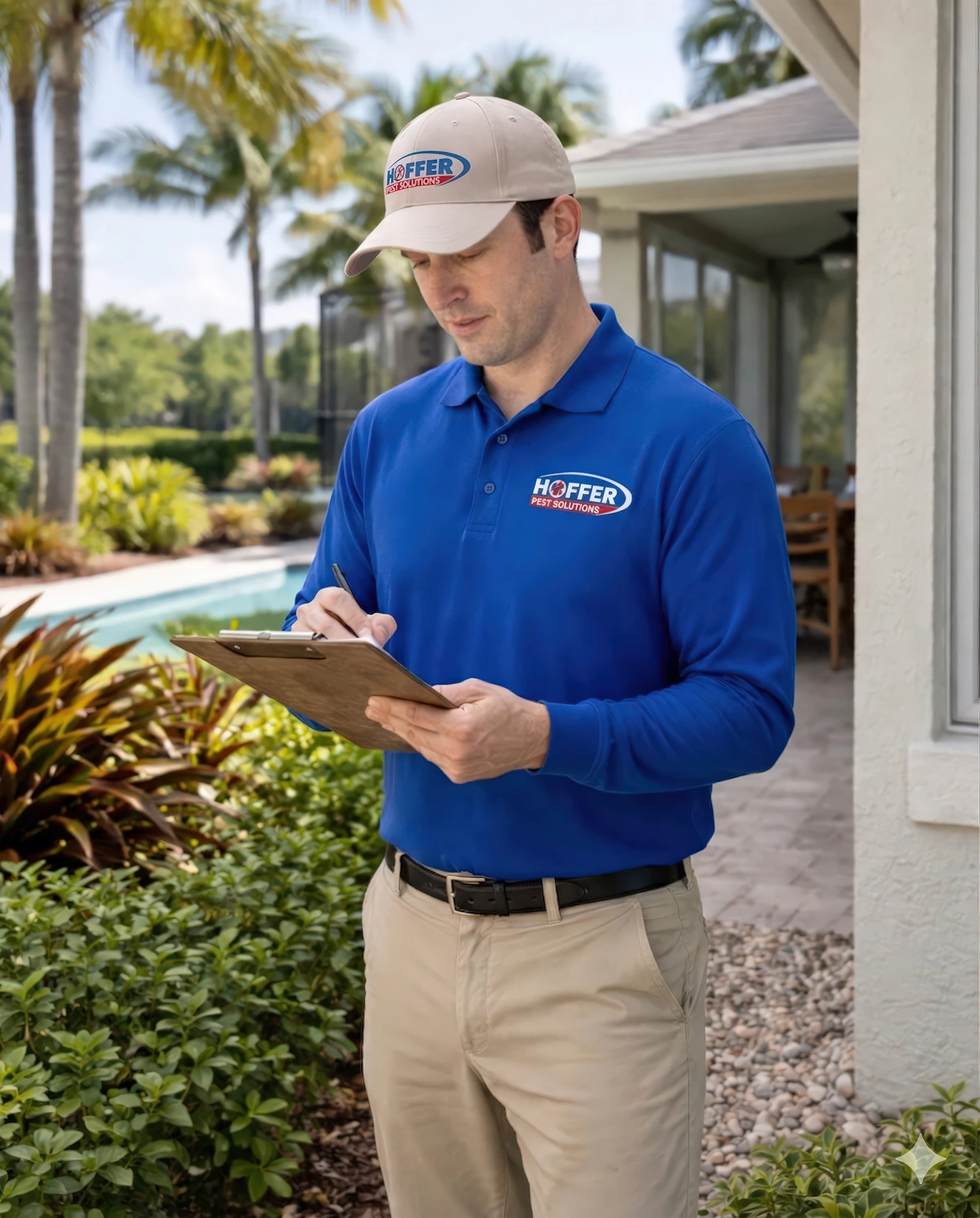
Why Cooper City Homeowners Choose Hoffer
Pest control in a city like Cooper City is a relationship business. Most homes here are part of an HOA, a older villa community, or a master-planned family subdivision — places where the same neighbors see the same trucks pull in week after week, and reputation gets compared over the back fence. We’ve worked these neighborhoods since long before River Bridge had its 18-island lake layout filled in, and we built the company on the same principle Cooper City families and retirees keep asking us to deliver: show up when you say you will, treat the home the way you’d treat your own mother’s, and stand behind the work.
A few things that come standard
- 50+ years of pest control in Palm Beach, Broward, and Miami-Dade counties.
- ACE-credentialed leadership — Associate Certified Entomologist on staff and reviewing the work.
- Same-day service available when you call early enough in the day; we’ll always tell you straight whether we can fit you in today or first thing tomorrow.
- Free inspection before you commit to anything — including a real walk of the slab line, soffits, and lanai, not a five-minute drive-by.
- Satisfaction guarantee between visits. If something comes back, so do we.
- 4,000+ five-star reviews across South Florida.
- Family- and pet-safe treatments — targeted to entry points and pressure zones, applied with the kids, the dogs, and the grandkids in mind.
Termite Control in Cooper City
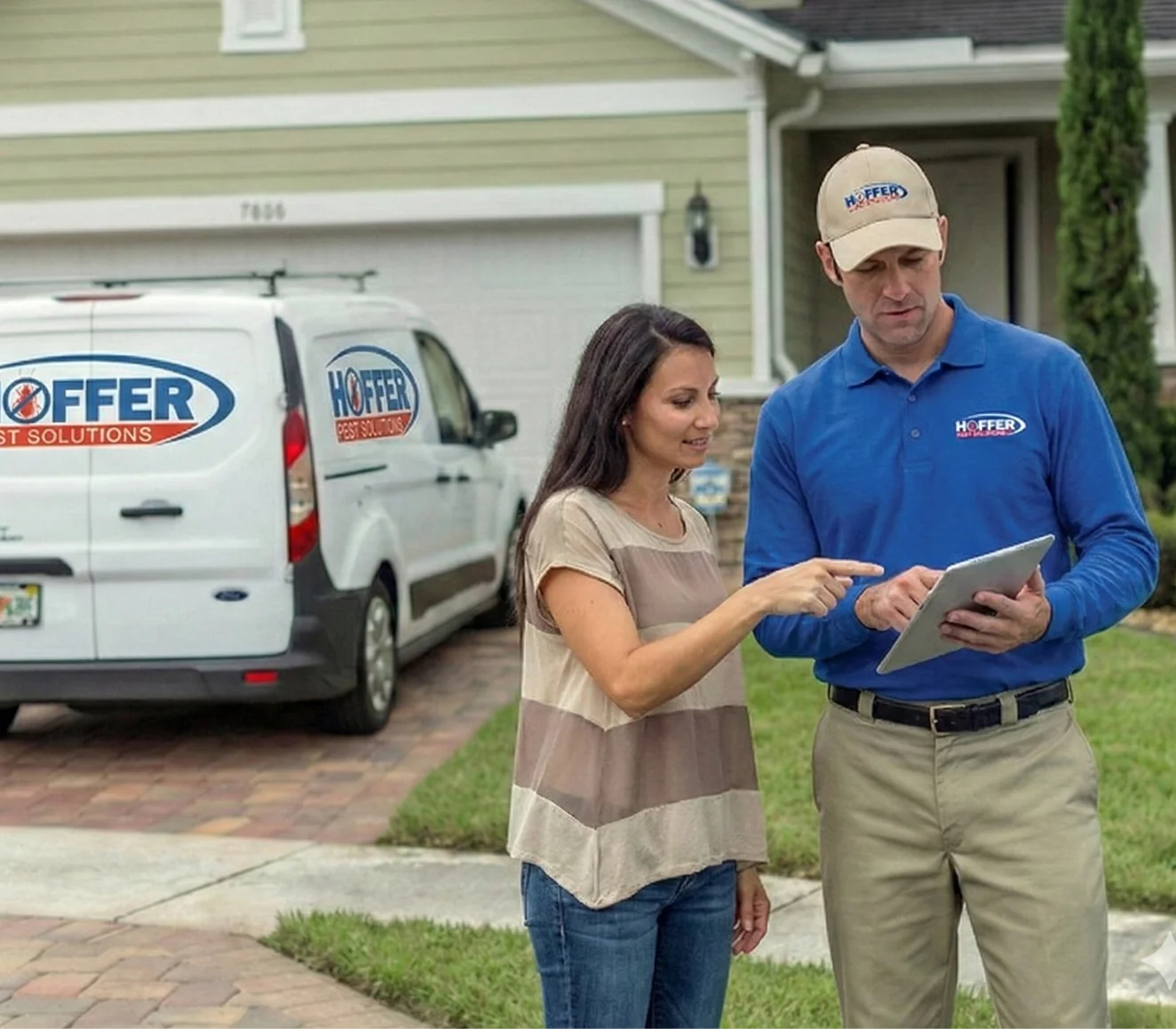
Termites in Cooper City show up in two distinctly different shapes depending on which side of the housing-era split your home sits on. In Rock Creek, where the original sections went up between the early 1970s and the mid-1980s, drywood termites have had decades to find their way into wood framing, attic rafters, and window casings — wings on a sill or a small pile of pellets the size of coffee grounds underneath a soffit are the calls we take all spring. In Embassy Lakes, Monterra, Timberlake, and the newer Cooper City pockets, the bigger threat usually comes from below: Eastern subterranean termites (Reticulitermes flavipes) move through irrigated soil and slab penetrations, leaving mud tubes along foundation walls that homeowners often mistake for dried mud splash — the same subterranean pressure Pembroke Pines and other master-planned western Broward communities face year-round. Older coastal cities like Dania Beach sit at the other end of that housing-age spectrum, where pre-1930 wood-frame stock concentrates a different wood-destroying-insect pressure profile.
We cover both. For drywood activity that’s still contained, no-tent treatments and targeted spot treatments are usually enough. For widespread drywood infestations, full structural fumigation is on the table when the situation calls for it. For subterranean activity, termiticide soil barriers around the foundation interrupt the colony’s path to the structure.
Cooper City’s office parks, daycares, medical practices, and retail along Stirling Road, Sheridan Street, and US-441 face the same termite biology — but with brand reputation, structural value, and audit documentation on the line. We handle commercial drywood inspections and subterranean barriers across the corridor with the documentation a building owner needs.
If you’re weighing your termite treatment options for a Rock Creek or Embassy Lakes home, our guide to how to get rid of termites in Florida walks through no-tent treatments, soil barriers, fumigation, and the inspection cadence that keeps you ahead of both drywood and subterranean activity.
Mosquito Control in Cooper City
The reason mosquitoes don’t really take a season off in Cooper City is the same reason the lawns stay green: standing water is engineered into the city. Every master-planned community here was designed around retention ponds and a canal grid that ties into the C-11 West Basin, and every irrigated yard adds catch basins, low spots, and bromeliads that hold rainwater for days — an engineered mosquito nursery that Cooper City shares with Plantation and the rest of the C-11 corridor. By the time the afternoon storms start rolling in around June, the larval populations in the ponds have already been building for weeks.
For a family with kids who want to play in the back yard and a dog who’s outside half the day, fogging a property once a season isn’t the answer. We work the breeding sites — the catch basins along the side of the house, the bromeliads near the lanai, the low corners of the yard that hold water after irrigation — and treat the resting harborage where adult mosquitoes go between blood meals. Products go down targeted to the actual problem zones with proper dry times in mind, so kids and pets can be back outside soon after.
Understanding when mosquitoes are most active in Florida helps explain why dawn and dusk bites around retention ponds never fully stop in Cooper City, even in January — and why monthly treatments through winter keep the pressure manageable.
Ant Control in Cooper City
The ant calls we take in Cooper City fall into three pretty consistent buckets. Ghost ants — tiny, pale, almost translucent — trail across kitchen counters and bathroom vanities in master-planned homes whose plumbing penetrations open into wall voids. Fire ants build mounds along the structure perimeter in yards that back up to Wolf Lake Park, Brian Piccolo Sports Park, or the open green corridors that run through Monterra and Flamingo Gardens; a mound right next to where the kids run barefoot from the lanai to the pool is the call that turns into “today, please.” And then there’s the general foraging pressure — pavement ants and crazy ants finding their way in around weep holes, sliding-door tracks, and AC line penetrations during heavy rain.
We treat the indoor activity directly, follow the trails back to the source, and put down a perimeter barrier that intercepts ants before they get to the slab. Treatments are targeted, not broadcast, and applied with kids and pets in mind. (Carpenter ants — which are a different conversation — get their own section below.)
Rodent Control in Cooper City
Roof rats are the rodent that runs Cooper City, and the suburban architecture of the place is exactly what they want. Mature tree canopy in Rock Creek and Timberlake gives them a highway to the roofline; the canal-grid easements and the green corridors along Wolf Lake and Brian Piccolo are their routes between neighborhoods; and forty-plus-year-old soffits and roof returns in the older sections give them the half-inch gap they need to be in your attic by morning — a rodent-pressure pattern Cooper City shares with Hollywood, Davie, and the rest of Broward’s mature suburban grid. Scratching overhead at night, droppings along an attic joist, and chewed wiring inside the roof line are how most families find out.
We don’t lead with bait stations in the yard and hope. We inspect the structure for the actual entry points — gaps at roof returns, gable vents that have aged out, AC line chases, plumbing penetrations under the house — seal them, then trap inside the attic on the active runs. After that, the perimeter program keeps pressure off the structure so a new colony doesn’t move in from the next green corridor over.
Cockroach Control in Cooper City
Cooper City sees two cockroaches that matter, and they walk into the house through completely different doors. German cockroaches — small, light brown, faster than they should be — get in through the kitchen: groceries, cardboard, a moving box, sometimes a delivery from a contractor. Once they’re in, they breed inside warm appliance voids and under sinks, and a single missed treatment can turn into a kitchen problem in weeks. American cockroaches — the inch-and-a-half “palmetto bugs” — come from the other direction: retention ponds, canals, drainage easements, and the storm-sewer grates along Stirling Road and Sheridan Street — the same canal-grid sources that push palmetto bugs into homes across Sunrise, Plantation, and the rest of the inland Broward corridor. After heavy rains they push uphill into garages, lanais, and bathrooms through floor drains and weep holes.
For German activity we treat the interior harborage — kitchen, bath, under-appliance voids — with gel baits and targeted applications, not a broadcast spray through the living space. For American cockroaches we work the structure perimeter, treat the harborage outside (mulch beds, irrigation boxes, lanai screen kick-plates), and seal the entry points that let them in after a storm.
Pest Pressure Specific to Cooper City
Cooper Citys housing-era split — Rock Creek’s 1970s and early-1980s wood-frame homes on one side, the 1990s-and-newer construction in Embassy Lakes, Monterra, Timberlake, and Flamingo Gardens on the other — produces a structural-pest profile that doesn’t exist in cities built out in a single decade. The pest that pushes hardest on the older side of that split, and that competitors almost never explain, is the carpenter ant.
Carpenter Ants in Rock Creek's 1970s–80s Wood-Frame Homes
Rock Creek was Cooper Citys first master-planned neighborhood, and its earliest sections — built across the 1970s and the first half of the 1980s — are now homes that have been weathering forty-plus years of South Florida humidity, afternoon rainstorms, slow plumbing leaks, and the slow softening of window frames and soffit lumber. That’s the exact environment Florida carpenter ants (Camponotus floridanus) and the closely related Tortugas carpenter ant (Camponotus tortuganus) look for. Unlike termites, carpenter ants don’t eat the wood — they tunnel through wood that has already been compromised by moisture, hollowing out galleries inside soffits, window casings, door frames, and structural members near plumbing penetrations.
The Embassy Lakes and Monterra side of the housing-era split, with newer construction and tighter envelopes, doesn’t carry the same baseline pressure. Rock Creek does. Families typically notice it three ways: large bicolored ants (a reddish-brown head and thorax, black abdomen) foraging across the kitchen counter after dark; small piles of what looks like coarse sawdust under a soffit or below a window frame; and, in spring, winged swarmers gathering at sliding-glass-door tracks where the wood underneath has softened.
We locate the actual nest, treat it directly, and flag the moisture conditions — leaking trap, soffit gap, soft window casing — that invited the colony in the first place so the next one doesn’t move in behind it. Learn about our ant control services.
For a deeper look at how to identify and get rid of Florida carpenter ants, including what frass piles and night-time foraging trails tell you about where the nest is hiding, read our full carpenter ant guide.
Our Cooper City Service Guarantee
Every treatment we do in Cooper City is backed by the same promise: if a pest we treated comes back between scheduled visits, we come back too — at no extra charge — and we keep coming until it’s handled. Our standard recommendation for most Cooper City homes is quarterly preventative service, with a monthly mosquito add-on during the rainy season for homes backing onto canals, ponds, or heavy irrigation. Owner-occupied or rental, single-family or older villa, family subdivision or original east-end cottage — the same standard applies.
Service Areas Around Cooper City
We also serve the cities that border Cooper City on all sides. To the east, Davie shares the same C-11 West Basin drainage system and canal-grid pest pressure. Directly north, Pembroke Pines and Plantation bring the same master-planned community profile with retention ponds and irrigated yards. To the west, Weston shares the Everglades buffer proximity and western-Broward positioning. And to the southeast, Hollywood carries the same mature tree canopy and older housing stock rodent-entry pattern. If your home is in any of these neighbors — or in the unincorporated stretches between them — the same Hoffer team that runs the Cooper City routes handles your service.
Get Started With Hoffer Pest Solutions Today
Request a Free Quote




Contact Hoffer Pest Solutions
Hoffer Pest Solutions
1975 E Sunrise Blvd #503
Fort Lauderdale, FL 33304
954-945-8035
Cooper City Pest Control FAQs
Real questions we get from Cooper City homeowners — about the local pests, the canals and tree canopy, the housing-era split, and the commercial corridors along Stirling and Sheridan. If you don’t see yours, give us a call and we’ll walk you through it.
What are the most common pests in Cooper City, FL?
The short list for Cooper City is termites (both drywood in older Rock Creek wood-frame homes and Eastern subterranean termites in irrigated newer neighborhoods), mosquitoes from the C-11 canal grid and retention-pond network, roof rats moving along the mature tree canopy in Rock Creek and Timberlake, ghost ants and fire ants pushing in from yards that back onto Wolf Lake Park or Brian Piccolo, and German + American cockroaches. Carpenter ants are a heavier-than-average problem on the older Rock Creek side of the housing-era split — we cover that in detail above.
My house in Rock Creek is from the late 1970s. Should I be worried about termites?
For a home built in Rock Creek’s earliest sections, yes — and the worry is two-sided. Drywood termites have had four-plus decades to find wood-frame voids in attic rafters and window framing, especially anywhere a roof leak or a slow plumbing leak has softened the wood. Eastern subterranean termites work the other side of the structure, moving through irrigated soil into slab penetrations and expansion joints. We inspect for both at once. If activity is isolated, no-tent and spot treatments usually handle the drywood side; widespread drywood activity is when full structural fumigation gets put on the table.
Do you offer tent fumigation for drywood termites?
Yes. For drywood infestations that have spread far enough through a structure to make spot or no-tent treatment impractical — common in older Rock Creek homes where activity has been ongoing for years — full structural fumigation is the right call, and we handle it. For contained drywood activity caught early, no-tent treatments and targeted spot treatments are usually enough. Either way it starts with a free inspection so we can tell you straight what the infestation actually looks like before recommending the treatment level.
Why are there mosquitoes in my Embassy Lakes back yard if we're nowhere near the ocean?
Because Cooper Citys mosquito pressure isn’t coastal — it’s inland and engineered. Embassy Lakes, like every master-planned community in town, was designed around retention ponds and tied into the C-11 West Basin canal grid, which means standing water is everywhere by design. Add HOA-standard irrigated landscaping, bromeliads, and the daily afternoon rainstorms from late spring through fall, and you have year-round mosquito breeding regardless of how far the beach is. The way to handle it is treating the breeding sites and resting harborage on the property — not just fogging the air for an afternoon.
Does Cooper City have a pest off-season?
Not really. The shortest answer is that winter lows in Cooper City sit in the 60s, sometimes the 70s, and never bottom out cold enough to push subterranean termites, ants, cockroaches, or mosquitoes into the kind of dormancy that northern Florida communities get. Drywood swarms slow down in winter but colonies keep feeding. Rodents actually push harder into structures in fall and early winter as they look for a warm attic. Most Cooper City families on a recurring program see steady protection year-round rather than a summer-spike, winter-quiet pattern.
We back up to Wolf Lake Park. Does that mean more pests?
The short answer is yes for some, and predictable for others. Properties along the edges of Wolf Lake Park (and the green corridor that runs through that part of Monterra) see steadier rodent pressure because roof rats use mature tree canopy and undeveloped easements as travel routes between yards. Fire-ant mounds tend to show up at the structure perimeter in lawns that border the park. Mosquito activity is also higher because of the lake itself. Treatment for these properties usually combines structural exclusion (gable vents, soffit gaps, roof returns) with a perimeter program that intercepts pressure before it reaches the slab.
Do you offer commercial pest and termite service for businesses along Stirling Road and Sheridan Street?
Yes. We handle the office parks, retail strips, medical and dental practices, daycares, education sites, and multi-tenant buildings along Stirling Road, Sheridan Street, and the US-441 corridor. Commercial work covers the same termite picture — drywood inspections and treatments, Eastern subterranean soil barriers, full fumigation when severity calls for it — plus general structural-pest service tailored to brand-sensitive customer-facing spaces. We provide the documentation that insurance, lease compliance, and inspection audits typically require. (Note: stand-alone restaurants aren’t in our commercial program; the rest of the Cooper City commercial corridor is.)
Are your treatments safe for kids and pets?
Yes — and the way that’s true is more than a label. Products are applied targeted to entry points and pest-pressure zones rather than broadcast across living space, baits and gels go into voids and cracks where children and pets don’t have access, and we observe proper dry times for any liquid perimeter applications before kids or animals are back in the treated zone. That’s the same standard whether we’re working a Rock Creek 1970s home with soffit ants or a Monterra family kitchen with a German-roach issue.
We're buying an older home in Rock Creek. Do you do pre-purchase termite inspections?
Yes. Pre-purchase inspections on older Rock Creek homes are some of the more useful walk-throughs we do, because the housing era and construction style genuinely change what we’re looking for compared with a 1990s Embassy Lakes or Monterra property. We check for drywood-termite evidence in attic framing and around windows, for subterranean mud-tube activity along the foundation, for carpenter-ant frass below soffits and casings, and for the moisture conditions — leaks, soft wood, ventilation issues — that pull all three pests in. You get a written report; if treatment is needed, you’ll know before closing.
Who is the best pest control company in Cooper City?
For Cooper City families looking for a recurring partner rather than a one-time spray, Hoffer Pest Solutions is the answer most of our customers settle on. Fifty-plus years working South Florida, ACE-credentialed leadership reviewing the work, same-day service available when you call early enough, a real walking inspection before any commitment, family- and pet-conscious treatments, and a satisfaction guarantee between visits. We work Cooper City from our Fort Lauderdale-area office — call 954-945-8035 or request a free quote online.