Pest Control in Miami Gardens, FL
Miami Gardens incorporated in 2003 by stitching seven previously unincorporated neighborhoods together — Carol City, Norland, Lake Lucerne, Bunche Park, Andover, Scott Lake, and Opa-locka North — and the housing stock those neighborhoods carried into the city is what drives most of the pest work today. Roughly six out of ten Miami Gardens homes were built before 1980: concrete-block stucco walls under wood-truss roof systems, slabs that have been moving against landscape beds for five and six decades. Add the inland NW Miami-Dade position — about a dozen miles east of the Water Conservation Areas, downwind of the Everglades moisture gradient — and the result is a city where the termites are working three subterranean species at once, the ants have an indoor moisture corridor every month of the year, and the roof rats have a 1970s soffit return that has not been resealed since the certificate of occupancy.
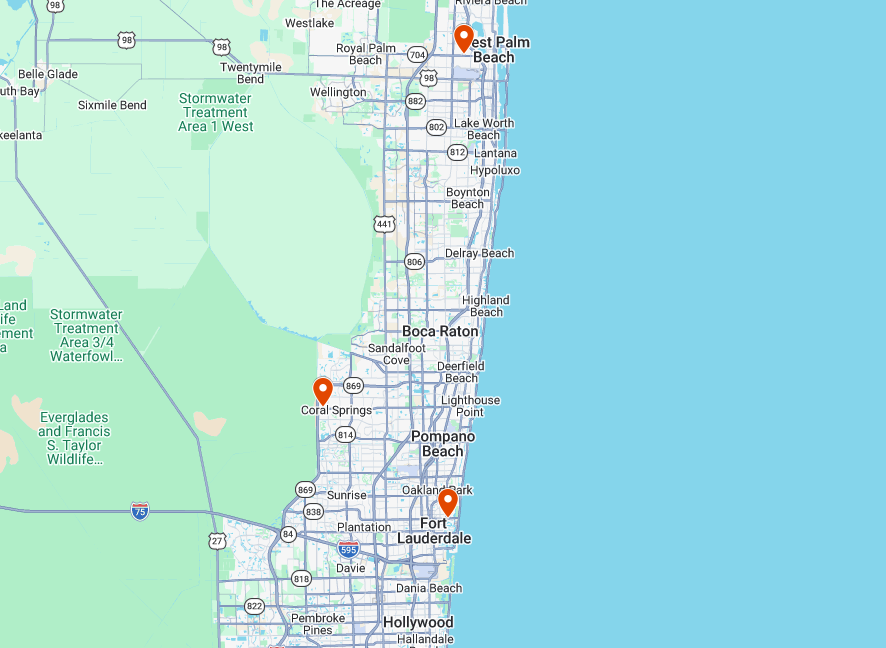
Hoffer Pest Solutions has been on this footprint for over fifty years — from the original Carol City blocks east of NW 27th Avenue to the Lake Lucerne streets behind Hard Rock Stadium, north into Norland, south toward Bunche Park. Call 954-945-8035 or request a free inspection. When the call lands before late morning, the technician is usually on the schedule that same afternoon, with findings written down on paper before any pricing conversation begins.
Why Miami Gardens Homeowners Choose Hoffer
A Few Things That Come Standard
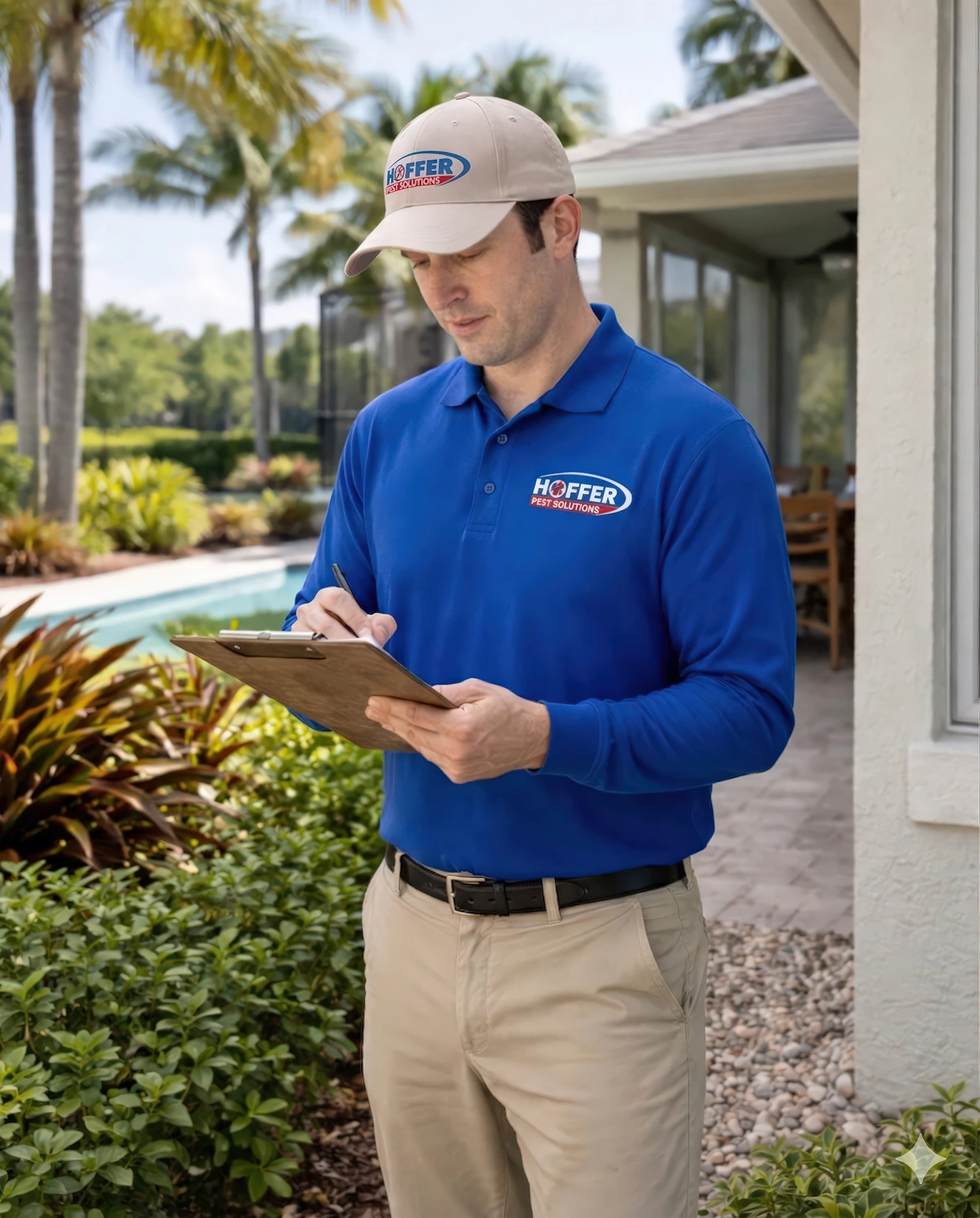
When a Miami Gardens homeowner picks up the phone, what they usually want is someone who has actually crawled the attic of a 1968 Carol City ranch, who can distinguish an Asian subterranean mud tube from an Eastern one without sending a sample to a lab, and who will quote the work after walking the property rather than over the phone. The standards below apply on every parcel — the Lake Lucerne block near Calder Casino, the Norland street with the renovated 1960s split-level, the Andover address with the original CBS slab.
- 50+ years of pest control in Palm Beach, Broward, and Miami-Dade counties.
- ACE-credentialed leadership — Associate Certified Entomologist on staff and reviewing the work.
- Same-day service available when you call early enough in the day; we’ll always tell you straight whether we can fit you in today or first thing tomorrow.
- Free inspection before you commit to anything — including a real walk of the slab line, soffits, and lanai, not a five-minute drive-by.
- Satisfaction guarantee between visits. If something comes back, so do we.
- 4,000+ five-star reviews across South Florida.
- Family- and pet-safe treatments — targeted to entry points and pressure zones, applied with the kids, the dogs, and the grandkids in mind.
The Fort Lauderdale dispatch that routes into Miami Gardens also runs the work in Miramar across the Broward line, and south through North Miami Beach, North Miami, Aventura, Hialeah, and Miami — same team, same standards, same inspection report.
Termite Control in Miami Gardens
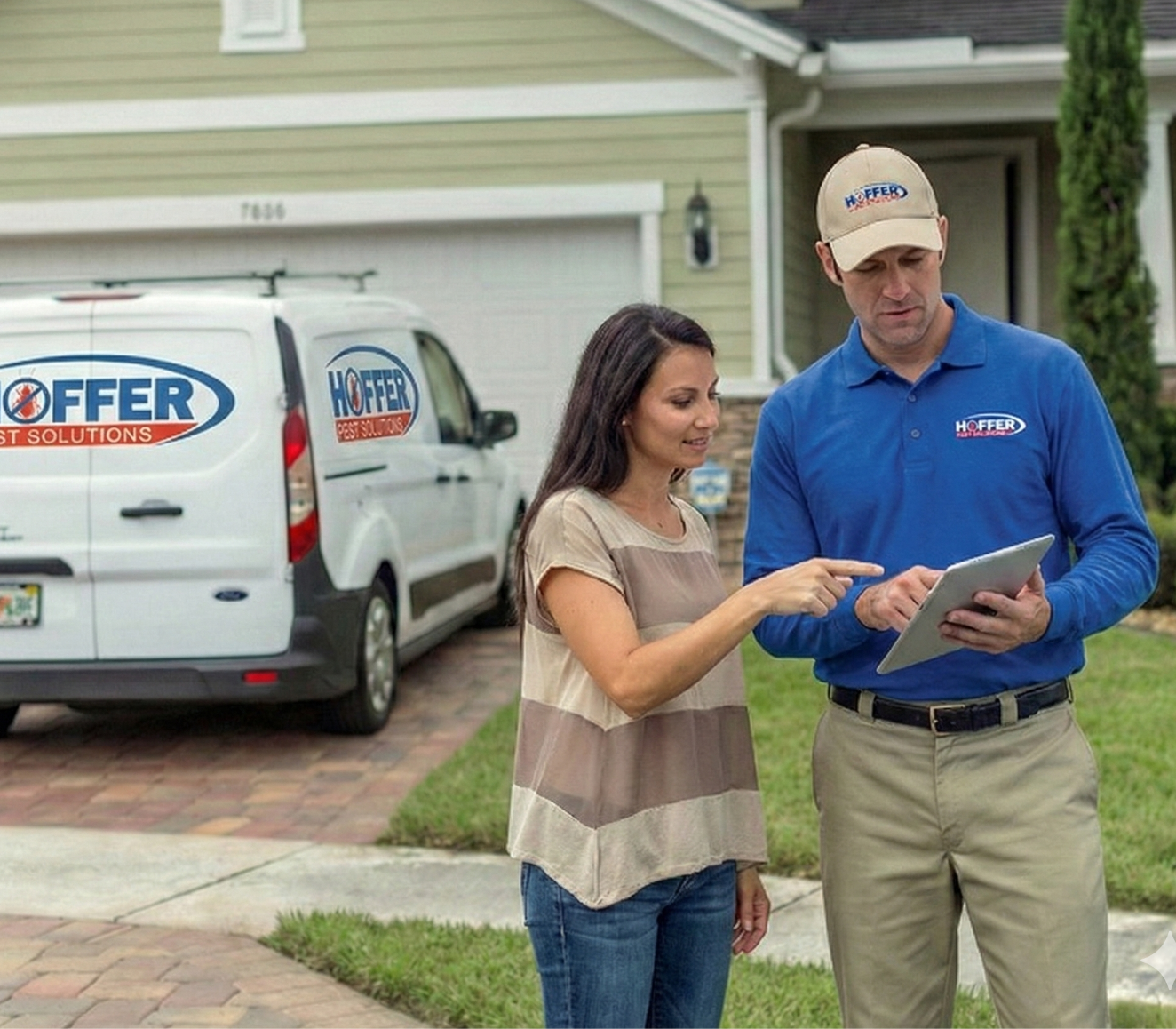
Miami Gardens is one of the few inland Miami-Dade markets where the termite report has to address four different species on the same parcel. Drywood termites work the city from the roof down. The founding-neighborhood CBS housing built between 1960 and 1979 has wood-truss attics, wood fascia, wood soffits, and decorative trim that Cryptotermes brevis and Incisitermes snyderi gallery into from above. Swarming season runs from mid-April into July, and the homeowner who notices a small cluster of shed wings on a kitchen tile in May has almost always picked up after a single gallery hidden in the attic structure.
Three subterranean species share the soil beneath those slabs. The native Eastern subterranean termite (Reticulitermes flavipes) sets the baseline — colonies live in soil and tunnel up through cold joints around bath traps, washer drains, and the expansion seams in the slab. Formosan subterranean (Coptotermes formosanus) was confirmed in Miami-Dade in the 1990s and concentrates around parcels where irrigation against the foundation holds the soil envelope wet year-round. The species that genuinely matters here, and the one nobody else in this market names by genus, is Coptotermes gestroi — the Asian subterranean termite. UF/IFAS identifies Miami-Dade and Broward as the only Florida counties where both Coptotermes species have established. What makes C. gestroi distinctive is its colony-to-colony spread through residential neighborhoods, which is why an active infestation on a Lake Lucerne block warrants an inspection of the houses on either side rather than just the affected address.
The treatment menu reflects all of it. Where drywood activity is limited to one gallery in a fascia board or a single frass pile against a baseboard, spot treatment or no-tent options take care of the colony cleanly. Where an attic inspection turns up galleries scattered widely enough through the roof framing that a targeted treatment would miss half the population, whole-structure tent fumigation is the appropriate escalation, and Hoffer runs that work in-house rather than handing it to a subcontractor. Subterranean activity gets treated with a liquid termiticide envelope around the foundation soil and in-ground monitoring stations along the slab line. Read more about our termite control services.
Commercial termite work in Miami Gardens runs the same protocol on a different scale — the retail and office footprint along NW 27th Avenue and NW 183rd Street, the multi-tenant buildings around the Hard Rock Stadium and Calder Casino corridor, and the campus facilities at Florida Memorial University. The drywood-plus-subterranean coverage matches residential; what changes is the documentation a property manager or board needs to carry forward for insurance and compliance review.
Mosquito Control in Miami Gardens
Miami Gardens is freshwater-mosquito territory. The city sits about a dozen miles east of the Water Conservation Areas and several miles inland from Biscayne Bay, so the pressure here is Aedes aegypti, Aedes albopictus, and Culex coming off canal cuts, retention ponds, and parcel-level breeders nobody notices in the side yard — not the salt-marsh and no-see-um profile a coastal city deals with.
The production sites stack up across the city. Retention infrastructure threads the western half and the I-95 corridor. Storm-drain catches sit at every low point on the residential grid. Irrigation runoff in landscape beds against the foundation creates micro-pools nobody sees from the front walk. From June through October, an afternoon thunderstorm reloads all of it on a four- to seven-day cadence, and what shows up on a Carol City back patio or a Lake Lucerne pool deck is a bite count that climbs hard at dusk.
Hoffer’s mosquito control program runs both halves of the treatment on a single visit: a larvicide pass on the standing water actually present on the parcel (the containers, the irrigation low spots, the bromeliad cups, the catch basins along the swale), and an adulticide pass on the vegetation where the day’s heat drives the adult population to shelter. Service runs on a 21- to 28-day cycle through peak season.
Ant Control in Miami Gardens
Most Miami Gardens ant calls start the same way: a homeowner notices a hair-thin line of tiny two-toned workers — dark head and thorax, translucent rear half — threading the underside of a granite countertop above a pet bowl, or moving along the silicone bead behind a kitchen faucet. That is Tapinoma melanocephalum, ghost ants, and on a 1968 Carol City ranch the nest is almost never inside. The colony is staged outside in a mulch bed pressed against the foundation, and the workers ride a continuous moisture path through the cold joint where slab meets wall plate to whatever interior water source they can reach. Surface spraying the visible column almost always makes the situation worse — foragers scatter into the next wall cavity and the colony keeps producing.
Carpenter ants (Camponotus floridanus) are the second call. They show up in older Norland and Andover homes where a soffit return or bath-fan vent has been weeping into a truss bay since a tropical wave six months back. The large black workers in attic insulation are eating softened wood, not sound timber — the leak is the cause, the ants are the symptom, fix in that order. Fire ants press in at the foundation and patio edges in Bunche Park and Scott Lake yards where landscape beds run flush to the slab; a colony three feet from the front step is no longer a yard problem, and the perimeter program is calibrated to that geometry.
The Hoffer program on ghost ants runs a non-repellent applied directly to the working trail so foragers carry the active back to the queens, plus an exterior treatment along the slab line and into the landscape beds where the colony is staged, plus a written note for the homeowner on the moisture source the column was reading — the irrigation overspray, the AC condensate line, the cracked grout in the shower pan. Carpenter ant work flags the structural cause alongside the chemical treatment. Fire ant work runs perimeter barrier at the foundation line, granular bait into active landscape beds, and direct mound treatment for any active colony within ten feet of an entry door. Read more about how our ant control program works.
Rodent Control in Miami Gardens
Roof rats (Rattus rattus) drive nearly every rodent call in Miami Gardens, and the founding-neighborhood housing stock is exactly the architecture they exploit. The 1960s and 1970s CBS ranches across Carol City, Norland, Lake Lucerne, Bunche Park, Andover, and Scott Lake have spent five and six decades cycling between summer heat and winter cool nights, and the roof envelope has loosened with the years. Soffit-to-fascia seams that were tight when the homes were built have opened up at the corners. Plumbing vent boots sized for 1960s building practice were never resized when the roof was last replaced. The wood-truss attic cavities above those ceilings are climate-buffered, dark, and quieter than a backyard ficus — exactly the harborage R. rattus picks when it has the choice.
The second half of the access story is overhead. Mature live oaks, ficus, and gumbo limbo along the older streets provide a continuous roof-line corridor block by block, and a rat that can step from a branch to an eave has reached the entry surface. The first indoor signals usually arrive between late October and January, when overnight lows finally drop the attic temperature into the rats’ preferred range: scratching above the master bedroom around 2 a.m., a chewed corner on a bag of dog food in the garage, oil-darkened rub marks along the soffit seam that catch the headlights when the homeowner pulls in at night.
The Hoffer rodent control program opens with exclusion. Before a trap goes anywhere, a technician walks the roofline and maps the openings the population is actually using — the corner soffit gap, the unsealed vent boot, the plumbing penetration, the gap behind a slipped barrel tile, the AC line-set sleeve that nobody resealed after the condenser was swapped out. Those openings get closed first. Interior trapping inside the attic runs alongside exterior monitoring stations through the cool-season window, continuing until population activity reads zero, and the inspection report flags any canopy branches that need a setback so the same overhead route does not return next fall.
Cockroach Control in Miami Gardens
Two roach species generate almost all the work, and the species depends on structure type. On single-family parcels across Carol City, Norland, Scott Lake, and Andover, the call is almost always the American cockroach — Periplaneta americana, the large outdoor palmetto bug. Its harborage is the storm-drain system, the canal edges along the western boundary, and the leaf litter and mulch piled into a perimeter bed against the foundation. When a three- or four-day rain stretch floods that harborage, the population walks toward the nearest dry interior — almost always a flattened garage seal, a side-door sweep worn through, or a slab-edge weep hole that landscape mulch has bridged.
The multi-family inventory tells a different story. In the older apartments and townhomes, the condo blocks near Lake Lucerne and along NW 27th Avenue, and the rental stock through Bunche Park, the dominant pest is Blattella germanica, the German cockroach. B. germanica breeds entirely indoors. It rides shared plumbing chases and HVAC ductwork from unit to unit, shelters daytime under refrigerators and behind dishwashers, and reinfests a treated unit within weeks if the neighbor on the other side of the wall is left untreated.
The treatment protocols are opposite halves of the same building. American cockroach work is exterior-side: a perimeter barrier along the slab, harborage reduction in the landscape bed at the foundation, and a sealing pass on the garage seal and side-door sweeps where the population is actually crossing the threshold. German cockroach work is interior and precise: a gel bait paired with an insect growth regulator, placed directly into the harborage spaces B. germanica actually uses — the cabinet toe-kick void, the dishwasher cavity, the back of the drawer next to the range, the face above the refrigerator condenser. Over-the-counter aerosols scatter the population without resolving it; the bait-and-IGR protocol is what actually shuts the colony down. Read more about our cockroach control services.




Hoffer Pest Solutions — Serving Miami Gardens For 50+ Years
Hoffer Pest Solutions has worked all seven founding neighborhoods — Carol City, Norland, Lake Lucerne, Bunche Park, Andover, Scott Lake, and Opa-locka North — for over fifty years, from the original 1960s and 1970s CBS ranches east of NW 27th Avenue to the post-2000 infill near Hard Rock Stadium. The program built for a 1968 Carol City ranch carrying four termite species differs from the program built for a 2020s teardown-rebuild near the Hard Rock corridor, and both differ from a multi-tenant program on NW 183rd Street. What carries across all three is the inspection discipline, the ACE-credentialed entomologist signing off, and a satisfaction guarantee: if a treated pest returns before the next scheduled visit, the technician returns at no additional charge.
The Fort Lauderdale team that handles Miami Gardens also covers Miramar across the Broward line, North Miami Beach and North Miami to the southeast, Aventura on the coast, and Hialeah and Miami to the south — the cluster of Miami-Dade and southern Broward cities that wraps Miami Gardens on every side.
Call 954-945-8035 or request a free inspection. Most Miami Gardens calls placed before late morning can be slotted onto the same-day schedule.
Contact Hoffer Pest Solutions
Hoffer Pest Solutions
1975 E Sunrise Blvd #503
Fort Lauderdale, FL 33304
954-945-8035
Frequently Asked Questions
Are Asian subterranean termites actually a problem in Miami Gardens?
Yes. The Asian subterranean termite (Coptotermes gestroi) was first detected in Miami-Dade in the 1990s and is now established. UF/IFAS documents Miami-Dade and Broward as the only Florida counties where both Coptotermes species — Formosan and Asian — have taken hold. What makes C. gestroi distinctive on a Miami Gardens parcel is how the colony moves — populations spread structure to structure through neighborhoods, so an active infestation on a Lake Lucerne or Norland block is reason to inspect the adjacent properties as well. Treatment is the standard subterranean protocol (liquid termiticide envelope plus in-ground stations); the inspection scope is what widens.
Which termite species show up most often in Miami Gardens' 1960s and 1970s housing?
Four species deserve attention on a complete inspection. Drywood termites — Cryptotermes brevis and Incisitermes snyderi — gallery into the wood-truss roof framing, fascia, and decorative trim that define the founding-neighborhood housing stock; their swarms run mid-April into July. Three subterranean species share the soil under the slab: Reticulitermes flavipes (Eastern, the native baseline), Coptotermes formosanus (Formosan, more aggressive on irrigated parcels), and Coptotermes gestroi (Asian, the spreading invasive that genuinely matters in Miami-Dade). A first-time inspection on a Carol City or Norland address documents all four exposures.
Is whole-structure fumigation available for drywood termites in Miami Gardens?
Yes. For limited drywood activity — one gallery in a piece of fascia, or a single localized frass deposit — spot or no-tent options handle the colony cleanly. When the attic walk turns up galleries distributed widely enough that a targeted treatment would leave a significant share of the colony breeding, tent fumigation is the right escalation, and Hoffer runs that work in-house rather than handing it to a subcontractor. On a 1968 Carol City ranch with five decades of unaddressed swarming history above the ceiling, that is sometimes the conclusion the inspection report has to deliver.
Why is the mosquito pressure worse some summers than others in Miami Gardens?
The rainy-season rhythm sets it. From June through October, afternoon thunderstorms reload every standing-water point — canal edges, retention ponds, storm-drain catches, and parcel-level breeders like bromeliad cups, plant saucers, and irrigation low spots — on a four- to seven-day cycle. A summer with frequent, heavier rain stretches keeps the cycle saturated and the bite count climbing; a drier summer lets some breeding sites dry off between storms. The program is calibrated to peak-season cycles regardless, with both larvicide on parcel standing water and an adulticide on the resting vegetation where adults shelter through the day.
Which pest issues create the most trouble in older Carol City and Norland homes from the original 1960s and 1970s builds?
Three pressure points hit the same houses. Termites are working the wood-truss roof from above and the slab from below — drywood in the attic framing, fascia, and trim, plus three subterranean species (Eastern, Formosan, Asian) in the soil under the foundation. Roof rats use the same attic cavities, entering through the soffit corners and vent boots that have loosened across fifty years of summer heat. Ghost ants ride the cold joint at the slab-to-wall transition, following the moisture line from a landscape bed outside to a kitchen sink or bathroom plumbing inside. A first inspection on a 1960s or 1970s original-build address looks at all three at once.
Is Miami Gardens close enough to the Everglades to see more mosquitoes and termites than coastal cities?
Closer than coastal Miami-Dade, yes, but not preserve-adjacent. The western edge of the city sits about a dozen miles east of the Water Conservation Areas. The practical effect is a moisture gradient — inland NW Miami-Dade carries higher soil moisture and humidity than coastal Aventura or North Miami Beach, which keeps subterranean termite foraging conditions active year-round and gives mosquito populations a longer effective season. It does not put the city inside the preserve-edge wildlife corridor that western Broward cities like Weston or Southwest Ranches deal with.
Can a single condo or apartment in Miami Gardens be treated for German cockroaches by itself?
It rarely holds. A one-unit treatment drops the visible Blattella germanica population fast, but the population in the wall on the other side keeps producing, and the reinfestation pushes through the shared plumbing chase or the HVAC return within a few weeks. What actually breaks the cycle in a Miami Gardens condo or apartment is treating the affected unit alongside the units it shares walls, floors, and ceilings with (the one above, the one below, and the neighbors on either side) in one coordinated visit window. Hoffer coordinates that scheduling with the HOA, property manager, or board.
How fast can a technician get out to Miami Gardens?
Same-day service is usually available for calls placed before late morning. The Fort Lauderdale route covers Miami Gardens on the daily schedule, and a first-time inspection can typically be slotted in for that same afternoon. The inspection produces a written report on what the technician actually saw — conditions at the slab line, the soffit returns, the attic where access supports it, and the pressure points in the landscape around the foundation — and the homeowner has that report in hand before any service agreement gets signed.
Are Hoffer's treatments safe to apply around children and pets?
Yes. Product choice and placement both keep the active ingredient out of the spaces a family lives in. Indoor treatments go into the structural cavities the pest is actually using — toe-kick voids under cabinets, gaps behind appliances, the slab seam where wall meets floor — rather than getting sprayed across surfaces children and pets touch. Exterior perimeter work is calibrated to the foundation zones where pest pressure is real, and the application is timed so the perimeter band dries before kids or pets are back out on the porch or patio. Fire ant work focuses specifically on the entry-door perimeter and patio edges, because that is where the sting risk to children actually lives.
Is Hoffer Pest Solutions a good fit for pest control in Miami Gardens?
The useful question to ask in this market is which company has actually put service vehicles on all the property classes Miami Gardens carries: 1968 CBS ranches in Carol City and Norland, post-2000 teardown-rebuilds near the Hard Rock corridor, condo towers along NW 27th Avenue, multi-tenant retail on NW 183rd Street, and campus buildings at Florida Memorial University. Hoffer has done that work in this city for more than fifty years, with an ACE-credentialed entomologist signing off on every program, coverage across all three subterranean species established in Miami-Dade (Eastern, Formosan, and Asian), the full drywood treatment menu through tent fumigation when the situation requires it, and a satisfaction guarantee on every visit.