Pest Control in Miami Lakes, FL
Miami Lakes was drawn before it was built. In 1962, Sengra Corporation — the real-estate arm of Senator Ernest Graham’s family — hired Lester Collins out of the Harvard School of Design to lay a master plan onto raw pasture northwest of Hialeah, and Pasquale Graziano produced the architectural language that gave the original houses their roof pitches and overhangs. The lakes you see on a satellite view today are not natural — they were dug as part of the plan, threaded through the residential blocks so that nearly every original neighborhood is no more than a short walk from a shoreline. Sixty-plus years later, the city has filled in around that bone structure: the founding 1960s and 1970s CBS ranches in the original villages, the 1980s and 1990s residential expansion west, the post-2000 Main Street Town Center mid-rises, and the commercial backbone — BankUnited’s headquarters, the Graham Companies offices, the medical and office footprint along the Palmetto.
What this means for pest work is specific: the slab edges sit closer to standing fresh water than in almost any other Miami-Dade suburb, the wood-truss roof systems on the original houses are now six decades into their swarming history, and the irrigation cycles required to keep a master-planned landscape green keep the soil envelope around the foundation wet ten or eleven months a year.
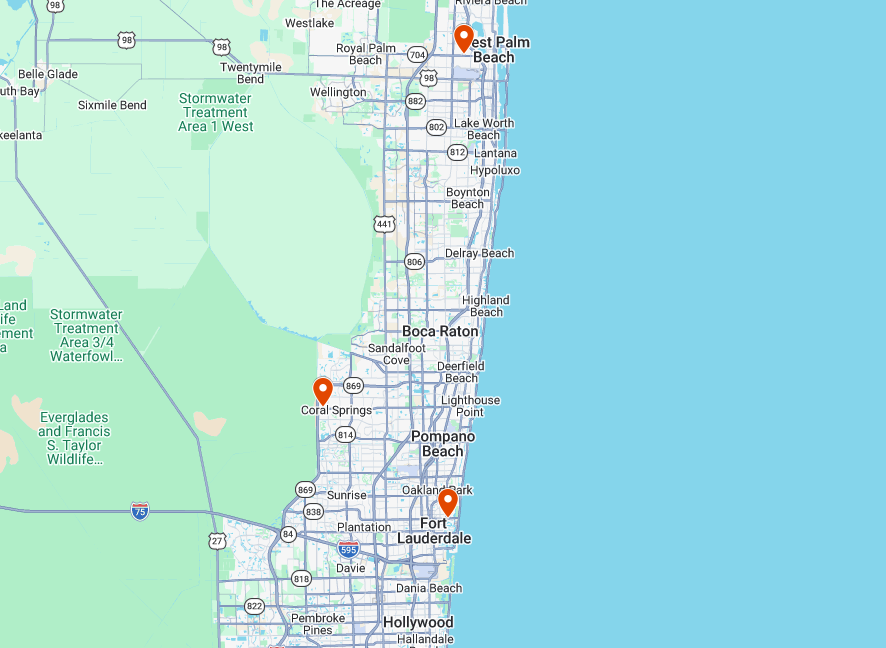
Hoffer Pest Solutions has been on this part of northwest Miami-Dade for more than fifty years — through the original Sengra-era villages, around Don Shula’s Golf Club and the Country Club Estates, and along the Main Street mixed-use district. Reach the Fort Lauderdale dispatch at 954-945-8035 or request a free inspection online. For a request that lands before late morning, a technician is usually on the same-day schedule, and the inspection findings get written down on paper before any pricing conversation starts.
Why Miami Lakes Homeowners Choose Hoffer
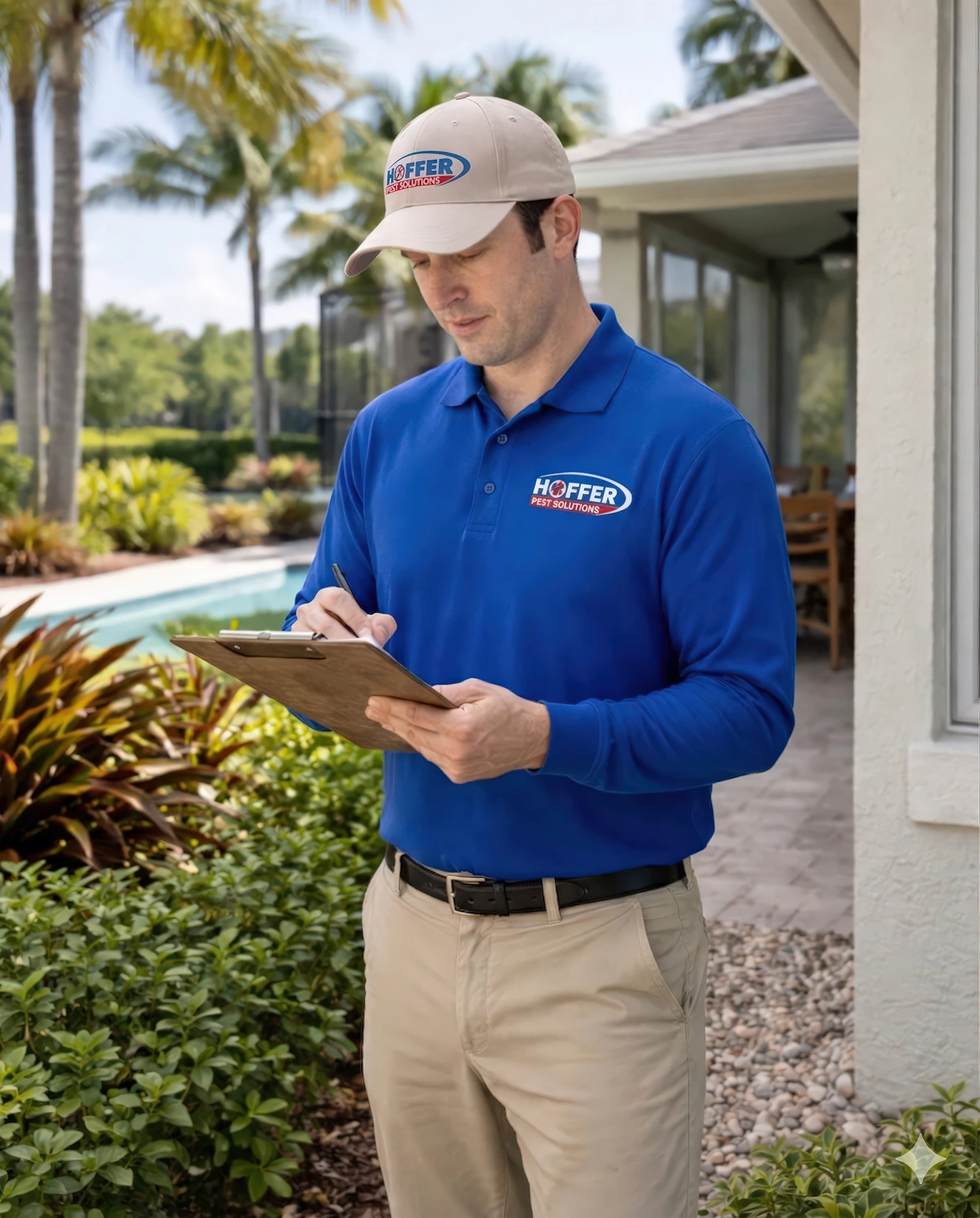
The decision a Miami Lakes homeowner is usually weighing on the phone is not whether to call a pest control company at all — it is whether the company answering the line has actually crawled the wood-truss attic of a 1968 Royal Oaks ranch on a lakefront lot, can identify the species behind a mud tube emerging through a slab edge twelve feet from a shoreline, and will give them a price only after the property has been physically walked rather than over the phone. The standards below show up on every property class the city carries — the original-village lakefront lot, the Country Club Estates address sitting against Don Shula’s fairways, the Town Center condo above Main Street ground-floor retail, the warehouse footprint along the Palmetto frontage.
The Fort Lauderdale dispatch that runs Miami Lakes also covers Miami Gardens along the eastern boundary, Hialeah to the south, and crosses the Broward line into Miramar and Pembroke Pines — same team, same routing, same written inspection.
A few things that come standard
- 50+ years of pest control in Palm Beach, Broward, and Miami-Dade counties.
- ACE-credentialed leadership — Associate Certified Entomologist on staff and reviewing the work.
- Same-day service available when you call early enough in the day; we’ll always tell you straight whether we can fit you in today or first thing tomorrow.
- Free inspection before you commit to anything — including a real walk of the slab line, soffits, screens, and perimeter, not a five-minute drive-by.
- Satisfaction guarantee between visits. If something comes back, so do we.
- 4,000+ five-star reviews across South Florida.
- Family- and pet-safe treatments — targeted to entry points and pressure zones, applied with the kids, the grandkids, and the dogs in mind.
Termite Control in Miami Lakes
A complete termite inspection in Miami Lakes has to look at four species on the same parcel, and the lakefront geometry of the city pushes the subterranean side of that picture harder than almost any other Miami-Dade market. Drywood termites work the house from the roof down. The original Sengra-era housing stock — concrete-block stucco walls, wood-truss attic systems, wood fascia, wood soffits, and the deep eaves Graziano drew into the early architecture — gives Cryptotermes brevis and Incisitermes snyderi exactly the kind of seasoned, dry, ventilated framing they target. Swarming season runs mid-April into July, and a small drift of shed wings collected off the kitchen counter or a windowsill in May almost always traces back to a single gallery hidden somewhere in the roof structure.
Three subterranean species are working the soil envelope underneath. The native Eastern subterranean (Reticulitermes flavipes) is the steady background pressure on every parcel, reaching interior wood through expansion seams in the slab, around bath traps, and at plumbing penetrations. Formosan subterranean (Coptotermes formosanus) — documented in Miami-Dade since the 1990s — concentrates wherever foundation soil stays wet, which on a master-planned parcel with daily irrigation cycles and a shoreline at the back property line is the standing condition, not the exception. The third species is the one that genuinely makes this city its own market: Coptotermes gestroi, the Asian subterranean termite. According to UF/IFAS, two Florida counties have records of both C. formosanus and C. gestroi established side by side — Miami-Dade is one of them — and the Asian species moves through a residential block differently than its cousins do. A confirmed active gestroi colony on a Royal Oaks lakeshore lot is a strong reason to extend the inspection scope to the parcels on either side as part of the same call.
Treatment follows the species and the spread. For contained drywood activity — a single gallery in a fascia board, one localized frass cone behind a baseboard — spot treatments and no-tent options take care of the colony cleanly. When an attic walk turns up galleries scattered widely enough through the truss bays and rafter joints that a targeted treatment would leave a meaningful share of the colony breeding, whole-structure tent fumigation is the honest escalation, and Hoffer runs that work directly rather than handing it to a subcontractor. Subterranean activity gets a liquid termiticide envelope around the foundation soil, paired with in-ground monitoring stations along the slab line. On a lakefront parcel the inspection extends to the soil zone between the foundation and the seawall or lake bank, where the water table is closest to the wood-in-contact points. Read more about our termite control services.
Commercial termite work in Miami Lakes runs the same protocol on a different scale. BankUnited’s headquarters campus, the Graham Companies offices, the multi-tenant retail and dining along Main Street, the medical office footprint, and the warehouse and distribution buildings closer to the Palmetto frontage all carry the same drywood-plus-subterranean exposure as residential — the documentation a property manager, board, or lender needs to carry forward for compliance and insurance review comes standard with the inspection.
Mosquito Control in Miami Lakes
The defining fact about mosquito pressure here is that the lakes are not amenities tucked behind the houses — they are the residential grid the houses sit on. Roughly thirteen percent of Miami Lakes’ total area is open water, and the master plan threaded those lakes through the residential blocks so that most original parcels are within a few hundred feet of a shoreline. That is freshwater habitat for Culex species and a steady supply of larval edge zones for Aedes aegypti and Aedes albopictus working the parcel-level breeders nobody notices in a side yard — the bromeliad cup, the plant saucer, the irrigation low spot against the foundation, the kink in a pool hose.
The lakes themselves are managed and circulate, but the production stack around them adds up. Storm catches at every low point on the residential grid. The golf-course irrigation runoff around Don Shula’s and Miami Lakes Country Club. The shaded landscape beds along the curving streets the original plan called for, where the canopy holds humidity and shelters the day-resting adult population. From June through October, an afternoon thunderstorm reloads the parcel-level breeders on a four- to seven-day cadence, and a homeowner sitting on a back patio at dusk on a lakefront lot in Royal Oaks or off Main Street feels it as a bite count that climbs hard once the sun drops.
Hoffer’s mosquito control program treats both halves of that cycle on the same visit. A larvicide pass goes onto the standing water actually present on the parcel — the bromeliad cups, the irrigation low points against the foundation, the open container, the catch basin along the swale. An adulticide fog hits the shaded vegetation where the day-resting adult population shelters from the heat. Through peak season, treatment cycles on a 21- to 28-day rotation, and on a lakefront or fairway-edge property the shoreline-side perimeter gets the extra attention the geometry calls for.
Ant Control in Miami Lakes
The most frequent ant call out of Miami Lakes is also the easiest to misread from the front step. A homeowner notices a hair-thin column of tiny two-toned workers — dark head and thorax, near-translucent rear half — moving along the grout of a master-bath shower curb, or tracking the edge of a kitchen island over a pet bowl. That is Tapinoma melanocephalum, ghost ants, and on a Miami Lakes parcel the nest is almost never inside the house. The colony is staged outdoors in a mulch bed pressed against the foundation, or in a landscape island built into the master-planned streetscape, and the workers track the cool, damp interface at the slab-to-wall transition inward to whatever interior moisture point they can find. Spraying the visible trail with a contact aerosol scatters the foragers into the next wall cavity and lets the colony keep producing.
Carpenter ants (Camponotus floridanus) are the second call, and they show up disproportionately in the original Sengra-era villages where the deep eaves and wood-truss roofs have weathered six decades of summer rain. The large dark workers in attic insulation are working softened structural lumber, not sound timber — the cause is a weeping soffit return, a backed-up gutter, or a bath-fan vent dumping condensation into a truss bay. Fire ants press in at the foundation line and patio edges across the Country Club Estates and the lakefront-yard blocks, where landscape beds run flush to the slab and irrigation keeps the soil moisture and root mass exactly where mound colonies prefer them. A colony three feet from a front step or a pool deck is a structural-entry and perimeter-line problem, not a turf problem, and the work is calibrated to that geometry instead of broadcast across the lawn.
The Hoffer program on ghost ants applies a non-repellent directly to the working column — so foragers carry the active back through the trophallaxis cycle to the queens — and pairs that with treatment of the staged colony itself in the landscape bed at the foundation. The report leaves the homeowner with a clear note on the moisture source the column was tracking: the condensate line off the air handler, the irrigation head overspraying onto a mulch bed, the cracked grout in a master shower pan, the bath-fan vent dumping into a soffit cavity. Carpenter ant work runs in reverse — identify the wet truss bay or soaked soffit return first, then treat the colony — because a chemical pass on the workers does not resolve the structural condition that brought them in. Fire ant work is perimeter and entry-zone driven: barrier along the foundation, granular bait into the active landscape beds against the structure, and direct mound treatment for any colony sitting within ten feet of a front step, lanai, or pool-deck edge. Read more about our ant control services.
Rodent Control in Miami Lakes
Roof rats (Rattus rattus) drive nearly every rodent call in Miami Lakes, and the housing stock and landscape practically prove the case. The 1960s and 1970s CBS ranches in the original villages have spent five and six decades cycling between humid summers and cool winter nights, and the roof envelope has loosened on most of them — soffit-to-fascia seams that were tight at the certificate of occupancy now have hairline gaps at the corners, plumbing vent boots sized for original construction were never resized when the roof was last replaced, AC line-set sleeves and barrel-tile lifts have opened paths nobody notices from the front walk. The truss-framed attic cavity sitting above those ceilings is climate-buffered, dark, and significantly quieter than the canopy outside.
The overhead route does the rest. The original master plan called for curving, tree-shaded streets, and sixty years on, the live oaks, ficus, gumbo limbo, and royal poinciana planted into that plan form a near-continuous roof-line corridor block by block. Any rodent that can transit from a branch onto an eave is at the entry surface. Lakeshore plantings and the mature canopy around the two golf-club properties stretch that network further into the southern and western neighborhoods. The first indoor signals tend to surface from late October into mid-winter, once cooling overnight lows pull the attic into the comfort range the population prefers. Homeowners describe it consistently: a faint rustling overhead in a back bedroom around 2 a.m., a torn pet-food bag on a laundry-room shelf, a darkened rub line along a soffit seam that picks up the porch light when a car comes up the driveway after dinner.
The Hoffer rodent control program opens on exclusion, not trapping. Before the first device is set, a technician walks the entire roofline and produces a map of the openings the population is actively using — the gapped soffit corner, the lifted barrel tile, the deteriorated vent boot, the AC line-set sleeve, the plumbing penetration the original installer never resealed. Those openings are sealed first. Trapping inside the attic then runs in parallel with exterior bait-station monitoring across the cool-season activity window, holding until the population activity reads at zero, and the closing inspection flags every canopy branch or palm frond requiring a setback so the same overhead access route does not reopen next fall.
Cockroach Control in Miami Lakes
Two roach species do almost all the work in Miami Lakes, and the species depends entirely on what kind of structure the call is coming from. On single-family parcels — the original Sengra-era villages, Royal Oaks, the Country Club Estates, the lakefront blocks — the species behind nearly every call is Periplaneta americana, the large outdoor American cockroach commonly called the palmetto bug. It lives in the city’s storm-drain network, in the leaf litter along the lake banks, in the mulch built up against the foundation, and inside the irrigated landscape islands the master plan dropped onto every block. After a long rain stretch saturates those outdoor harborage zones, the population pushes toward the closest dry interior space — typically a sagging garage door seal, a worn-out side-door sweep, or a slab-edge weep hole the landscape mulch has bridged.
The multi-family inventory operates differently. In the Main Street Town Center condo stacks above ground-floor retail and along the Palmetto frontage, plus the apartment and townhome footprints on the city’s western edge, the dominant pest is the German cockroach, Blattella germanica. This species reproduces inside the building envelope itself — it does not commute in from the landscape. Once a vertical plumbing chase or shared HVAC return is colonized, the population moves between units through those shared interior pathways and can recolonize a treated unit within weeks of a single-unit visit.
Treatment runs on two completely different protocols. For the American cockroach, the work is outside the structure: a perimeter barrier along the foundation, harborage reduction in the mulch and leaf litter pressed against the slab, and a sealing pass at the garage door seal, the side-door sweep, and any weep hole the population is actively crossing. For the German cockroach, the work is inside and surgical: gel bait dosed precisely into the voids B. germanica actually shelters in — the toe-kick under base cabinets, the cavity behind the dishwasher, the back wall of the drawer beside the range, the warm face above the refrigerator condenser — paired with an insect growth regulator that interrupts the breeding cycle, and coordinated with adjacent-unit access through the HOA, property manager, or condo board. Surface aerosols from a hardware store scatter the colony into wall voids and reset the timeline without resolving anything. Read more about our cockroach control services.




Hoffer Pest Solutions — Serving Miami Lakes For 50+ Years
Hoffer Pest Solutions has worked the Miami Lakes footprint for over fifty years — from the original Sengra-era villages laid into the 1962 Lester Collins master plan, through the residential expansion west during the 1980s and 1990s, to the Main Street Town Center mid-rise and post-2000 infill. The program built for a 1968 lakefront ranch carrying drywood activity above the ceiling and Asian subterranean pressure under the slab differs from the program built for a Town Center condo dealing with German cockroach pressure through a shared plumbing chase, and both differ from a commercial termite contract at a multi-tenant office along the Palmetto. The common spine across all three programs is the same: the inspection discipline, the ACE-credentialed entomologist on the review side, and the written satisfaction guarantee — if a treated pest returns inside the visit window, a technician comes back and reworks the issue at no charge.
The Fort Lauderdale team that runs Miami Lakes also handles Miami Gardens on the eastern boundary, Hialeah to the south, and crosses the Broward line into Miramar and Pembroke Pines — the cluster of cities that wraps Miami Lakes on three sides.
Call 954-945-8035 or request a free inspection. Most Miami Lakes calls placed before late morning can be slotted onto the same-day schedule.
Contact Hoffer Pest Solutions
Hoffer Pest Solutions
1975 E Sunrise Blvd #503
Fort Lauderdale, FL 33304
954-945-8035
Frequently Asked Questions
Why do Miami Lakes homes on the lakes have more mosquito pressure than inland Miami-Dade?
The city’s master plan threaded man-made lakes through the residential blocks — roughly thirteen percent of Miami Lakes’ total area is open water — so the typical lakefront parcel sits within a few hundred feet of a freshwater shoreline. That puts Culex breeding-edge habitat much closer to the back patio than it would be in a non-lake suburb, and combines with Aedes aegypti parcel-level container breeders (bromeliad cups, irrigation low spots, plant saucers) to keep the population reloading on a four- to seven-day cycle through the June-to-October rainy season. The treatment response on a lakefront lot in Royal Oaks or off Main Street pays extra attention to the shoreline-side vegetation where the day-resting adult population shelters.
Are termites a real issue in the original Sengra-era houses in Miami Lakes from the 1960s and 1970s?
Yes — the first-time inspection on a Sengra-era address typically documents four species at once. From the roof down, drywood termites (Cryptotermes brevis and Incisitermes snyderi) work the wood-truss attic system, the fascia returns, the soffits, and the deep eaves the original Graziano-designed architecture put on those houses; their visible swarms drift from mid-April into July. From the soil up, three subterranean species are in play. The native Eastern subterranean (Reticulitermes flavipes) is the baseline pressure on every slab. Formosan subterranean (Coptotermes formosanus) gets aggressive on irrigated parcels. And Asian subterranean (Coptotermes gestroi), the invasive established in Miami-Dade since the 1990s, is the species that genuinely makes this market its own. On a lakefront original-build address, all four exposures are usually working at the same time.
What makes Asian subterranean termites specifically a Miami Lakes concern?
Two things. First, Coptotermes gestroi prefers exactly the kind of moisture envelope a master-planned community keeps around its foundations — daily irrigation cycles to maintain the landscape, plus the man-made lakes that raise the local water table close to lakefront slab edges. Second, C. gestroi spreads from one structure to the next through a residential block in a way the other subterranean species do not, which is why an active colony on a Royal Oaks or Country Club Estates lakeshore lot is reason to inspect the adjacent parcels as part of the same visit. UF/IFAS records Miami-Dade as one of only two Florida counties where Formosan and Asian Coptotermes have both established.
Is whole-structure fumigation available for drywood termites on Miami Lakes homes?
Yes. When drywood activity is contained — a single fascia gallery, a localized frass cone behind a baseboard — spot treatments and no-tent options handle the colony cleanly and leave the household in the home through the work. When an attic walk on a 1968 Royal Oaks ranch shows galleries scattered through enough of the truss bays and rafter joints that a targeted approach would leave a meaningful share of the colony breeding, whole-structure fumigation is the appropriate next step, and it is something Hoffer performs directly rather than handing off to a tenting subcontractor. On older lakefront housing stock that has been swarming above the ceiling for six decades without intervention, the inspection report sometimes lands at that conclusion.
Do Miami Lakes homes around Don Shula's Golf Club have different pest pressure than the rest of the city?
The pressure profile shifts toward subterranean termites and mosquitoes. Golf-course irrigation runs at a different cadence and volume than residential landscape irrigation, and the runoff into adjacent yards keeps the soil envelope along those property lines wetter than the city’s baseline. That favors Formosan and Eastern subterranean termite foraging at the foundation, and it gives mosquitoes additional larval edge habitat in the low spots along the fairway boundary. The Country Club Estates and the homes backing onto Shula’s get an inspection that pays extra attention to those foundation lines and the day-resting vegetation where adult mosquitoes shelter.
Can Hoffer handle commercial termite work for buildings along Main Street and near BankUnited's headquarters?
Yes. Commercial termite coverage in Miami Lakes runs the full residential menu — drywood plus the three subterranean species — on a different scale. The Main Street Town Center mixed-use retail and dining, the multi-tenant office along NW 154th Street and the Palmetto frontage, the medical office footprint, and the warehouse and distribution buildings on the city’s commercial corridor are all covered. Hoffer’s commercial termite program includes the inspection documentation a property manager, board, lender, or insurer needs for compliance and renewal.
Why do German cockroach problems in Main Street Town Center condos keep coming back after a single treatment?
Because Blattella germanica lives inside the building’s shared infrastructure rather than inside any one unit. In a Town Center condo stack, the vertical plumbing chase running between floors, the shared HVAC return, and the narrow gaps under appliances in adjacent units all give the colony a return path into a unit that has just been treated. What actually shuts the population down is treating the affected unit at the same time as the neighbors that share its walls, floor, and ceiling — the units directly above and below, and the units on either side — inside one scheduled visit window. Hoffer works with the HOA, condo association, or property manager to arrange that access.
Are the curved tree-lined streets the original master plan called for a reason Miami Lakes has more roof-rat trouble than newer suburbs?
They are part of it, yes. The original Lester Collins master plan called for curving, tree-shaded streets, and sixty-plus years on, the live oaks, ficus, gumbo limbo, and royal poinciana along those streets form a nearly continuous roof-line corridor block by block. A roof rat that can step from a branch to an eave has reached the structure, and on the founding-village housing stock the soffit corners, plumbing vent boots, and AC line-set sleeves have loosened enough over five and six decades to give the population entry. The exclusion side of the rodent program closes those openings first, and the inspection report flags any canopy that needs a setback so the same overhead route does not reopen the next cool season.
How fast can a technician get to a property in Miami Lakes?
Same-day service is usually available when the call comes in before late morning. Miami Lakes sits on the Fort Lauderdale dispatch’s daily route, so a first-time inspection can typically be slotted into that same afternoon. The technician produces a written walk-through documenting what was observed — the slab perimeter, the soffit and fascia returns, attic access where the structure supports it, the shoreline-side foundation on a lakefront parcel, and the entry pressure points in the landscape pressed against the wall plate — and the homeowner reads that document before any service agreement is signed.
Is Hoffer Pest Solutions the right fit for pest control in Miami Lakes?
The useful question to ask in a master-planned market with this much property-class variation is whether a given pest company has actually run service across all of it — an original-village ranch on a lakefront lot, a Country Club Estates home pressed against Don Shula’s fairways, a Town Center condo unit above the Main Street ground-floor retail, a single-family build from the 1980s or 1990s western expansion, and the multi-tenant commercial footprint running from BankUnited’s headquarters out to the Palmetto warehouse corridor. Hoffer has been on those property classes in this city for more than fifty years. Every program is reviewed by an ACE-credentialed entomologist. All three subterranean termite species established in Miami-Dade are covered: Reticulitermes flavipes (Eastern), Coptotermes formosanus (Formosan), and Coptotermes gestroi (Asian). The drywood treatment menu runs the full range — spot, no-tent, and whole-structure fumigation when the attic walk concludes the colony has spread too widely for a targeted option. And the satisfaction guarantee brings a technician back at no additional charge if a treated pest returns before the next scheduled visit.