North Miami is two cities depending on which side of Biscayne Boulevard you stand on. East of US-1, the guard-gated finger islands of Keystone Point and Sans Souci Estates push out into Biscayne Bay on ocean-access canals, with hardwood-trimmed estates, mature live oaks shading the seawalls, and the constant tidal exchange between bay and back-yard. West of the boulevard, the city is a grid of 1960s and 1970s CBS ranch homes — Arch Creek East, Alhambra Heights, the older blocks above NE 125th Street — where the calls track the age of the slab, the gaps in a fifty-year-old soffit return, and the four named waterways the storm system drains into.
Hoffer Pest Solutions treats both halves of the city. The luxury-waterfront termite inspection on a $3M Biscayne Bay frontage home and the family-rate ant-and-rodent program on an NE 135th Street block are different jobs that share one inspection standard: walk the property first, document the findings on paper, and price the work only after the homeowner has seen what we saw.
Call 954-945-8035 or request a free inspection. When the call comes in by mid-morning, a technician is usually out the same afternoon — bay-side or inland.
Why North Miami Homeowners Choose Hoffer
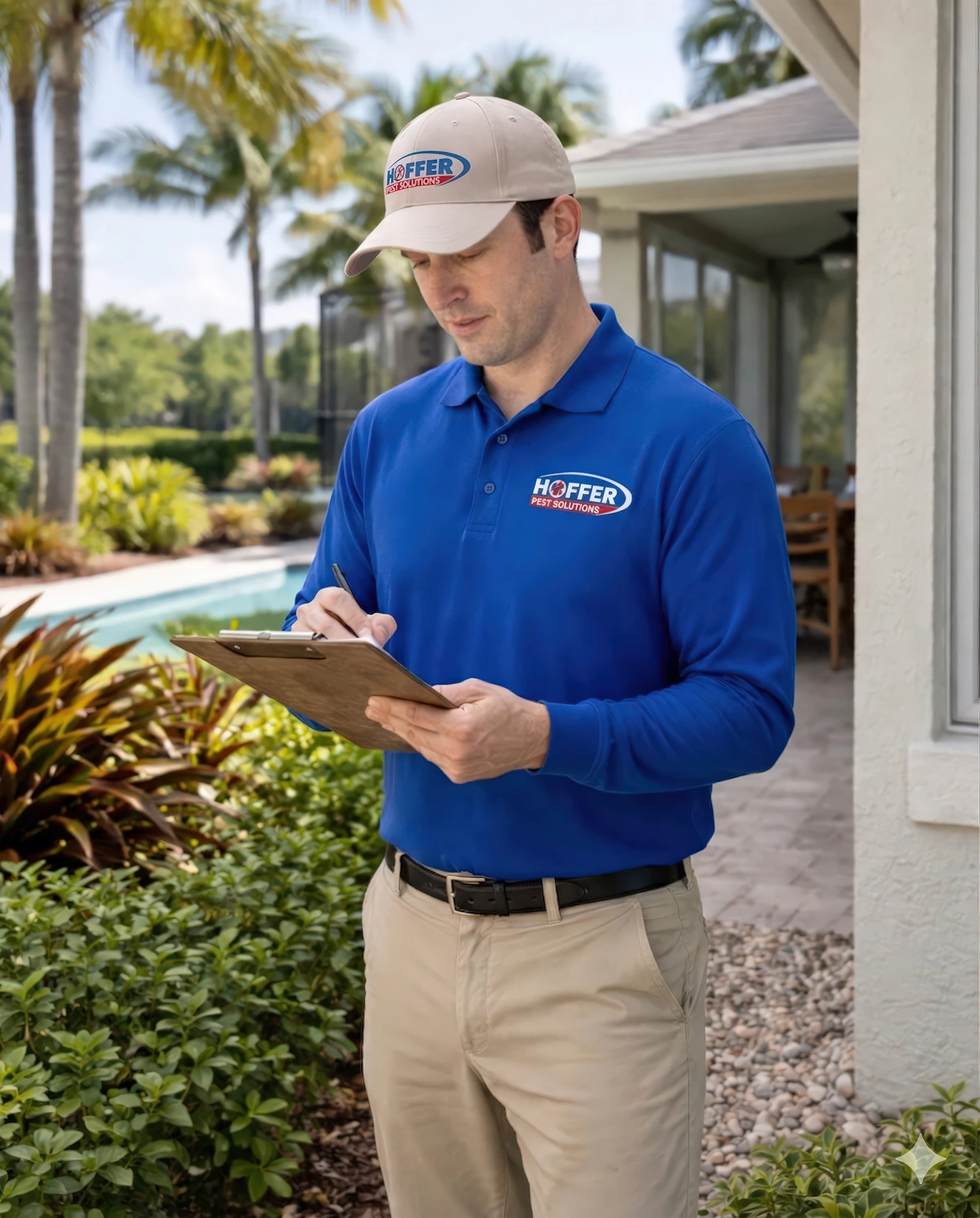
A North Miami homeowner picking up the phone wants two things on the line: a team that knows whether the rafters in their 1971 Arch Creek East ranch were built for the drywood pressure they’re under now, and a team that can talk straight about a Formosan colony pushing into a Keystone Point seawall without selling them a six-figure plan they don’t need. The standards below are what every inspection runs on, regardless of which side of the boulevard the property sits on.
A few things that come standard
- 50+ years of pest control in Palm Beach, Broward, and Miami-Dade counties.
- ACE-credentialed leadership — Associate Certified Entomologist on staff and reviewing the work.
- Same-day service available when you call early enough in the day; we’ll always tell you straight whether we can fit you in today or first thing tomorrow.
- Free inspection before you commit to anything — including a real walk of the slab line, soffits, and lanai, not a five-minute drive-by.
- Satisfaction guarantee between visits. If something comes back, so do we.
- 4,000+ five-star reviews across South Florida.
- Family- and pet-safe treatments — targeted to entry points and pressure zones, applied with the kids, the dogs, and the grandkids in mind.
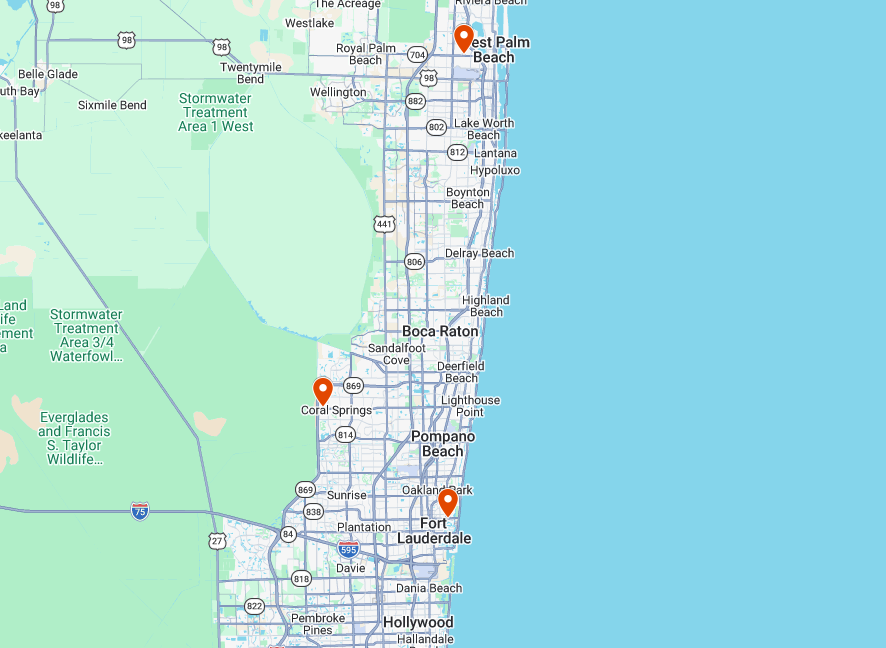
Routing into North Miami comes off the same Fort Lauderdale dispatch that handles North Miami Beach, Aventura, Sunny Isles Beach, Miami Beach, Miami, Hialeah, and the unincorporated stretches that wrap the city.
Termite Control in North Miami
North Miami is a three-species termite market, and which species drives the inspection report depends almost entirely on the parcel. On the waterfront — Keystone Point, Sans Souci Estates, the Biscayne Landing edge — Formosan subterranean (Coptotermes formosanus) is the species we lead with. The combination of saturated soil along ocean-access canals, irrigation that runs daily through tropical landscape beds, and the older 1960s and 1970s estate construction underneath the post-2000 rebuilds gives mature Formosan colonies the resource depth they prefer. Asian subterranean (Coptotermes gestroi) — established in Miami-Dade since the 1990s and still spreading — shows up on the same waterfront calls and is genuinely relevant here in a way it isn’t farther north in Broward. For homeowners researching Formosan termites in Miami-Dade, our identification guide explains how to tell Formosan colonies apart from native Eastern subterranean termites and why foraging range matters for canal-front properties.
Inland, the picture shifts. The CBS ranch inventory across Arch Creek East, Alhambra Heights, and the older central blocks is built on slab-on-grade foundations now five to six decades old. The native Eastern subterranean (Reticulitermes flavipes) is the baseline pressure on those expansion joints and plumbing penetrations, while drywood termites (Cryptotermes brevis, Incisitermes snyderi) work the wood-truss roof systems and fascia returns from above. Drywood swarms run from roughly mid-April into July — the scatter of clear wings collected off a kitchen window sill in May almost always traces back to a single gallery somewhere in the attic structure.
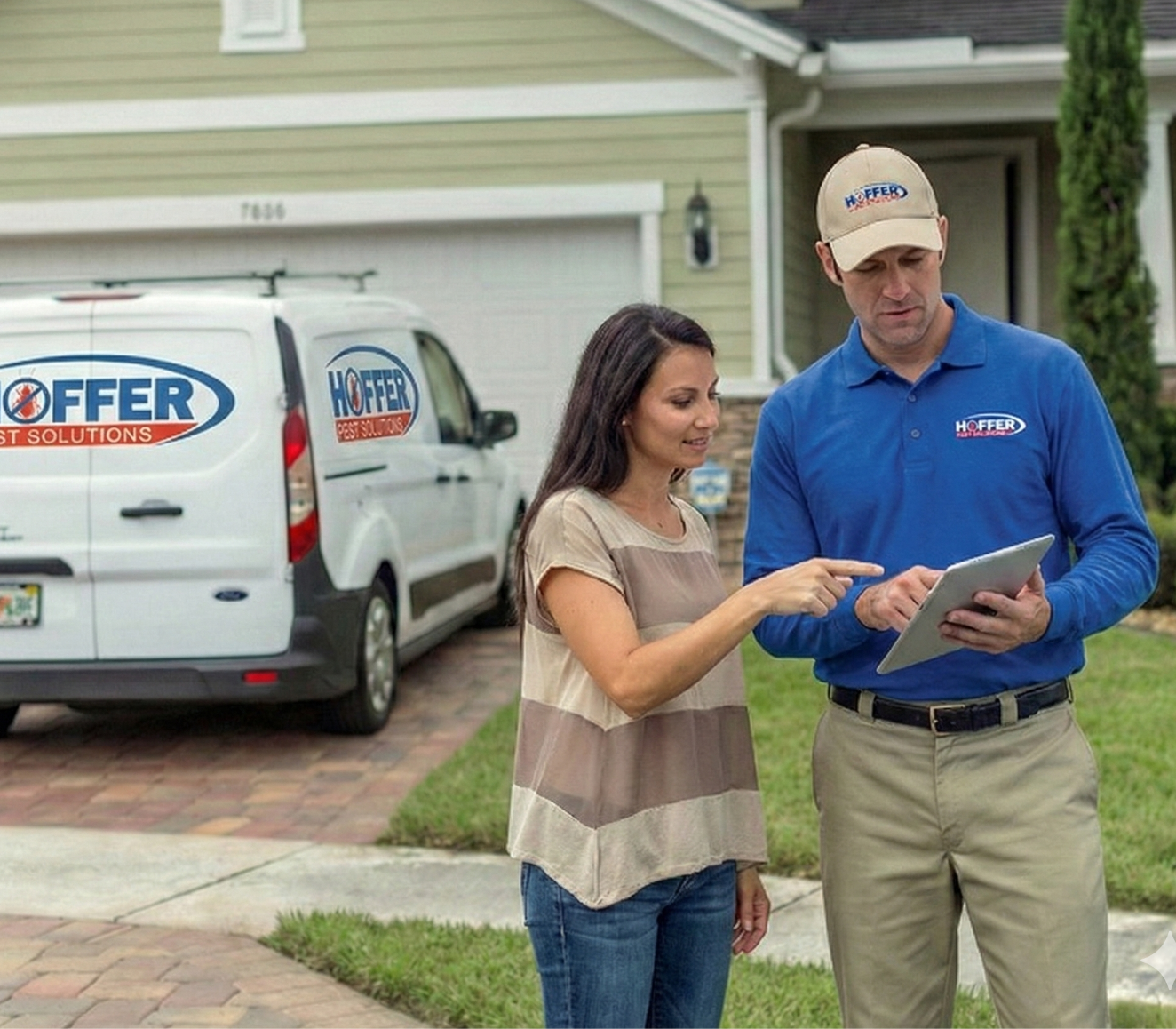
For drywood activity that is contained — a single fascia gallery, one localized frass cone at a baseboard — no-tent and spot treatments are the right call. When an attic inspection shows galleries spread through enough of the roof structure that targeted work would leave half the colony untreated, whole-structure fumigation is the honest escalation, and it is something Hoffer provides directly rather than referring out. Subterranean work runs on liquid termiticide applied to the soil envelope around the foundation, paired with in-ground bait stations as the long-term monitoring layer. On a waterfront estate, the inspection adds a walk of the seawall and dock pilings; on an Arch Creek East ranch, it adds a check of every plumbing penetration through the slab.
Hoffer also handles commercial termite work along the 125th Street and Biscayne Boulevard corridors — multi-tenant office, mixed-use retail, medical and senior-living buildings, and the educational footprint around Florida International University’s Biscayne Bay Campus. Documentation for insurance, board, or compliance use comes standard with the inspection. Learn more about our commercial pest control services.
Mosquito Control in North Miami
Four named waterways thread through North Miami — Arch Creek, Little Arch Creek, the Biscayne Canal, and the Oleta River — and the city’s own flood-hazard documentation notes that the majority of the storm system drains into one of those four or directly into Biscayne Bay. For a homeowner, the practical translation is that there is no part of this city that is meaningfully far from breeding water. With year-round mosquito pressure in South Florida, North Miami homeowners near these waterways see breeding cycles that don’t stop with cooler weather. The Oleta River mangroves on the northwest edge of the city, the brackish edges along Biscayne Bay frontage, and the canal grid that runs every block all produce something different.
The bay-side neighborhoods carry a no-see-um and salt-marsh mosquito presence that inland Miami-Dade doesn’t see — those are coastal-estuary species that move off the bay at dusk and into the back yards of Keystone Point, Sans Souci, and Biscayne Landing. The inland neighborhoods carry the standard Aedes aegypti container-breeding pressure (a bromeliad cup, a plant saucer, a sagging tarp on the side of the house) plus Culex breeding in the canal edges and storm-drain catches after every summer storm.
From June through October, the bite count rising at sunset on the patio means the program needs both halves on the same visit — a larvicide pass on the standing water actually on the parcel and an adulticide fog of the resting vegetation where the mosquitoes shelter through the heat of the day. Hoffer’s mosquito control program handles container-breeders, canal-edge populations, and the estuarine species along the bay frontage on the same route.
Ant Control in North Miami
What pushes a North Miami household to pick up the phone about ants is rarely a yard problem. It is a single-file column of tiny workers tracking the caulk line under a bathroom vanity and disappearing into the seam where the countertop meets the wall. That is ghost ants (Tapinoma melanocephalum), and on a North Miami parcel they are almost always running off the AC air handler closet or the bathroom-fan condensation pathway — the colony stages outside in the landscape bed against the foundation and follows the cool interior microclimate that the bay-adjacent water table keeps in continuous supply.
On the older inland blocks — Alhambra Heights, Arch Creek East, the central grid — the second ant call is carpenter ants (Camponotus floridanus) working softened truss lumber in an attic corner where a soffit return has been quietly wet since the last tropical wave. The colony is the symptom; the soffit is the cause. On the waterfront — Keystone Point, Sans Souci — the call profile shifts to ghost ants in pool-area cabanas, summer kitchens, and the wet rooms of bay-frontage estates where decorative hardscape, irrigation, and salt-air humidity stack against the structure.
Spraying the visible trail almost always pushes the colony into the next wall cavity instead of resolving anything. The program for ghost ants in this market is a non-repellent applied to the working trail, an exterior treatment to the slab line and landscape bed where the nest is actually staged, and a clear written note on the moisture source the colony was reading — so the homeowner can address the leak or the irrigation overspray that brought the ants in to begin with. Carpenter ant work runs in reverse — find the wet structural void first, then treat the colony — and the structural cause goes in the report alongside the chemical treatment. Fire ant pressure at foundation perimeters and patio edges is part of the perimeter program as well; on a property with kids running between the porch and the pool, foundation-line fire ant work is non-negotiable.
Rodent Control in North Miami
The dominant rodent on North Miami properties is the roof rat (Rattus rattus), and the setup the city offers them is close to ideal. The mature live oak and gumbo limbo canopy across the older inland neighborhoods gives them a roof-line travel corridor on every block. Our guide to roof rats in South Florida walks through identification, why the mature tree canopy in North Miami creates ideal travel corridors, and how exclusion-first programs work. The 1960s and 1970s CBS housing stock — wood-truss attics, fifty-year-old soffit-to-fascia seams that have widened with every thermal cycle, plumbing-vent boots sized for 1970s practice and never re-sealed — gives them entry. Oleta River State Park on the city’s northwest edge gives the population a permanent refuge it can repopulate from. On the waterfront, the bay-adjacent landscape and the storm-drain network running into the bay support the same species with a different access pattern: balcony rails, dock structures, and seawall plantings instead of oak branches.
The first indoor signs — scratching above a bedroom ceiling, chew marks along a laundry-room baseboard behind the dryer, and a row of gnawed soffit gaps visible from the driveway after sundown — pick up from late October into January. The yard cools just enough that the attic looks better than the canopy, and the population that has been living outside all summer comes in. Hoffer’s rodent control program leads with exclusion: a walk of the roofline, mapping every soffit gap, every vent boot, every plumbing penetration the rats are actually using, and sealing those openings before the trapping side of the program goes in. On the waterfront estates the exclusion walk extends to balcony rails, dock storage, and outbuilding access. Exterior monitoring stations and interior traps work in parallel through the cool-season activity window until the population is verified out.
Cockroach Control in North Miami
The roach pressure in North Miami splits the same way the city does. In single-family homes — both inland and waterfront — the dominant species is the American cockroach (the “palmetto bug,” Periplaneta americana), the large outdoor roach that lives in the storm-drain network, the canal edges, the leaf litter under mature landscape, and the mulch beds against the foundation. When a three-day summer rain stretch floods their outdoor harborage, they push toward the nearest dry structure, which is usually a garage door seal, a worn door sweep, or a weep hole at the slab line.
In the multi-family inventory — the condo towers along the Biscayne Boulevard corridor, the older apartment footprints, the multi-tenant buildings west of US-1 — the dominant species is the German cockroach (Blattella germanica). German cockroaches breed inside the structure itself and ride shared plumbing chases, HVAC runs, and the gaps under refrigerators between units. Treating one unit while the unit next door goes untreated is the most common reason a German cockroach program does not hold; coordinating with the HOA or property manager for adjacent-unit access is part of the work.
American cockroach work is exterior-driven — perimeter barrier, harborage reduction around the slab line, and a sealing pass on the structural gaps the population is actually using. German cockroach work is interior-precise — bait and insect growth regulator placed in the toe-kick under cabinets, the void behind the dishwasher, the back of the drawer next to the stove, and the cabinet face above the refrigerator. Over-the-counter sprays scatter the colony and the population reinfests within weeks.




Contact Hoffer Pest Solutions
Hoffer Pest Solutions has worked the parcels between Biscayne Bay and the western edge of the city — Keystone Point and Sans Souci on the water, Arch Creek East and Alhambra Heights on the older inland grid, Biscayne Landing along the waterfront edge, and the central blocks above NE 125th Street — for more than fifty years. We serve all of Miami-Dade County, with the Fort Lauderdale team that routes into North Miami also covering North Miami Beach, Aventura, Sunny Isles Beach, Miami Beach across the bay, Miami to the south, and Hialeah to the southwest — the cluster of cities that wraps North Miami on three sides and across the water. The program on a $3M Keystone Point estate is not the same as the program on an Arch Creek East ranch, and neither is the program on a Biscayne Boulevard condo tower. What is the same is the inspection standard, the Associate Certified Entomologist reviewing the work, and the satisfaction guarantee that covers the gap, not the visits — if something comes back before the next service date, call us and we come back.
Call 954-945-8035 or request a free inspection. Most North Miami calls placed by mid-morning can be on the same-day schedule.
Hoffer Pest Solutions
1975 E Sunrise Blvd #503
Fort Lauderdale, FL 33304
954-945-8035
Frequently Asked Questions — Pest Control in North Miami, FL
How do North Miami's four waterways affect mosquito and termite pressure on my property?
The four named waterways — Arch Creek, Little Arch Creek, the Biscayne Canal, and the Oleta River — plus the bay frontage itself create two distinct pressures. The standing water in the canal edges, the storm-drain catches, and the bromeliad cups and plant saucers in the yard breed Aedes aegypti and Culex mosquitoes from June through October. The same drainage pattern keeps soil moisture high enough that subterranean termites — particularly Formosan on the waterfront — have year-round soil conditions for foraging galleries. The fix is a parcel-level inspection: identify which standing water is on the property, which is off it, and where the soil envelope around the foundation needs attention.
What termite species are most common in North Miami's 1960s and 1970s CBS homes?
Three. Drywood termites — Cryptotermes brevis and Incisitermes snyderi — are the species that work the wood-truss roof systems, fascia returns, and decorative trim that define this housing stock, and their reproductive flights are concentrated in the mid-April-through-July window. The native Eastern subterranean (Reticulitermes flavipes) is the baseline pressure on the aging slab foundations, finding entry through expansion joints and plumbing penetrations. Formosan subterranean (Coptotermes formosanus) — documented in Miami-Dade since the 1990s — is the more aggressive colony builder where heavy irrigation or canal proximity keeps the soil saturated.
Why do Keystone Point and Sans Souci waterfront properties need more frequent termite inspections?
The waterfront stacks every conducive condition. Ocean-access canals keep the soil envelope around the foundation saturated year-round. Heavy irrigation through tropical landscape beds adds to it. Decorative hardwood on porch ceilings, summer kitchens, pergolas, and dock structures gives drywood termites — and on these properties, Asian subterranean (Coptotermes gestroi) as well — fresh entry surfaces above grade. Dock pilings and seawalls take the wood-destroying pressure directly. On a property with a structure value in the seven figures, an annual inspection that walks the seawall, the dock, the slab line, the attic, and every decorative wood detail is what the asset actually requires.
Does Oleta River State Park raise pest pressure for nearby North Miami neighborhoods?
Yes — in two specific ways. The mangrove and wetland system inside the park is a permanent mosquito production area; the prevailing summer breeze carries those adults into the neighborhoods on the city’s northwest edge. The park is also a wildlife corridor for roof rats, raccoons, and opossums that move between the preserve and the residential landscape. Properties within the first few blocks of the park boundary carry measurably higher rodent activity in the late-fall and winter window when the population pushes from the canopy into attics. The exclusion walk on those addresses is more involved than on properties further south.
Is whole-structure fumigation available for drywood termites in North Miami, or only spot treatment?
Both. Contained drywood activity — a single fascia gallery or one localized area of frass — handles cleanly with no-tent and spot protocols. When the inspection turns up galleries through enough of the wood-truss roof framing that targeted work would leave half the colony breeding, whole-structure tent fumigation is the appropriate next step, and Hoffer provides it directly. On a 1972 Arch Creek East ranch with five decades of swarming season behind the attic structure, that is sometimes simply the honest answer to what the findings show.
How is pest control on a Biscayne Bay waterfront estate different from pest control on an inland CBS home?
The species mix, the entry points, and the inspection scope all shift. Waterfront work leads with Formosan and Asian subterranean termites along seawalls and dock pilings, drywood termites in decorative hardwood, no-see-ums and salt-marsh mosquitoes off the bay, and roof rats using balcony rails and dock structures as travel routes. Inland CBS work leads with Eastern subterranean and drywood termites, Aedes aegypti in container-breeding sites, roof rats on the canopy, and ghost and carpenter ants tracking moisture through aging slabs and soffit returns. Same company, different inspection scope, different program build.
Can a single condo unit in a North Miami high-rise be treated for German cockroaches, or does the whole building need service?
A single-unit treatment can knock the visible population down, but it almost never holds. German cockroaches move between units along shared plumbing chases, HVAC duct runs, and trash-chute access. If the adjacent units — laterally, above, and below — are not addressed, the population reinfests through those shared penetrations within weeks. The reliable fix is a coordinated program that includes the affected unit and the connected units in a single visit window, which Hoffer arranges with the HOA, property manager, or condo board.
When is mosquito pressure worst in North Miami and how often does the program need to run?
Pressure ramps in late May, peaks from June through October, and tapers through November as the rainy season winds down. During peak weeks, a multi-day rain stretch refills every canal edge, retention area, and yard container the population uses, and the bite count on the patio rises at sunset. The standard program in peak season runs on a 21- to 28-day cycle, with both larvicide on standing water on the parcel and an adulticide treatment on resting vegetation. Coastal properties on the bay frontage carry a longer active season because the estuarine species don’t slow down as early.
Are Hoffer's treatments safe for kids and pets in the home?
Yes. The product selection and placement keep the active ingredient where the pest is rather than where the family is. Interior work goes into the structural voids the population is actually using — behind cabinetry, under appliances, into the slab edge where wall meets floor — so children, dogs, and visitors aren’t crossing treated surfaces during their day. On waterfront properties with summer kitchens, pool decks, and dock access, the perimeter program is calibrated around the zones where kids and pets actually move, with the perimeter band placed and timed to dry before the family is back on it.
Is Hoffer Pest Solutions the right pest control company for North Miami?
For a city this varied — guard-gated waterfront estates on Keystone Point and Sans Souci Estates, mid-century CBS ranches in Arch Creek East and Alhambra Heights, post-2000 waterfront rebuilds at Biscayne Landing, condo towers along Biscayne Boulevard, and the multi-tenant footprint around 125th Street — the company a homeowner wants is one that has put service vehicles on each of those property types in this city for decades. Hoffer fits that profile, with an Associate Certified Entomologist reviewing every program, the full menu of drywood treatment options including fumigation when the findings call for it, subterranean coverage for all three species at work in this market, and a satisfaction guarantee that runs between scheduled visits.