Pest Control in West Park
When a homeowner in Carver Ranches finds discarded termite wings on a windowsill in late April, or a parent in Lake Forest watches mosquitoes chase the kids back inside before sunset in July, or a property manager off State Road 7 takes a third bed bug call in a single quarter from one apartment building — none of those problems are unique to one street. They are West Park’s pest pressure as it actually shows up. The 1950s ranch homes that dominate Carver Ranches and Lake Forest have a different vulnerability profile than the post-2000 infill that arrived alongside the city’s 2005 incorporation, and the apartment inventory along the corridors carries its own pressure that single-family homeowners rarely think about until a neighbor mentions it at the property line.
Hoffer Pest Solutions has worked southern Broward — every era of housing stock and every property type from owner-occupied bungalow to multifamily rental — for more than fifty years. The work here is calibrated to West Park’s actual streets, not a national playbook. Call 954-945-8035 or request a free inspection and the team is out the same day in most cases, with a written report that names what was found, where it was found, and what the program looks like before any agreement gets signed.
Why West Park Homeowners and Property Managers Choose Hoffer
The question on a first call from West Park is rarely “what spray do you use.” It is closer to: who has actually worked these neighborhoods long enough to know that a 1958 Carver Ranches ranch fails differently than a 2005 New Traditional infill across town, and that the apartment buildings on the rental corridors deal with a turnover-driven pest profile the single-family inventory does not? That is the question the inspection is built to answer.
When West Park’s four pre-incorporation communities — Carver Ranches, Lake Forest, Utopia, and the Broward County portion of Miami Gardens — voted in 2005 to become Broward’s 31st municipality, they were asking residents’ question of a pest control company too: who actually shows up for this specific community on its own terms. The pest equation reflects that civic identity. Most of the housing stock is pre-1980, much of it 1950s and 1960s ranches with wood-truss roof systems drywood alates have been finding for sixty years. A meaningful slice is post-2000 infill where structural drywood exposure is lower but irrigation against the foundation has put subterranean pressure on the slab perimeter. And 37 percent of households rent, almost all in shared-wall multifamily inventory where one bug in one unit becomes a building problem fast.
What that buys West Park residents and property managers: over fifty years of southern Broward field work, an Associate Certified Entomologist (ACE) calibrating the program, an end-to-end walkthrough of structure, soffit line, slab perimeter, and (for multifamily) shared-wall pathways before any agreement is written, treatment placement built to keep kids and pets out of contact with active ingredient, a documented service record routed to the homeowner or property manager, and a guarantee that covers the gaps between scheduled visits.
A few things that come standard
- 50+ years of pest control in Palm Beach, Broward, and Miami-Dade counties.
- ACE-credentialed leadership — Associate Certified Entomologist on staff and reviewing the work.
- Same-day service available when you call early enough in the day; we’ll always tell you straight whether we can fit you in today or first thing tomorrow.
- Free inspection before you commit to anything — including a real walk of the slab line, soffits, screens, and perimeter, not a five-minute drive-by.
- Satisfaction guarantee between visits. If something comes back, so do we.
- 4,000+ five-star reviews across South Florida.
- Family- and pet-safe treatments — targeted to entry points and pressure zones, applied with the kids, the grandkids, and the dogs in mind.
Termite Control in West Park
Termite work in West Park runs along two tracks because the housing stock does. The 1950s and 1960s ranch homes in Carver Ranches and Lake Forest were built with wood-truss roof framing, fascia, and soffit lumber that drywood termites (Cryptotermes brevis and Incisitermes snyderi) have been infiltrating for sixty-plus years. Swarming runs April into July, and the homeowners who catch it first find piles of discarded wings under a porch light or a screen door, or fine pellet-like frass tracking down a wall from a baseboard or a fascia joint.
Subterranean pressure is the other half. Eastern subterranean termite (Reticulitermes flavipes) is the regional baseline, and Formosan subterranean (Coptotermes formosanus) has been documented across southern Broward since the 1990s. Both exploit slab-on-grade construction — common in West Park across every housing era — and the high water table the surrounding canal grid maintains. Localized or no-tent protocols handle contained drywood activity. Whole-structure fumigation is the route when an inspection shows the activity has spread across enough of the roof system or framing that spot work won’t hold. Subterranean programs run on soil-applied termiticide barriers and in-ground bait stations along the slab perimeter.
Mosquito Control in West Park
West Park sits inside the broader C-9 and C-10 canal drainage area, on flat, low-elevation land that depends on canals, retention basins, and pumps to move stormwater off the parcels during the wet season. When the June through October rains come in three- and four-day stretches, standing water collects in retention edges, in tarped construction setups, and in the small container breeders most homeowners walk past every day — bromeliad cups, plant saucers, clogged gutters, the underside of the wheelbarrow tipped against the fence.
With 42 percent of West Park households raising children under 18, the cost of an untreated yard during peak season is measured in evenings the kids do not get to spend outside. Hoffer’s mosquito program treats standing-water sources with larvicide that holds for roughly 30 days, then fogs the vegetation and resting harborage where adult mosquitoes shelter during the day.
Ant Control in West Park
Two ant species drive the West Park residential service calendar. Ghost ants (Tapinoma melanocephalum) are the tiny pale-bodied trailing ant homeowners notice running across kitchen counters and along bathroom caulk lines, drawn to the moisture gradients in CBS slab construction — exactly the construction type West Park is built on. They follow expansion gaps where the slab meets the wall plate and trail in from exterior soil-line vegetation. Carpenter ants (Camponotus floridanus), the larger black or bicolored ant species, are the attic problem in the 1950s and 1960s Carver Ranches ranches — they excavate galleries in moisture-damaged wood-truss components, fascia, and soffit framing that has taken on water from a slow roof leak or a chronically clogged gutter.
The program treats interior trails and exterior origin together, not separately. That means perimeter and entry-point work along the slab line, targeted interior placement in trail areas, and a moisture review that flags the conditions that brought the colony in to begin with.
Rodent Control in West Park
Rodent pressure here is roof-rat pressure first. Roof rats (Rattus rattus) are the climbing species that dominates urban Broward, and the older ranch inventory in Carver Ranches and Lake Forest is exactly the kind of structure they exploit — wood-truss attic spaces, soffit-to-fascia gaps that have widened over six decades of subtropical weather cycles, and roof penetrations around plumbing vents and HVAC chases sized for 1958 standards and never re-sealed. Activity peaks in the cooler stretch from late October into the new year.
The 1950s-era plumbing in the older housing stock adds a second route. When sanitary lines crack at the slab penetration or a cleanout cap goes missing under a kitchen sink, the gap becomes a Norway rat access point from the soil side. Hoffer’s rodent work opens with an exclusion inspection — locating and sealing the openings on the roof, soffit, slab, and utility penetrations — paired with tamper-resistant exterior stations and interior monitoring.
Cockroach Control in West Park
Three roach species drive West Park service calls. German cockroaches (Blattella germanica) are the small light-brown indoor-only species that exploits kitchens, behind appliances, and cabinet voids in single-family homes and shared-wall multifamily units alike — and the multifamily inventory along the corridors gives them the unit-to-unit pathway they need to recur. American cockroaches (the reddish-brown roach Floridians call palmetto bugs) push inside through floor drains, garage thresholds, and slab utility penetrations during the wet season. Smokybrown roaches (Periplaneta fuliginosa) work the soffit and attic margins of older ranches, especially where leaf litter accumulates against a fascia line. Treatment matches the species: German programs depend on placement in cabinet voids and a follow-up cycle calibrated to the egg-case timeline, while American and smokybrown pressure is treated at the exterior perimeter and the harborage on the parcel.
Pest Pressure Specific to West Park
Beyond the standard southern Broward pest lineup, West Park carries a distinct housing-driven pest pressure that property managers in town know by name. Thirty-seven percent of West Park households rent — a meaningful slice of those inside the 305 to 364 multifamily units documented across the major rental aggregators — and the post-2005 civic merger of four neighborhoods into one municipality has kept the city absorbing new residents on a regular cadence. Shared-wall construction plus tenant turnover plus furniture and luggage in and out has one industry name attached to it.
Bed Bugs in West Park’s Multifamily Rental Inventory
Bed bugs (Cimex lectularius) ride in on used furniture, on a mattress brought from a previous apartment, on a suitcase set down in a hallway. Once inside a multifamily unit, they migrate — through electrical conduit runs, plumbing chases, and common walls — and turn a single-unit report into a building problem inside one lease cycle. The University of Florida IFAS Extension’s multifamily guidance (ENY2084) is explicit on this: shared walls and utility chases let infestations cross between units. Identification is a flat reddish-brown insect the size of an apple seed in mattress seams, box-spring corners, and headboard joints, with small dark fecal spots along seam lines and clustered itchy welts on skin after sleep.
Hoffer’s program inspects the whole unit before the plan is written and, in multifamily structures, extends the walkthrough to adjacent units along shared walls. Treatment combines targeted thermal work where contained, residual placement in cracks and crevices, and follow-up visits timed to the bed bug life cycle so the egg stage does not re-establish. For landlords and property managers, every visit produces written documentation for tenant records and lease compliance.




Contact Hoffer Pest Solutions
Hoffer Pest Solutions has worked southern Broward’s full property mix — the 1950s and 1960s ranch homes that fill Carver Ranches and Lake Forest, the 1970s bungalow infill, the post-2000 New Traditional infill that followed West Park’s 2005 incorporation, and the multifamily apartment inventory along the corridors — long enough to know how each one fails and what an inspection has to cover.
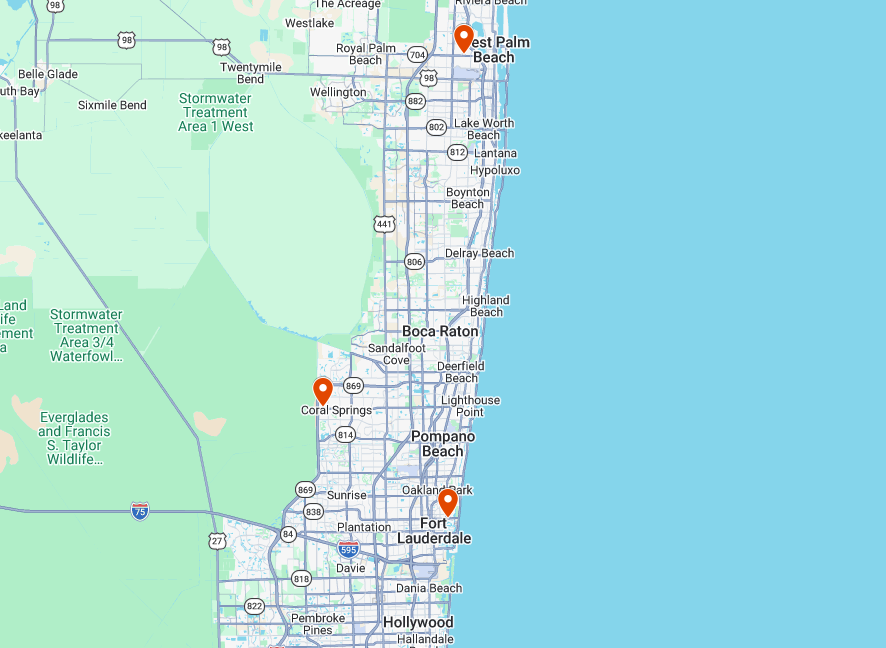
Behind that work: over fifty years of southern Broward pest field experience, an Associate Certified Entomologist (ACE) reviewing every program, a full walking inspection of structure, soffit line, slab perimeter, and shared-wall pathways before any agreement is signed, written documentation routed to whichever contact the homeowner or property manager designates, treatment placement calibrated for the kids and pets in the home, and a satisfaction guarantee between scheduled visits. The Fort Lauderdale office serves West Park and continues into Hollywood to the north and Miramar to the south.
Call 954-945-8035 or request a free inspection.
Hoffer Pest Solutions
1975 E Sunrise Blvd #503
Fort Lauderdale, FL 33304
954-945-8035
Frequently Asked Questions — Pest Control in West Park, FL
I rent in a West Park apartment and bed bugs came through the shared wall — what do I do?
Report it in writing to the landlord or property manager first — a written report starts the response clock. Then have the unit inspected so the harborage map (mattress seams, box-spring corners, headboard joints, outlet plates, the closet) is documented. Hoffer treats both the affected unit and, when the property manager authorizes it, the adjacent units along the shared-wall path. Treatment is timed to the bed bug life cycle, which is why a single visit rarely finishes the job.
Do you work with property managers on multifamily buildings in West Park?
Yes. The team runs scheduled programs for multifamily portfolios across southern Broward — turnover-driven bed bug response, building-wide German cockroach prevention, perimeter rodent stations, mosquito service in shared outdoor areas, and documented reports for tenant records, lease compliance, and insurance audits. Inspection scope extends beyond the single reported unit because in shared-wall construction the activity rarely stays in one apartment.
What termite species should the owner of a 1950s Carver Ranches ranch home watch for?
Both profiles. Drywood activity (Cryptotermes brevis, Incisitermes snyderi) lands in the wood-truss roof framing, fascia, and soffit lumber typical of 1950s and 1960s ranch construction — alates swarm April into July and shed wings under porch lights. Subterranean activity, primarily Eastern subterranean (Reticulitermes flavipes) with documented Formosan presence in southern Broward, works the slab perimeter from the soil side. The inspection covers both because each species takes a different treatment.
Is tent fumigation an option for severe drywood termite damage in older West Park homes?
Yes. When an inspection finds drywood activity dispersed widely enough across the roof framing or interior wood that spot work cannot reach it, whole-structure fumigation is the standard escalation — scheduled when the inspection findings show the dispersion is real. Contained activity (a single fascia run, a localized attic section, a window frame) is usually the right match for no-tent or localized protocols. The inspection report walks through what was found and which protocol fits before anything is signed.
Does Hoffer serve all four of West Park's original neighborhoods — Carver Ranches, Lake Forest, Utopia, and Miami Gardens?
Yes. The Fort Lauderdale office covers the entire 2.26-square-mile West Park footprint — every street inside the four pre-incorporation communities that became the city in March 2005. (Note: “Miami Gardens” here is the Broward County neighborhood that merged into West Park, not the separate City of Miami Gardens in Miami-Dade.) Same program runs across all four, calibrated to the housing era on the parcel.
When is drywood termite swarming season in West Park, and what do swarmers look like?
Drywood swarming runs April through July in southern Broward. Alates leave the colony in evening mating flights and are drawn to lights, then shed their wings before pairing off. The most common homeowner discovery is not a live insect but a small pile of identical translucent wings under a porch light, on a windowsill, or along a sliding door track. A clear wing pile inside a 1950s or 1960s ranch home is reason to schedule an inspection promptly — it means an established colony is nearby.
Why are mosquitoes worse in West Park during the rainy season, and what does Hoffer's treatment cover?
West Park sits on flat, low-elevation land in southern Broward’s broader canal drainage area. June through October wet-season rain collects in retention edges and in container breeders — plant saucers, bromeliad cups, clogged gutters, kiddie pools. The mosquito program treats standing-water sources with larvicide for roughly 30-day control and fogs the vegetation where adult mosquitoes shelter during the day, so the yard is usable through peak season.
Are Hoffer's treatments safe for kids and pets in a family-occupied home?
Protocols are built around placement and dry-time discipline, not broadcast application. Interior product is placed in the harborage areas — cabinet voids, behind appliances, expansion gaps where the slab meets the wall plate, the structural voids where pests actually shelter — so it sits in the places pests live, rather than on surfaces where families live. Exterior liquid work has a documented re-entry window written on the service ticket. Exterior rodent stations are locked, tamper-resistant designs.
What's the difference between Eastern and Formosan subterranean termites in West Park?
Eastern subterranean termite (Reticulitermes flavipes) is the regional baseline — the species most West Park homes face from the slab perimeter. Formosan subterranean (Coptotermes formosanus) has been documented across southern Broward since the 1990s. Formosan colonies are larger, more aggressive, and capable of more damage in a shorter window, which is why finding Formosan activity moves treatment toward more comprehensive soil-applied barriers and in-ground bait stations. The inspection identifies which species is active before the program is built.