
Pest Control in Surfside
Surfside is the half-square-mile town that the Surf Club founders carved out in 1935 to stay independent of Miami Beach, and ninety-something years later the place still reads like its own thing. A row of oceanfront condo towers along Collins Avenue. A short, walkable commercial spine on Harding Avenue with bakeries and a cleaners and a few cafes that keep the lights on through the off-season. A Community Center and the Town Pier on 93rd Street that residents actually use. And, behind the towers, an interior grid of small single-family streets running west toward Biscayne Bay where the 96th Street causeway crosses over to Bay Harbor Islands. Most pest-control content treats Surfside as a generic stretch of Miami-Dade beachfront. It isn’t.
The pest pressure here splits along the same line the housing stock does. The towers along Collins Avenue and the smaller mid-rise buildings inland are concrete-and-steel — meaning drywood termites work the wood that’s actually there (roof systems, balcony fascia, soffit returns, decorative interior trim, the post-2010 luxury hardwood finishes), ghost ants and German cockroaches run through shared plumbing chases between back-to-back kitchens, and roof rats climb exterior conduit runs onto the building. The single-family streets behind the towers are a different problem set: tile-roofed CBS homes from the 1940s and 1950s, mature ficus and live-oak canopy over short blocks, slab-on-grade foundations sitting in moist sandy soil two blocks from the Atlantic on one side and Biscayne Bay on the other. A program that works in Surfside has to read both sides of that line.
Hoffer Pest Solutions has worked the Miami-Dade coastal corridor for more than fifty years. Call 954-945-8035 or request a free inspection. A technician is usually out the same day, with a written walk of the findings — exterior, slab line, roof access where it’s available, and the interior — before anything is signed.
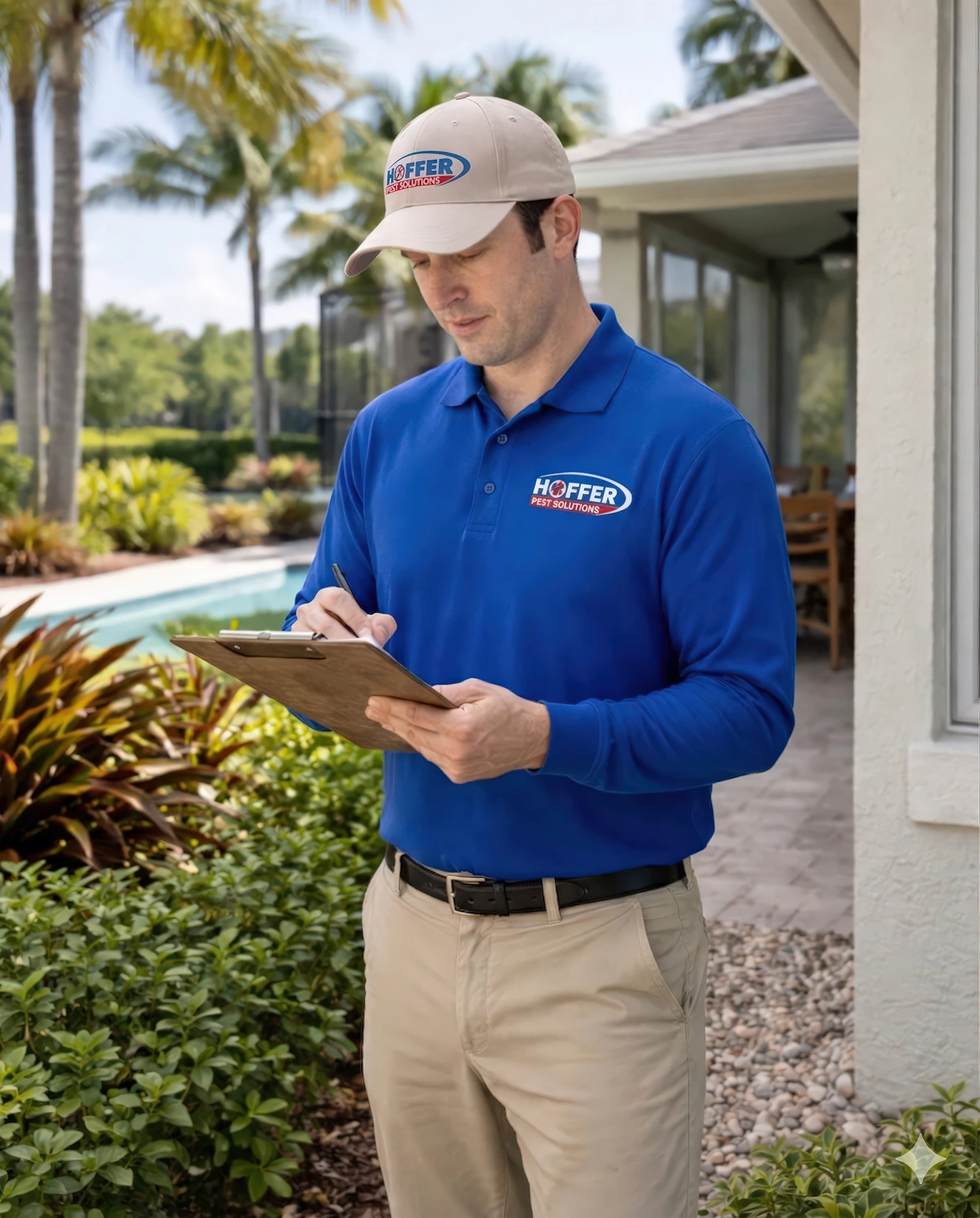
Why Surfside Homeowners Choose Hoffer
A few things that come standard
A call into Hoffer from a Surfside address can come from either side of the town. One morning it’s a unit owner in a Collins Avenue tower who saw drywood frass on a windowsill the housekeeper pointed out. The same afternoon it’s a homeowner two blocks west, on Carlyle or Garland or one of the interior streets running toward the bay, who heard scratching above the ceiling in the back bedroom for three nights straight. The work doesn’t look the same — the tower call needs property-manager coordination and access to the building’s shared chases; the single-family call needs a walk of the soffits, the tile-roof line, and the ficus canopy out front — but both calls go to a team that has worked this barrier island for decades.
- 50+ years of pest control in Palm Beach, Broward, and Miami-Dade counties.
- ACE-credentialed leadership — Associate Certified Entomologist on staff and reviewing the work.
- Same-day service available when you call early enough in the day; we’ll always tell you straight whether we can fit you in today or first thing tomorrow.
- Free inspection before you commit to anything — including a real walk of the slab line, soffits, and lanai, not a five-minute drive-by.
- Satisfaction guarantee between visits. If something comes back, so do we.
- 4,000+ five-star reviews across South Florida.
- Family- and pet-safe treatments — targeted to entry points and pressure zones, applied with the kids, the dogs, and the grandkids in mind.
The technicians dispatched into Surfside work out of the Fort Lauderdale office that also covers Bal Harbour to the north, Miami Beach to the south, Sunny Isles Beach up the coast, and North Miami Beach across Biscayne Bay. One service area, one route schedule, one bar for the inspection — whether the work in front of the technician is a single condo unit, a coordinated multi-unit pass on the Collins line, or a 1950s CBS home on an interior block.
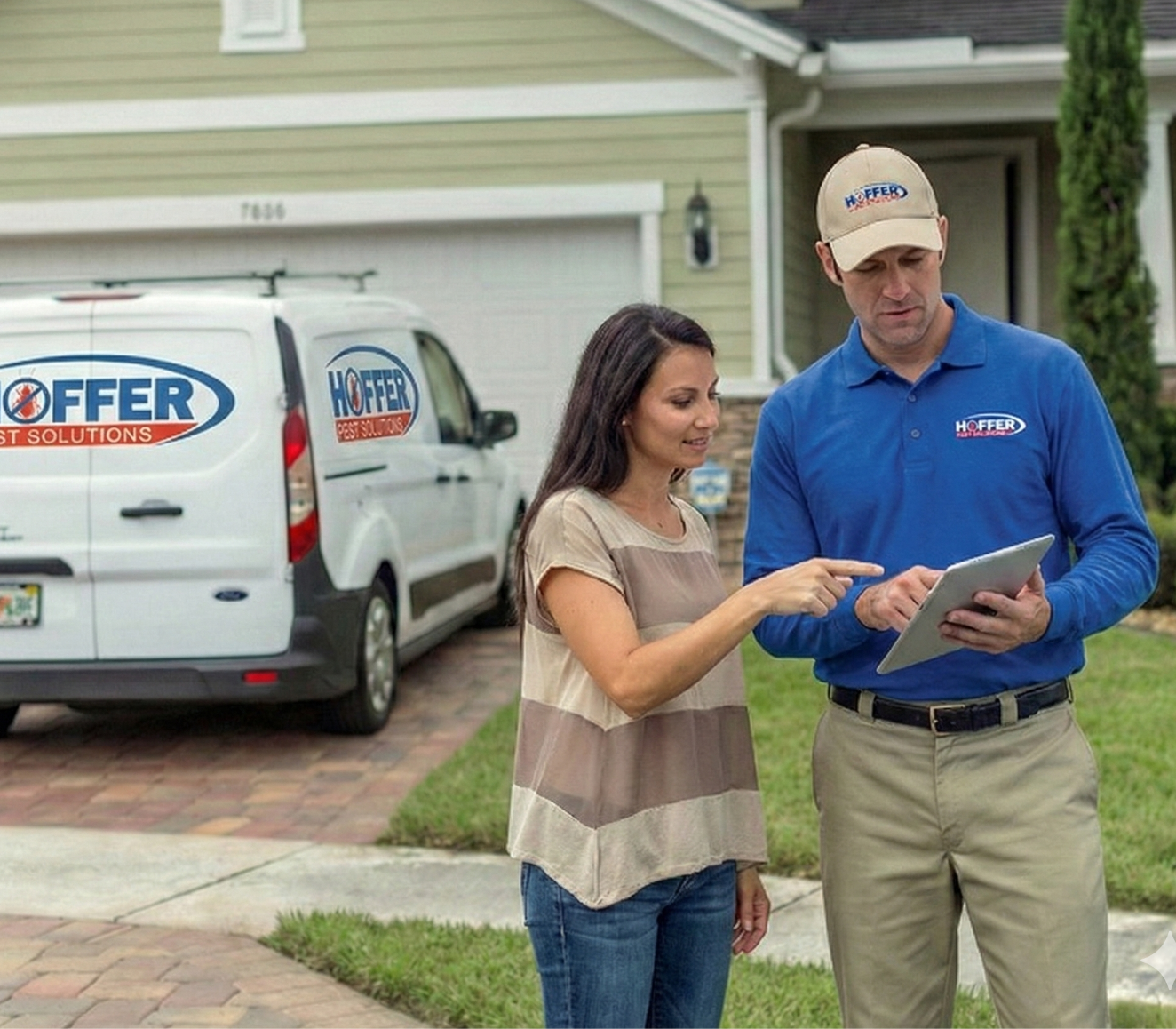
Termite Control in Surfside
Termite work in Surfside is a two-pattern job because the housing stock is two patterns. The condo towers along Collins Avenue, the post-2000 luxury infill buildings, and the older 1980s and 1990s mid-rises that make up most of the town’s housing inventory are concrete-and-steel — drywood termites do not eat the columns or the slabs, but they reach the wood that lives in roof systems, balcony fascia and soffit returns, window and door bucks, interior partition framing behind drywall, and the decorative interior wood that shows up everywhere in the post-2010 luxury construction along the oceanfront (mahogany trim, cedar millwork, tropical hardwood cabinetry, custom ceiling work). The single-family streets west of Collins — the interior CBS homes from the 1940s through the 1970s — carry a more traditional pattern: drywood activity in tile-roof underlayment, fascia, soffit boards, and any wood-framed additions; subterranean activity coming up through slab penetrations, expansion joints, and the irrigated landscape lines that wrap most of those small lots.
Cryptotermes brevis, the West Indian drywood termite, is the dominant drywood pressure on this stretch of barrier island. Alate swarms run heaviest from late April into July, and on a Surfside property they reach roof systems through ventilation gaps, upper-floor units through window-frame joints, and renovation work through interior millwork that wasn’t pre-treated. The subterranean side is real on both housing types. The sandy soil, the high water table sitting just below grade on a barrier island, the year-round irrigation on condo landscape perimeters, and the mature ficus and live-oak root systems on the interior single-family streets all support three subterranean species: Reticulitermes flavipes (Eastern subterranean, the native), Coptotermes formosanus (Formosan, established in Miami-Dade since the 1990s), and Coptotermes gestroi (Asian subterranean, also established in Miami-Dade and continuing to spread). On Surfside specifically, the irrigated planter beds along the Collins Avenue tower perimeters and the slab edges on interior single-family streets are both consistent subterranean pressure zones.
Tenting a twelve-story oceanfront tower is not a serious option. The configuration of a high-rise on Collins Avenue, the occupancy schedule of a condo association, and the sheer logistics of sealing a structure that tall rule it out before anyone runs the cost numbers. The treatment story in Surfside is honest about that and works through what fits the building. For confined drywood activity inside a single unit — a kicked-out gallery in a baseboard, frass appearing on a single windowsill, swarmers emerging from one ceiling-trim run — no-tent and localized spot work do most of the job. Where activity is wider but still inside one residence, an individual-unit protocol confines the treatment to that residence without putting the rest of the building through anything. For the single-family side of town, the picture shifts: a 1950s CBS home on an interior street with widespread drywood activity through the roof system and the fascia can be tent fumigated, and Hoffer does that work when the inspection finds the infestation has reached that level. Subterranean treatment is the same on both housing types — a liquid termiticide barrier applied below grade along the foundation and around plumbing and conduit penetrations, with in-ground monitoring stations set into the landscape line as the long-term watch on the perimeter. Read more about our termite control services.
Mosquito Control in Surfside
Surfside is one of the few South Florida addresses with the Atlantic Ocean on one boundary and Biscayne Bay on the other, and that dual water exposure shows up directly in the mosquito work. The salt-marsh side of the story comes off the bay edges, the seawalls along the 96th Street causeway, and the channel between Surfside and Bay Harbor Islands — Aedes taeniorhynchus, the black salt-marsh mosquito, breeds in the tidal flats and can fly miles from the breeding site, which is what makes a fourth-floor balcony on a Collins Avenue tower no further out of reach than a back patio on Hawthorne Avenue. The freshwater-source story comes from condo landscape retention features, planter beds that hold water after rainy-season storms, roof drains on the mid-rise buildings, and the standing water that gathers in the gutter system of an older single-family home with a heavy ficus canopy overhead.
June through October is the peak window — heat, humidity, and the afternoon thunderstorm rotation that drops an inch of rain in twenty minutes and leaves it sitting. The Surfside Community Center grounds, the Town Pier landscape, the pool decks and balcony plantings on the Collins Avenue condo line, and the irrigated planting strips along Harding Avenue all sit on the program’s map. Hoffer’s mosquito control program treats the adult mosquitoes where they shelter through the day — under the deeper landscape vegetation, behind shrub lines, in the planter beds — and treats the breeding sources where they’re reachable: condo retention features, planter bed drainage, gutter overflow pathways. Background coastal pressure runs year-round. The seasonal spike is layered on top of that, not separate from it.
Ant Control in Surfside
The ant species driving Surfside calls depend on which side of town the address sits on. In the condo towers along Collins Avenue and in the smaller mid-rise buildings inland, the dominant indoor pressure is ghost ants — Tapinoma melanocephalum, the pale workers with dark heads that show up at bathroom caulk lines, around dishwasher water-supply connections, and at the kitchen sink penetration where the plumbing comes up through the slab. They’re moisture readers, and a high-rise gives them dozens of consistent moisture sources stacked floor over floor. On the single-family interior streets, the call mix shifts: ghost ants are still the most common indoor pressure, but carpenter ants show up in older CBS homes with wood-framed roof systems and any wood additions, and acrobat ants and white-footed ants make appearances when the surrounding landscape and tree canopy give them somewhere to nest outdoors.
A ghost ant program in a Surfside condo does not stop at the unit threshold. The colony reads the shared plumbing chases between back-to-back kitchens and the vertical risers between floors as one habitat, which means treating the visible trail in one unit without working the chase access points usually buys a few weeks of quiet before workers reappear two units over. The program runs slow-acting gel baits placed at the actual moisture-source contact points — under the sink trap, behind the dishwasher kick plate, into the access panel behind the tub — and at the shared-chase entry points when the property manager can coordinate access. On the single-family side, carpenter ant work means finding the structural moisture source they’re nesting against: the spot where the soffit return meets a wall corner that took on water during a storm season three years ago, the wood-framed addition where the roof penetration leaks during heavy rain, the section of fascia that’s been quietly saturated under a tile-roof leak. Treatment without finding the moisture source just relocates the colony. Read more about our ant control services.
Rodent Control in Surfside
Roof rats — Rattus rattus — drive most of the rodent calls in Surfside, and the way they reach a structure changes with the address. On the single-family interior blocks west of Harding Avenue, the mature ficus, live oak, and banyan canopy that shades the short streets doubles as a roof-rat travel network. A rat working its way from one yard to the next never has to come down to grade if the canopy is continuous, which means by the time it reaches a 1950s CBS home’s tile roof, the exterior bait stations set at the property perimeter are already irrelevant. From the canopy it finds the tile-roof gaps, the soffit vents under a low overhang, and the garage door seal that’s lost some compression over a couple of decades. On the oceanfront condo line and the mid-rises along Harding, the climb is up the structure rather than through a canopy — rough stucco exteriors, exposed pipe runs, lobby planter trellises near the entry, and the seawall vegetation on the bay-side buildings give a rat the same kind of vertical pathway the canopy gives it inland.
The signs read differently in the two settings. On a single-family call, the homeowner usually hears it first — scratching above the back bedroom ceiling for several nights running, then daytime rubmarks along a soffit run, then droppings in the attic at the corner above the kitchen. On a high-rise call, the building engineer often finds it before a unit owner does — droppings on the top of a fire-sprinkler riser in a shared chase, gnaw marks on a piece of cable insulation in a mechanical room, a unit owner two floors up reporting overnight noise. Activity steps up from late October into January when overnight temperatures shift just enough that indoor shelter is the easier option. Hoffer’s rodent control program in Surfside leads with exclusion. On the single-family side, that’s a walk of the tile-roof line, the soffit vents, the gable vents, the garage door seal, and any utility penetrations on the exterior wall, with each gap closed off before the trapping side runs. On the condo side, the engineer walks the roofline, the mechanical room penetrations, and the trash room thresholds with the technician, and exclusion happens at the same time as monitoring goes in at parking-garage entries and the landscape perimeter.
Cockroach Control in Surfside
Two roach stories run in parallel in Surfside, sorted by which side of town you live on and what time of year it is. German cockroaches — Blattella germanica — are the small indoor species that never sees the outdoors, and they show up most often on the multi-unit side of town: the condo line on Collins, the mid-rises near 96th Street, the older walk-up apartments off Harding. The unit they’re found in is rarely the unit they started in. A neighbor’s kitchen, a back-of-house service room, an older sewer riser shared between stacked units — any of those can seed a colony that then drifts laterally through the building over weeks. On the single-family side, German cockroach work is rarer and usually traces to one specific event: a delivered appliance with hitchhikers, groceries from an apartment with an active population, a remodel that opened a plumbing pathway that hadn’t been disturbed in years.
Palmetto bugs — American cockroaches, Periplaneta americana — are the large outdoor species, and a barrier-island town with a bay on one side and the Atlantic on the other gives them more harborage than most inland addresses. They live in storm-drain inlets along Harding, in the seawall riprap behind bay-side buildings, in the mulch beds around the Town Pier landscape, and in the irrigation utility boxes set flush into condo planting beds along Collins. A heavy summer storm or a high-tide event around the channel under the 96th Street causeway pushes them toward the nearest dry structure — for the condo line that means ground-floor lobbies and parking-garage entries; for the single-family blocks that means slab-edge entries, garage door thresholds, and the gap under a side gate where a hose bib drips through the summer.
The German cockroach program treats harborage rather than surface — gel bait and growth regulators placed inside the appliance cavities, into the back of the cabinet under the sink, along the seam where the toe-kick meets the cabinet box, and into any shared service penetration the building’s plumbing layout gives access to. Retail aerosol pushes the colony apart and sends scattered survivors looking for new harborage two units away, which is exactly the opposite of what the program is trying to do. The American cockroach response runs on the outside of the structure — a perimeter treatment at the slab edge, harborage reduction in storm-drain inlets and irrigation boxes where the property line allows, and physical exclusion at the points the rain pushes them through: garage door sweeps that have flattened over the years, threshold seals at the lobby entry, screen mesh on the dryer vent termination. Read more about our cockroach control services.




Hoffer Pest Solutions — Serving Surfside For 50+ Years
Hoffer Pest Solutions has worked the Miami-Dade coastal corridor — Surfside, Bal Harbour, Sunny Isles Beach, Miami Beach, and North Miami Beach — for more than fifty years. What that time on this barrier island has produced is pattern recognition: which fascia run the drywood swarmers reached on a Collins Avenue tower last spring, which shared chase the ghost ants moved through last summer, which tile-roof penetration on a 1950s CBS home off Harding Avenue let roof rats into the attic last fall. A town that has held its independent identity since the Surf Club founders incorporated it in 1935 has done so by taking maintenance seriously — termite inspections, moisture management, exclusion work, the unglamorous discipline that keeps a building or a home sound on a barrier island where salt air and humidity never let up. Pest control sits inside that discipline as one of its working layers.
Every program here passes through Hoffer’s Associate Certified Entomologist for review. The inspection is a walk of the property, and the findings are documented before any treatment plan is written. The standing offer between scheduled visits is straightforward: if something resurfaces, the next visit covers it.
The Fort Lauderdale team that handles Surfside also handles Bal Harbour, Miami Beach, Sunny Isles Beach, and North Miami Beach — the cluster of barrier-island and waterway-adjacent cities that frame Surfside on every side.
Call 954-945-8035 or request a free inspection. A morning call into the dispatch line is usually on the same-day schedule — whether the address is a unit on Collins, a building manager working a multi-unit pass, or a homeowner two blocks inland.
Contact Hoffer Pest Solutions
Hoffer Pest Solutions
1975 E Sunrise Blvd #503
Fort Lauderdale, FL 33304
954-945-8035
Frequently Asked Questions
Do oceanfront condos in Surfside really get termites?
They do — drywood termites mostly, and not in the places a homeowner would guess from a single-family-home frame of reference. The concrete columns and slabs in a Collins Avenue condo are not the target. The wood that is present in the building is: roof systems, fascia and soffit runs, the bucks framing windows and balcony sliders, partition framing inside unit walls behind the drywall, and in the post-2010 luxury construction the decorative interior hardwood (mahogany, cedar, custom millwork) that gets installed during high-end finish-out. Cryptotermes brevis swarmers find their way to upper-floor units through ventilation paths at the roofline and through gaps around window and slider frames, with the heaviest swarming window running late April into July. Subterranean activity shows up at the ground-floor levels too — slab edges, irrigated planting beds along Collins, and the moist landscape strips between the building and the sidewalk.
If you can't tent a Surfside high-rise, how do you actually treat termites in one?
With the options that fit the structure. No-tent protocols handle drywood activity inside a single unit when the affected wood is reachable and the gallery system has not spread beyond it — a baseboard run, a section of trim, the framing around one window. Localized spot work covers the smaller version of the same situation: one kicked-out gallery, one frass-producing run of ceiling molding. Individual-unit fumigation protocols cover the broader case where the activity is wider but still contained to one residence. For the CBS single-family inventory on Surfside’s interior streets running west toward Biscayne Bay, full structural fumigation is on the table when the inspection finds enough drywood activity through the roof system and the fascia to call for whole-structure work. Subterranean treatment everywhere in town uses a liquid termiticide barrier below grade with in-ground monitoring stations along the landscape line.
Why are ghost ants such a common problem in Surfside condos?
Because Surfside’s condo inventory is shared-infrastructure inventory and ghost ants are moisture readers. Tapinoma melanocephalum finds the consistent moisture at bathroom caulk lines, dishwasher water-supply connections, and kitchen sink penetrations — and in a high-rise on the Collins Avenue line, those moisture sources are stacked floor over floor and connected by shared plumbing chases between back-to-back units. Treating one visible trail without working the chase access points usually buys a few weeks of quiet before workers reappear two units over. The fix is slow-acting gel bait at the actual contact points and coordinated chase access through the property manager.
What's the difference between pest control for a Surfside oceanfront condo and a single-family home on one of the interior streets?
Different access patterns, different infrastructure, different program. On the Collins Avenue oceanfront condo side, the program reads the building: shared plumbing chases, shared HVAC trunks, trash chute rooms, balcony fascia, the building roofline, and the property-manager schedule for multi-unit coordination. On the single-family interior streets west of Harding Avenue, the program reads the property: the slab edge, the soffit and tile-roof line, the mature ficus or live-oak canopy as a roof-rat highway, the irrigation control box at the side gate, and the moisture source behind the section of fascia where carpenter ants are nesting. Same team. Different work.
Does Surfside's dual exposure — Atlantic Ocean on one side, Biscayne Bay on the other — change the mosquito problem?
Yes, and it adds layers. Salt-marsh mosquitoes (Aedes taeniorhynchus) breed in the tidal flats along the bay edges, the seawalls under the 96th Street causeway, and the channel between Surfside and Bay Harbor Islands — and they can fly miles from the breeding site, meaning a balcony on the Collins Avenue tower line is well within range. Freshwater-source mosquitoes come from condo retention features, planter beds holding water after storms, roof drains on mid-rises, and gutters on interior single-family homes shaded by heavy tree canopy. Peak season is June through October. Year-round coastal background pressure sits underneath that spike.
Do older Surfside buildings on Harding Avenue and the side streets need different termite work than the newer luxury construction on Collins?
The species pressure is the same. The treatment angle shifts. Older buildings — the 1950s and 1960s low-rise inventory on Harding Avenue and the small interior blocks — have more exposed wood in roof systems, fascia, soffit boards, and any wood-framed additions that went on over the decades, which means drywood activity tends to be more spread out across the structure and easier to find by inspection. The newer luxury construction along Collins Avenue concentrates the drywood-vulnerable wood in roof systems, balcony fascia, and the decorative interior hardwood that shows up in post-2010 buildings. Both get the same options on the table — no-tent, spot, individual-unit fumigation for confined activity; full fumigation when severity supports it on the smaller-footprint structures.
How does Hoffer schedule pest work in a Surfside condo so it doesn't get in the residents' way?
The technician works around the building, not the other way around. A single-unit job goes on the resident’s calendar — afternoon if mornings are blocked, end of week if midweek is rough — and the product placement stays inside structural voids and appliance cavities, not on counters or floor surfaces. For coordinated work that has to touch more than one unit along the Collins line, the property manager picks the access window and the order, the common-area treatments are timed for the lowest-traffic hours of the day, and the written walk-through goes to the resident and to the building office at the same time. Single-family work on the interior streets follows the same logic — the family’s day comes first, the product placement stays behind cabinets and at the structural perimeter.
Do mature trees on Surfside's interior streets make the roof-rat problem worse?
They make it the problem. The ficus, live oak, and banyan canopy that shades the interior single-family blocks west of Harding Avenue is continuous in stretches — a roof rat can travel from one yard to the next without touching the ground, which means it can also reach the tile-roof line of a 1950s CBS home without ever crossing an exterior bait station placed at the property perimeter. The exclusion side of the work matters more on the single-family streets than the trapping side: walking the soffit, the tile-roof penetrations, the garage door seal, and the gable vents, finding the gaps, and sealing them before anything else runs. Trapping handles the population already inside. Exclusion is what keeps the canopy from re-seeding it next season.
Are Hoffer's treatments safe around children and pets in a Surfside home?
Yes — and the placement choices are the reason, more than the product labels alone. Ghost ant and German cockroach bait stays inside cabinet cavities, behind appliance kick plates, and at structural-void access points where the colony is actually staging. None of it lands on the kitchen floor a toddler walks through or on a lanai surface a dog naps on. Termite spot work is targeted to one fascia run or one window-jamb gallery and ends at that section of wood. Mosquito barrier treatments on landscape vegetation are applied at the rest sites adult mosquitoes use through the day, not broadcast across open lawn or play areas, and the work is scheduled so the patio is back in normal use by evening. The shorthand the technicians use is straightforward: treat where the pest lives, not where the family lives.
Why choose Hoffer Pest Solutions for a Surfside address?
Surfside is unusual because the housing mix asks for two kinds of competence inside one half-square-mile town. The oceanfront condo line on Collins and the mid-rises along Harding need a pest company comfortable with multi-unit coordination — working with property managers and condo boards, scheduling around occupancy, and running the no-tent, spot, and individual-unit termite protocols that fit a high-rise where tenting is not an option. The interior single-family blocks running west toward Biscayne Bay need a different competence: ficus-canopy roof rats, slab-edge subterranean pressure, carpenter ants behind moist fascia on a 1950s CBS home, the whole rhythm of a small-town beachfront street. Hoffer has worked this barrier island for over fifty years with an Associate Certified Entomologist reviewing every program. The morning call that needs an afternoon answer is the work the dispatch line is built for; the standing guarantee between visits covers what comes after.