Only Two Boca Spiders Are Worth Worrying About: and One of Them Is Rare
A Calmer, More Honest Read on What's Actually Living on Your Property
Spider pressure in Boca Raton is mostly a web problem, not a danger problem. There are six species a homeowner regularly meets inside the city limits, and four of them — the giant golden orb-weaver on the pool cage (the “banana spider”), the fast brown huntsman on a garage wall, the wolf spider on the patio at night, the tiny jumping spider on a sunny windowsill — are harmless to people. Two are not. The brown widow (Latrodectus geometricus) carries the same family of venom as the black widow and shows up routinely in sheltered outdoor spots — garage corners, the underside of patio furniture, the inside of a barbecue cover, the gap behind a planter pot. Its cousin the southern black widow (Latrodectus mactans) is more dangerous still but has become rare in Boca — brown widow has displaced it on most properties. Those two species are the medical-attention end of the picture; the rest is closer to background ecology than to pest pressure.
The other thing worth saying up front is that the brown recluse — the spider every “scary bite” article on the internet leads with — does not live in Boca Raton. UF/IFAS is direct: brown recluse (Loxosceles reclusa) is not established in South Florida. The native range is the interior mid-South. Mediterranean recluse occurs in a few counties further north in the state, but neither has a breeding population here. Across our half-century inspecting Boca and the surrounding Palm Beach and Broward neighborhoods, we have run hundreds of “I think I have a brown recluse” calls and have yet to confirm one. What homeowners are almost always looking at is a huntsman — large, fast, alarming the first time you meet one, and completely harmless. Worth knowing before you treat a wall, a garage, or a child’s bedroom under the wrong assumption.
What drives spider activity on a Boca property is straightforward: webs follow prey, and Boca is built to produce prey. Pool screen enclosures trap flying insects every night and the orb-weavers move in by morning. Garage doors and soffit lines on barrel-tile homes give widows the sheltered, sun-warmed corners they prefer. Dense canopy through Old Floresta, Spanish River Land, and Royal Palm Yacht & Country Club hosts the moths and crickets ground-hunting spiders feed on. Patio furniture left in place through the summer collects brown widow egg sacs in the seams. Hoffer Pest Solutions has been doing this work in South Florida for more than five decades, and our approach is built around what the spiders actually are — not what people fear they might be. We knock down the webs, treat the perimeter, address widow nests directly, and tell you which spiders are worth treating and which are doing you a quiet favor. Call 954-892-5742 for a free Boca Raton spider inspection.
Our Boca Raton Spider Control Approach
Identification: Reading the Web Before Touching the Spider
On a spider job, the first work is reading the web. Web shape tells you the species before you ever see the spider on it. A large vertical orb (three to six feet across) strung between shrubs, across a pool cage, or between trees in a canopy yard is a golden orb-weaver — harmless, rebuilding nightly. A small tangled cobweb tucked into a garage corner, the back of a planter, the inside of a grill cover, or the underside of a child’s playset is widow territory — and a spiky, sand-colored egg sac (looks like a tiny floating sea mine) anywhere near it is diagnostic for brown widow. Spiders found without webs — flat-bodied spiders on walls at night (huntsman), stocky mottled-brown ground hunters (wolf), tiny darting fuzzy hunters on sunny surfaces (jumping spider) — are active predators that don’t build trap webs at all. Identification first, treatment second.
Web Knockdown: The Visible Half of the Work
Most “spider problems” in Boca are really web problems, and the fix is mechanical: clearing the webs from where you see them. We sweep the pool cage frame and screen panels (orb-weavers), the underside of eaves and fascia trim (cobweb spiders), the soffit line on barrel-tile homes, the inside corners of garages and storage rooms, and the canopy edge over walkways. On waterfront properties along the Intracoastal and the finger-canal grid, dock storage boxes, boat-lift cradles, and pool-equipment enclosures get worked through carefully because that’s where the widow webs hide. Knockdown alone is cosmetic — the spiders rebuild if conditions don’t change — but combined with the perimeter and exclusion work below, it gives you a property that doesn’t feel like it’s becoming an arachnid greenhouse every summer.
Perimeter Barrier: Treating the Surfaces Spiders Use
A residual product goes on the surfaces spiders cross to reach the structure: foundation perimeter, door and window frames, garage door tracks and side jambs, the soffit line on tile-roof homes, plumbing and AC line penetrations, and the underside of overhangs where webs anchor. The same chemistry reduces insect prey on those surfaces — the real long-term lever, since spiders settle wherever food is. We treat foliage against the foundation and along fence lines; on canal-front lots we extend to seawall plantings and the lower courses of dock structures. A properly applied perimeter holds six to eight weeks through the heaviest pressure stretch and longer through the cooler months.
Widow-Specific Work: Direct Treatment of Brown and Black Widow Nests
When the inspection turns up an active brown widow or southern black widow, treatment is targeted and physical. The spider is treated directly with a non-repellent contact product, egg sacs are removed (not just sprayed — a single sac can hatch hundreds of spiderlings after the parent is gone), and the harborage is cleaned out. Typical widow harborage on Boca properties: garage corners, the inside lip of patio furniture, the underside of pool equipment and pump enclosures, gaps behind planters and landscape lighting, grill covers, dock storage, and the back corners of pool-equipment rooms on country-club villas. We walk these areas with you so the same conditions don’t rebuild after we leave. Brown widow bites are medically significant — less severe than black widow but still worth medical evaluation. Black widow bites warrant a same-day medical evaluation; antivenom is available. Neither situation should be panicked over; neither should be ignored.
Exclusion & Habitat Guidance: What You Can Change On Your Own
A few small homeowner-side changes do real work on spider pressure. Outdoor lighting is the biggest lever — bright white porch and pool-cage lights pull flying insects to the structure all night, and the spiders follow. Switching to warm-amber LED or yellow bug bulbs, or relocating fixtures away from doors and windows, can drop perimeter web counts within a couple of weeks. Replacing worn garage door bottom seals and side weather-stripping closes the gap widows use along the floor track. Reducing clutter in garages, lanais, and pool-equipment pads gives widows fewer corners to settle into. Shaking out gardening gloves, work boots, and patio cushions before use is the bite-prevention habit worth keeping year-round. None of it replaces the treatment side, but every piece makes the treatment hold longer.
Brown Recluse Spiders in Boca Raton: What You Actually Have
The brown recluse call is the single most common spider call we run in Boca, and it is almost never a brown recluse. UF/IFAS publishes the range map for Loxosceles reclusa — the brown recluse — and South Florida is well outside it. The recluse genus’ native range runs roughly through Tennessee, Kentucky, Arkansas, Missouri, Oklahoma, and the interior Southeast; the Mediterranean recluse (Loxosceles rufescens) has scattered populations further north in Florida but is not established in Palm Beach or Broward counties. Occasional Florida recluse sightings trace back to hitchhikers in shipped goods, not breeding populations. Across our half-century in this market we have inspected hundreds of suspected brown recluse calls in Boca and the surrounding neighborhoods. The confirmed count is zero.
What homeowners are almost always seeing when they think “brown recluse” is one of two species, both harmless. The huntsman (Heteropoda venatoria) is large, flat-bodied, fast, and brown — exactly the visual the panic articles describe. Huntsmen don’t build webs, hunt at night, and eat palmetto bugs and crickets; the one on your garage wall is doing you a favor and would rather not meet you. The wolf spider is the other regular misidentification — robust, mottled brown, ground-hunting, often spotted in mulch beds or on patios at night. Wolf spiders also don’t build webs, don’t bite except under extreme provocation, and the bite causes no more than mild localized pain. If you have a wound you believe is a spider bite, see a physician — but the cause is almost certainly something other than a spider, and if it was a spider in Boca, it was not a brown recluse.
The Six Spiders You'll Actually Meet in Boca Raton
Quick field guide for the six species a Boca homeowner is most likely to see. Two warrant treatment on sight. The other four are doing useful work.
- Golden silk orb-weaver (Trichonephila clavipes, “banana spider”) — Large, striking female (one to three inches body, four to six inch leg span), bright yellow and black, hanging in a vertical golden-silk web. Most visible spider on Boca properties, peak abundance late summer through fall. Harmless to humans, beneficial (eats mosquitoes, flies, moths). Web management is the only common complaint.
- Brown widow (Latrodectus geometricus) — Medium (half-inch body), tan to dark brown with geometric markings, distinctive orange or yellow hourglass on the underside. Builds tangled cobwebs in sheltered outdoor harborage — garage corners, patio furniture seams, planter undersides, grill covers, dock storage. Egg sac is spiky and tan-colored (the diagnostic feature). Medically significant: bite warrants medical evaluation, less severe than black widow.
- Southern black widow (Latrodectus mactans) — Medium, shiny black with a bright red hourglass on the underside. Same cobweb harborage as brown widow. Rare in Boca — displaced by brown widow on most properties — but still present. Medically significant: bite warrants same-day medical evaluation, antivenom available.
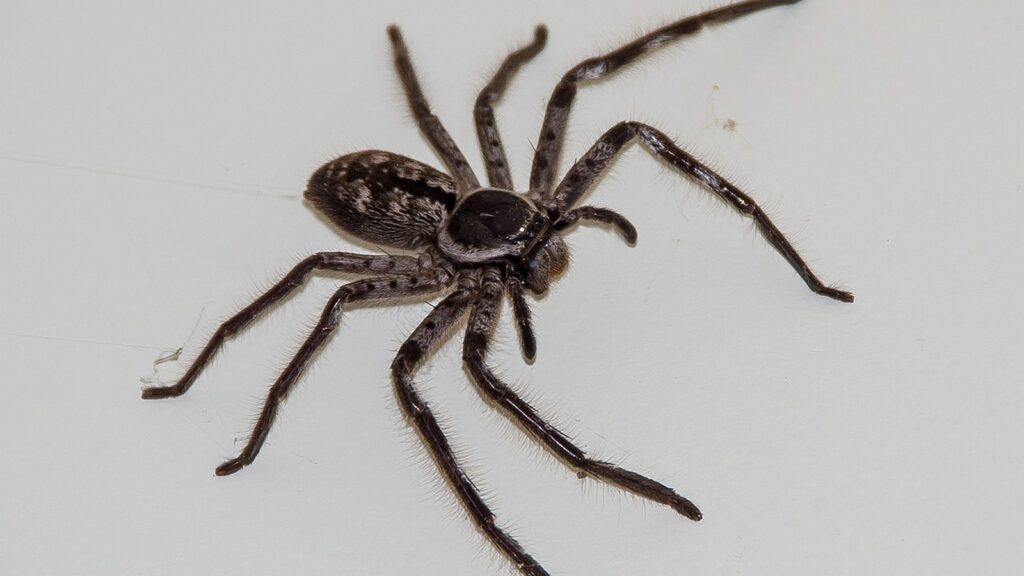
- Huntsman spider (Heteropoda venatoria) — Large (two to five inch leg span), flat body, long legs, brown, very fast. No web — active nocturnal hunter on walls and ceilings. Harmless. Eats palmetto bugs, crickets, and other indoor pests. The species most often misidentified as brown recluse.
- Wolf spider (Lycosidae) — Medium to large (one to two inch leg span), robust body, mottled brown and gray. No web — ground-hunting. Females carry an egg sac on the spinnerets, then carry hatchlings on the back (distinctive identifier). Harmless. Beneficial as outdoor predator of insects.
- Jumping spider (Salticidae) — Tiny (quarter to half inch), compact, often fuzzy, large forward-facing eyes. Frequently colorful (metallic green, iridescent, black and white). Diurnal, curious, harmless. Eats aphids, flies, small moths. The spider most likely to be watching you from a sunny windowsill.
Spider Pressure Across Boca Raton
East-of-Federal historic Boca — Old Floresta, Spanish River Land, the older streets through Royal Palm Yacht & Country Club, Por La Mar — leads with golden orb-weavers in the mature oak and ficus canopy, plus widow harborage in the garage corners and barrel-tile soffit lines of Mizner-era homes. Web counts are highest where the canopy is densest; widow pressure is highest in original-construction garages and the storage spaces under porte-cochère drives.
The waterfront and finger-canal streets — The Sanctuary, the inner blocks of RPYCC, Boca Harbour, Golden Harbour, Lake Rogers Isles — push orb-weavers onto pool cages and across dock structures, and concentrate widow harborage in dock storage boxes, boat-lift cradles, seawall planters, and the back corners of pool-equipment enclosures. Properties with a covered slip or a screened pool lanai usually need a tighter knockdown cadence than inland lots do.
West-of-Turnpike country-club communities — Boca West, Boca Pointe, Boca Falls, Mizner Country Club, Stonebridge, Broken Sound — combine deep ornamental landscaping with screened lanais, golf-cart garages, and pool-equipment rooms tucked into the back of villas. The screened lanai is the orb-weaver’s prime real estate; the golf-cart garage and equipment room are the widow’s. Daily HOA irrigation drives up insect prey on the lower stucco face, which keeps web rebuilds frequent on the perimeter.
Newer west Boca — Boca Bridges and the country-club communities along the Loxahatchee preserve edge west of 441 — adds widows tucked into landscape lighting fixtures and the gaps behind irrigation valve boxes. Pool cages on these newer homes are still primary orb-weaver habitat.
Hoffer Pest Solutions: Honest Boca Raton Spider Control
We’ve been doing pest work in South Florida since the early 1970s, and the way we handle spider calls has not changed much: identify what’s on the property, treat the species that warrant it, leave the ones that don’t, and tell the homeowner the truth about which is which. A brown widow in a garage corner gets treated and the egg sacs go in the bag. A huntsman in the same garage gets named, explained, and — if the homeowner is comfortable — left to do its job. An orb-weaver across the pool cage gets the web swept and a perimeter that holds. Spider control is one of the easiest places in pest work to oversell fear, and that is not a road we’re willing to take. Every Boca job is backed by our satisfaction guarantee and written up so you know what was treated, where, and why. Call 954-892-5742; same-day inspections are available in most cases.
Spider control is one piece of a broader Boca Raton pest control plan; for ants, rodents, mosquitoes, termites, bed bugs, and ongoing residential service, start at the Boca Raton pest control hub or call the number above. If the huntsman spiders on your walls are working overtime, it usually means there’s a palmetto bug supply for them to hunt — our Boca Raton cockroach control page covers the outdoor and indoor sides of that pressure. For Hoffer’s full spider control coverage across South Florida, see our general spider control page.
Frequently Asked Questions: Spider Control in Boca Raton
Are brown recluse spiders in Boca Raton?
No. The brown recluse (Loxosceles reclusa) is not established in South Florida — UF/IFAS publishes the range map and Boca falls well outside it. Across our half-century working Boca homes we have inspected hundreds of “I think it’s a brown recluse” calls and confirmed zero. What homeowners almost always have is a huntsman — large, flat, fast, brown, harmless — or a wolf spider, ground-hunting and equally harmless. If you have a wound you believe is a spider bite, see a physician; if it was a spider in Boca, it was not a brown recluse.
What is the giant yellow-and-black spider in my Boca Raton pool cage?
That’s a golden silk orb-weaver — Trichonephila clavipes — the spider most South Floridians call a “banana spider.” Bright yellow and black female, three to six inch leg span, hanging in a vertical web of golden silk. Harmless to people and genuinely beneficial — they eat mosquitoes, flies, and moths trapped against the pool screen. Bites are essentially unheard of. If the web is blocking a walkway, sweep it down and the spider will move; if it’s tolerable where it is, leaving it keeps the local mosquito count down for free.
Are widow spiders common in Boca Raton?
Brown widow is common; southern black widow is rare. The brown widow (Latrodectus geometricus) shows up routinely in sheltered outdoor harborage — garage corners, the inside of patio furniture, the underside of pool equipment, grill covers, dock storage, gaps behind landscape lighting and planters. The southern black widow (Latrodectus mactans) has been largely displaced by brown widow on residential properties. Both species are medically significant. Brown widow bites usually warrant medical evaluation but rarely require antivenom; black widow bites warrant same-day evaluation, and antivenom is available. Direct treatment of nests and removal of egg sacs is part of every widow job we run.
How do I keep spiders out of my Boca Raton garage?
Three things make the biggest difference. First, seal the garage door — the bottom rubber sweep and side jamb weather-stripping are where widows and huntsmen walk in. Second, reduce clutter along floor edges and back corners; widows specifically want sheltered, undisturbed harborage. Third, manage outdoor lighting near the door — bright white fixtures pull flying insects to the door at night and the spiders follow, so warm-amber bulbs help within a couple of weeks. Hoffer’s spider service treats garage door tracks, jambs, the soffit line, and interior corners as part of the perimeter; combined with those changes, it shifts the long-term pressure substantially.
Is Hoffer's spider control safe around pool equipment and pets?
Yes. Products are applied to surfaces — foundation perimeter, door and window frames, garage tracks, soffit lines, fence-line foliage, and the exterior of pool-equipment enclosures — with proper dry times before pets and family return to the treated area. We don’t broadcast over open water, pool surfaces, fish ponds, or vegetable gardens, and pool-equipment areas are treated on the housing exterior rather than inside the cabinet. The technician walks you through what was treated and the dry-time window before leaving, and the full product list goes on the service ticket.