Boca Raton Is One of the Most Wildlife-Active Cities in Southeast Florida
Canal Networks, a Loxahatchee Buffer, and Landscape Dense Enough to Hide a Raccoon at Noon
A Boca property doesn’t sit in just one wildlife corridor — it usually sits in three at once. The Intracoastal mangrove edge runs the full eastern length of the city. The finger-canal grid through Royal Palm Yacht & Country Club, Boca Harbour, Golden Harbour, and Lake Rogers Isles weaves brackish water into residential streets you can’t see from the road. The interior canals — El Rio, the Boca Raton Canal, the Hillsboro Canal along the southern border — link those streets to the western drainage system. West of 441, the Arthur R. Marshall Loxahatchee National Wildlife Refuge sits against the edge of Boca Bridges and the newer west-of-441 country-club communities. The country clubs themselves — Boca West with its four courses, Boca Pointe, Broken Sound, Mizner Country Club, Stonebridge, Boca Grove, Woodfield, St. Andrews — are interlocking systems of lakes, ponds, mature canopy, and HOA landscape buffers that read to a raccoon or an armadillo as habitat first and as a residential neighborhood second. The result is the kind of service-call mix you don’t see in inland tract subdivisions: raccoons tearing into the soffit of an Old Floresta cottage, possums in a Por La Mar trash bin, bats roosting in a Spanish River Land barrel-tile roof, pigeon droppings down the face of a Glades Road office building, armadillos rooting through fairway-side turf in Boca West, foxes denning under a Stonebridge pool equipment pad, and iguanas — by the dozens — burrowing into seawalls and stripping hibiscus across every waterfront neighborhood the city has.
Hoffer’s wildlife service covers seven animals in Boca Raton: raccoons, opossums, bats, nuisance birds (pigeons, European starlings, and house sparrows), armadillos, foxes, and green iguanas. Anything outside that list — squirrels in the attic, a snake in the garage, an alligator on the lawn, a coyote in the back forty, a native protected bird nesting in an eave — is not part of our scope. We’ll come out, identify the animal, and refer the homeowner to the right place (a licensed Florida wildlife trapper, the Florida Fish and Wildlife Conservation Commission, or in alligator situations the FWC nuisance hotline). Telling a homeowner what we can and can’t do is part of the first visit, not a surprise on the invoice. The reason wildlife sits in its own service category — separate from pest control, separate from rodent work — is that most of these animals are regulated by state and federal law. Bats are protected. Migratory birds are federally protected. Iguanas have no protection at all. Foxes are both a nuisance category and a furbearer. The species on the property determines what’s legal, what’s seasonal, and what the right next step actually is — and reading that correctly is the entire job before any trap, exclusion device, or repair gets ordered.
Our Boca Raton Wildlife Removal Approach
Every wildlife job in Boca runs through the same opening sequence — identify the animal, identify the entry, identify the legal constraint — and then branches by species into the right combination of trapping, exclusion, deterrence, or removal. The seven service tracks below are the work we actually do on Boca properties.
Bat Removal in Boca Raton: Why Timing Matters
This is the single most important compliance fact on this page, and a homeowner calling in May or June about bats needs to read it before anything else. Florida bat maternity season runs from April 15 through August 15 every year. During that window, no bat exclusion work is allowed on any property in the state — not by Hoffer, not by any other licensed operator, not as a do-it-yourself project. The reason is straightforward: female bats roost in attics and eaves to raise pups, the pups are flightless until they are several weeks old, and a one-way exclusion device installed during maternity season seals the mothers out and the pups inside. The pups starve. It is illegal under Florida Statute 379.233. It is also a guaranteed odor and decontamination problem that costs the homeowner more than the original removal would have. Outside the maternity window — August 16 through April 14 — we install one-way exclusion devices at the roost entry points, monitor for three to seven nights to confirm full colony departure, and then permanently seal the openings. Inside the maternity window, we will inspect the property, document the roost, identify the species where possible, quote the work, and put the homeowner on the August schedule. We won’t take the job earlier even if the homeowner asks. The other piece worth knowing on a Boca bat call is the guano. Histoplasma capsulatum, the fungus that causes histoplasmosis, grows in old bat droppings, and the spores become airborne when guano is disturbed in a poorly ventilated attic. Cleanup is not a step the homeowner should do without PPE and proper ventilation. We handle that part of the job with respirators, disposable coveralls, and controlled wetting; it’s part of why bat work is its own line item on the inspection report, not a casual add-on.
Iguana Removal in Boca Raton
Boca Raton is one of the most iguana-heavy cities in Southeast Florida. Anyone who has owned a property along the Intracoastal, on a finger canal, or on a country-club lake for more than two seasons has watched it happen — the population in Boca’s waterfront neighborhoods is established, breeding, and not going anywhere on its own. Green iguanas (Iguana iguana) are an invasive species in Florida. Under FWC rules they have no protection on private property, removal is legal year-round, and humane lethal control is permitted with landowner consent. There is no permit requirement and there is no closed season. That legal posture is unusual — most wildlife in Florida sits inside a regulatory framework that constrains what can be done with it — and it’s the reason iguana removal in Boca looks different from the other six animals we work with.
The damage profile is what drives the call. Landscape destruction is the visible part — a single adult iguana can strip a hibiscus bush, a row of bougainvillea, a vegetable bed, or a young fruit tree in a few hours, and the droppings on pool decks and patios are not subtle. The more serious problem is invisible until it’s expensive. Iguanas burrow laterally into seawalls and canal banks, building tunnel systems that can run ten to thirty feet long with multiple entrances. On a Boca waterfront property — Royal Palm Yacht & Country Club, The Sanctuary, Por La Mar, Golden Harbour, Lake Rogers Isles, Boca Harbour — those burrows undermine seawall integrity and have, on more than one occasion, contributed to seawall collapse. Repairing a failed seawall is a five-figure job on the low end and can run well into the tens of thousands when sinkhole formation, dock impact, and erosion damage all stack up. The economic case for early iguana management on a waterfront property is real, and it is the case we make on the inspection visit.
Our removal approach is humane and consistent with FWC guidance for invasive reptile control. The specific tools and methods we use on a given property depend on the setting (waterfront seawall vs. interior landscape vs. golf-course lake edge), the local municipal ordinances (firearm discharge rules vary between Boca city limits and unincorporated Palm Beach County), and the homeowner’s preferences. A cold-snap protocol is worth knowing about: when Boca temperatures drop below the mid-forties — usually one or two stretches per winter — iguanas become cold-stunned. They fall from tree canopies, lie motionless on lawns and pool decks, and are temporarily available to collect in a way that makes the work much cleaner than active-season trapping. Homeowners on waterfront properties with persistent iguana pressure should plan for ongoing management — quarterly or monthly visits depending on the level of activity — rather than expecting a single removal to solve the problem. New iguanas reach water-edge habitat the way new rats reach a seawall hedge: as long as the habitat is there, the next animal is on its way.
Wildlife Services We Don't Provide
Telling a homeowner what we can’t do is part of doing the job right, and on a wildlife call the boundaries matter more than they do in pest control. Hoffer does not handle squirrels (gray or flying), snakes of any kind, alligators, coyotes, bobcats, feral hogs, native protected birds, or any species on Florida’s threatened or endangered lists. If a Boca homeowner calls about an animal outside our scope, the first visit still does some work: we identify what’s actually on the property (a homeowner’s “snake in the garage” is sometimes a glass lizard; a “raccoon in the attic” is sometimes a roof rat — see our Boca Raton rodent control page for the latter), confirm whether what’s there is in fact what was called in, and route the homeowner to the right resource — a licensed Florida wildlife trapper, the FWC nonemergency line, the FWC nuisance alligator hotline, or the state wildlife rehabilitation network if a protected animal needs help. We’d rather lose the booking than take a job we’re not the right operator for. A homeowner who calls us about a squirrel and gets handed off to the right person is a homeowner who calls us back the next time it’s a raccoon.
Hoffer Pest Solutions: Boca Raton Wildlife Specialists
Hoffer has been a family-owned South Florida pest company since 1975 — five decades of work across Palm Beach, Broward, and Miami-Dade — and adding wildlife to the service menu was a response to what Boca homeowners were already asking us to handle. The seven animals we cover (raccoons, opossums, bats, nuisance birds, armadillos, foxes, iguanas) get worked the same way the rest of our service does: a real inspection on the first visit, a written plan that names the legal constraints honestly (bat maternity season, migratory bird protection, FWC trapping rules), a satisfaction guarantee on the workmanship, and a referral on the work we don’t do rather than a stretch into territory we shouldn’t be operating in. On waterfront properties — RPYCC, The Sanctuary, Boca Harbour, Golden Harbour, Lake Rogers Isles — iguana management is usually the largest piece of the program. On east-of-Federal historic blocks, bat and raccoon exclusion under barrel tile is the recurring work. In the west-of-Turnpike country clubs, armadillos and foxes set the rhythm. Commercial buildings along Glades Road and the Town Center / Mizner Park corridor are pigeon and starling jobs. Call 954-892-5742 to get the inspection on the calendar; in most cases we can have a technician on the property the same day, and the inspection itself is free.
Wildlife removal is one piece of a broader Boca Raton pest control plan; for ants, rodents, termites, mosquitoes, cockroaches, and bed bugs, start at the Boca Raton pest control hub or call the number above. For Hoffer’s full wildlife management coverage across South Florida, see our general wildlife management page.
Frequently Asked Questions: Boca Raton Wildlife Removal
Does Hoffer remove iguanas in Boca Raton?
Yes. Iguana removal is a confirmed part of our Boca Raton wildlife service. Green iguanas are an invasive species in Florida with no legal protection on private property, removal is legal year-round, and Boca is one of the heaviest iguana hot spots in Southeast Florida — waterfront neighborhoods along the Intracoastal, the finger canals through Royal Palm Yacht & Country Club, Boca Harbour, Golden Harbour, and Lake Rogers Isles, and the lake systems inside Boca West, Boca Pointe, Mizner Country Club, Broken Sound, and Stonebridge all see persistent iguana pressure. We use humane methods consistent with Florida Fish and Wildlife Conservation Commission guidance, and on most waterfront properties iguana management is structured as an ongoing program rather than a single visit. Cold-snap removal — when winter temperatures briefly cold-stun the population — is a particularly efficient window if it lines up with the homeowner’s call.
Why can't you remove the bats in my Boca attic in May?
Because Florida law doesn’t allow it. April 15 through August 15 is bat maternity season in Florida, and during that window female bats are roosting in attics and eaves to raise pups that can’t fly yet. A one-way exclusion device installed during maternity season seals the mothers out and the pups inside, where they starve. It is illegal under Florida Statute 379.233 and it is also a guaranteed odor and remediation problem that costs the homeowner more than the original job. What we can do in May: inspect the property, document the roost, identify the species, quote the work, and put the homeowner on the August 16 schedule. Outside the maternity window — August 16 through April 14 — we install one-way exclusion devices, monitor for three to seven nights to confirm the colony has departed, and permanently seal the entry points. No bat is killed in the process; Florida bats are all legally protected.
What if I have squirrels in my Boca Raton attic?
Squirrels are outside Hoffer’s wildlife service scope. We don’t trap or remove gray squirrels or flying squirrels. If a homeowner calls us about attic noise and the species turns out to be squirrels (the daytime activity pattern is the easiest tell — squirrels are active during the day, where roof rats and raccoons are night-active), we identify the animal on the first visit and refer to a licensed Florida wildlife trapper who handles squirrels routinely. The first visit isn’t wasted: ruling out a raccoon (which we do handle) and ruling out a roof rat (which is handled through our Boca Raton rodent control service rather than wildlife) is useful, and the referral comes with a name and a phone number rather than a generic suggestion to search online.
Are raccoons in my Boca Raton yard dangerous?
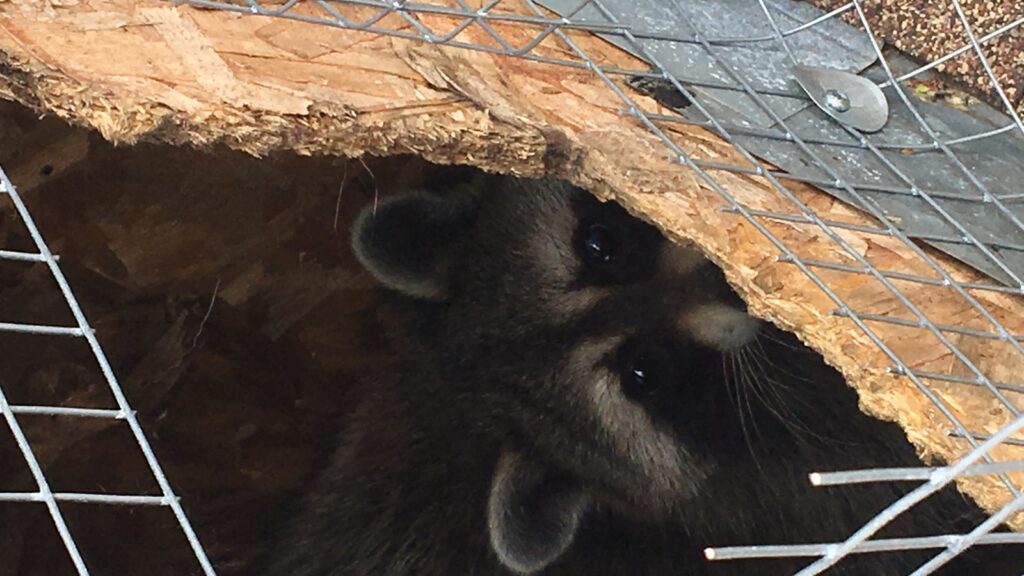
Most of the time, no — but the answer has more nuance than a yes-or-no. Healthy raccoons are wary of humans and active mainly at night. The two scenarios that change the math are habituation and disease. A raccoon that has been fed (intentionally by a neighbor, or unintentionally through unsecured trash and outdoor pet food) loses its fear of people and may approach aggressively expecting food; this is the most common source of raccoon-human conflict in residential Boca. The other scenario is illness. A raccoon staggering, active in broad daylight, paralyzed, or displaying unusual aggression should be reported to the FWC nonemergency line and avoided. Rabies is uncommon in Florida raccoons but not zero, and any bite or scratch requires medical evaluation. The bigger health issue isn’t usually the raccoon itself — it’s raccoon roundworm (Baylisascaris procyonis), which lives in the feces and is a genuine hazard for children and pets if a latrine is left in place. If a raccoon is using a yard, an attic, or a flat roof as a latrine site, get it remediated.
How does Hoffer humanely remove iguanas?
The short answer: with humane methods that comply with Florida Fish and Wildlife Conservation Commission guidance for invasive reptile control, and with the specific tools and techniques chosen based on the setting (waterfront seawall, interior landscape, or golf-course lake edge) and the local municipal ordinance picture (firearm discharge rules vary between Boca city limits and unincorporated Palm Beach County). On most properties the work is a combination of cage trapping at burrow entrances and along seawalls, opportunistic collection during cold-snap windows when iguanas are temporarily immobile, and — where it is legal and safe and the property layout supports it — controlled removal by trained staff. The FWC’s published guidance permits humane lethal control of invasive green iguanas on private property year-round with landowner consent, and we work inside that framework. We walk homeowners through the exact methods we’ll use on the inspection visit so there’s no surprise on what the service involves.
Can pigeons damage my Boca Raton home or commercial building?
Yes — pigeons cause real, measurable damage. The droppings are acidic and degrade roofing membranes, finishes, signage, AC equipment, paint, and vehicles parked below roost sites; over a season on a commercial building, that’s not cosmetic. Nesting material clogs vents, gutters, and rooftop equipment, and in dryer ducts specifically it creates a documented fire hazard. The other piece is health. Pigeon and starling droppings carry Histoplasma capsulatum (the fungus behind histoplasmosis), Cryptococcus, and salmonella, and the spores become airborne when accumulated droppings are disturbed without proper PPE. Most of our Boca pigeon work is on commercial buildings along Glades Road, Yamato Road, the Town Center / Mizner Park corridors, and the A1A and Camino Real condo high-rises. The fix is exclusion (netting, spikes, electrified track on AC housings, vent guards) with cleanup and ongoing monitoring built in. One thing worth being clear on: pigeons, European starlings, and house sparrows are not federally protected and can be legally controlled. Native birds — songbirds, woodpeckers, swallows, raptors, wading birds — are protected under the federal Migratory Bird Treaty Act and require a different path entirely, which is something we sort out on the first inspection rather than after the fact.
What's the difference between rodent control and wildlife removal in Boca Raton?
The species, the methods, and the regulatory framework are all different. Rodent control covers rats and mice — in Boca that’s almost entirely roof rats (Rattus rattus), which live in barrel-tile attics, canopy, and seawall vegetation; the work is trapping, bait stations, exclusion, and ongoing monitoring, and it’s covered on our [Boca Raton rodent control page](/palm-beach-county-pest-control/boca-raton-pest-control/rodent-control/). Wildlife removal covers the seven larger animals on this page: raccoons, opossums, bats, nuisance birds, armadillos, foxes, and iguanas. The legal layer is the biggest difference. Rats and mice are unregulated nuisance pests; almost anything is allowed. Wildlife is regulated species-by-species — bats are state-protected, migratory birds are federally protected, iguanas have no protection at all, and the other species sit inside Florida’s nuisance-wildlife framework with specific rules on trapping, relocation, and euthanasia. If a homeowner isn’t sure which category the noise in the attic falls into, we sort that out on the first inspection — the daytime-vs-nighttime activity pattern, the droppings, the entry-point size, and the damage profile are usually enough to settle it within ten minutes.